
Made in America (NJ)
for your Wall Decor
Handcrafted Picture Frames

On October 12, a local artist visited our New Jersey workshop after she nearly ruined a custom 16x20 watercolor because she didn't understand common frame sizes and the quarter-inch overlap they require. It's a stressful moment when you realize your precious memory might need a trim just to fit behind the glass. We agree that you shouldn't have to settle for "close enough." You deserve a display that reflects the quality and handcrafted precision of the art itself.
By mastering these dimensions, you can eliminate the guesswork and ensure your art looks like a museum-quality masterpiece. This 2026 guide provides the exact measurements you need to find a perfect fit for any print, whether it's a 4x6 snapshot or a large-format 24x36 poster. You'll learn the specific math of matting and how to calculate wall space for a cohesive gallery wall that reflects expert craftsmanship. We'll walk through standard dimensions and help you avoid the fear of cropping your favorite photos for good.
Standard frame sizes are pre-manufactured dimensions built to match the most frequent photo printing and paper standards. These dimensions are the industry benchmarks that allow you to walk into a shop and find a ready-made solution for your 4x6 or 8x10 prints. At our New Jersey frame shop, we see how these standards simplify the decor process for most homeowners. Choosing common frame sizes ensures that your project remains affordable and easy to complete without the lead times often associated with bespoke orders.
The history of these measurements is rooted in the evolution of photography. In 1913, the introduction of 35mm film established a 2:3 ratio that eventually made the 4x6 print a global staple. Paper manufacturing also played a role, with industrial standards like the US Letter (8.5x11 inches) dictating frame production for certificates and documents. These Standard photographic print sizes created a streamlined ecosystem where printers and framers could work in harmony.
Sticking to these sizes offers several practical benefits:
Standard sizes don't solve every problem. When you're dealing with a vintage 19th-century panoramic photo or a contemporary piece of street art with unique dimensions, standard options will fail. In these cases, our expert framers step in to provide handmade, museum-quality solutions that protect the integrity of the artwork. Recognizing when a piece is "off-grid" is the first step toward a professional display.
Aspect ratio is the proportional relationship between width and height. For a non-photographer, think of it as the shape of the rectangle. A 2:3 ratio is common for DSLR cameras, fitting 4x6 or 20x30 frames perfectly. However, most iPhones default to a 4:3 ratio. If you try to fit that smartphone shot into a 4x6 frame, you'll likely lose 0.5 inches of the image to cropping. Matching your print's ratio to common frame sizes prevents unwanted cutting of your favorite memories.
There's often confusion regarding "Inside Diameter" versus "Outside Diameter." When you buy a 5x7 frame, that measurement refers to the opening in the back, not the total footprint on your wall. Every frame has a "lip" or "rabbet," which is the inner edge that holds the glass and art in place. This lip typically covers about 0.25 inches of your image on all sides. We always recommend measuring your physical print with a precision ruler before you buy to ensure no vital details are hidden by the frame's edge.
The standard dimensions you select define how a photograph interacts with your living space. Among the most common frame sizes, four specific measurements dominate home decor: 4x6, 5x7, 8x10, and 11x14. These sizes are industry staples because they align with the aspect ratios of both traditional 35mm film and modern digital sensors. Whether you're decorating a bedside table or starting a small wall collection, these choices offer the most versatility for everyday memories.
Choosing between vertical (portrait) and horizontal (landscape) orientations depends entirely on your photo's composition. Portrait orientation focuses on height and is the standard for individual headshots or standing subjects. Landscape orientation captures wider scenes, such as family gatherings or horizons. Most high-quality frames include hardware for both directions, giving you the flexibility to refresh your art whenever you like.
The 4x6 frame is the universal standard for snapshots and postcard-sized prints. Since most photo labs print in this 3:2 ratio by default, it's the most accessible size for bulk printing. 5x7 frames provide more breathing room for your images. They're ideal for wedding invitations or portraits where you want a slightly larger border to highlight the subject. These smaller options are perfect for:
An 8x10 frame is a staple for formal photography. It's the most popular size for school photos, corporate bios, and professional headshots. It's large enough to be visible from across a room but compact enough to fit in tight wall segments. Moving up, the 11x14 frame is the "sweet spot" for home decor. It's the transition point where a photo begins to feel like a piece of art rather than just a snapshot. According to the Blick Art Materials guide to choosing a frame, using the right matting with these sizes can significantly enhance the visual impact of a standard print.
If you're planning a gallery wall, 11x14 frames act as excellent anchors. You can place one or two 11x14 pieces in the center and surround them with a cluster of 5x7 and 8x10 frames to create a balanced, professional look. This tiered approach adds depth to your display without overwhelming the room's architecture. To get started on your next project, you can browse our collection of handcrafted frames made right here in the USA.
Stepping up from small tabletop photos to wall-filling art changes how a room feels. Choosing from common frame sizes for large displays requires a balance between visual weight and physical durability. A 16x20 print isn't just a bigger photo; it's a design choice that draws the eye. These larger dimensions often serve as the "Statement Piece" in a living room or office, acting as a primary focal point that anchors other furniture and decor. Using one massive frame creates a cleaner, more professional look than a cluttered gallery wall of smaller prints.
The 16x20 dimension remains the professional standard for high-school senior portraits and wedding photography. It offers enough surface area to showcase facial expressions clearly from several feet away. You'll find that 20x24 is typically the largest size stocked by big-box retail stores. This limit exists because larger frames require professional-grade construction to stay rigid. For these mid-sized pieces, our expert framers suggest solid wood moldings. Unlike plastic or thin composite materials, wood holds its shape and supports the weight of heavy glass without sagging or warping over the years.
For fans of cinema or music, the 24x36 poster frame is the undisputed gold standard. This size fits most standard theatrical posters and limited-edition band merch perfectly. Handling art at this scale introduces new technical needs. Standard glass becomes a liability because of its weight and fragility. We often recommend high-quality acrylic for any large picture frames exceeding 24 inches. Acrylic is 50% lighter than glass and virtually shatterproof, making it much safer for homes with high foot traffic or children.
Moving beyond these common frame sizes into custom territory allows for even more impact. When art exceeds 30x40 inches, the frame's internal structure must be reinforced to prevent the corners from pulling apart. Our New Jersey workshop uses specific joinery techniques to ensure every handmade frame stays tight and secure. This level of craftsmanship is essential for preserving your art. Whether you're framing a vintage movie poster or a modern abstract painting, the right construction ensures your masterpiece remains a centerpiece for decades.
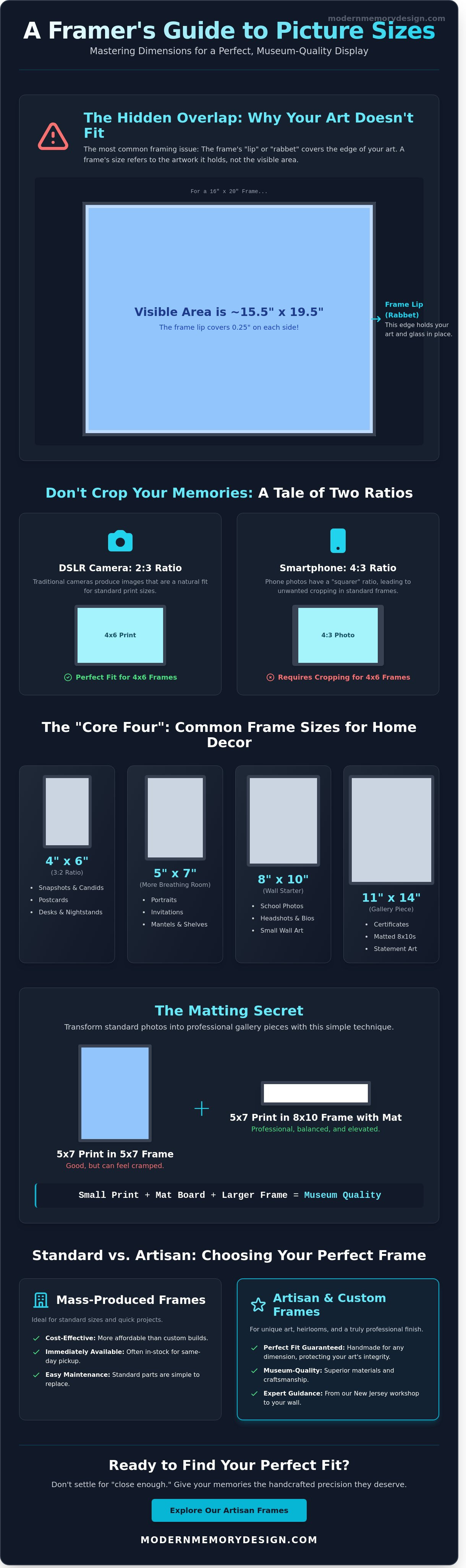
You don't need a massive print to make a statement on your wall. A simple 4x6 photo transforms into a gallery masterpiece when you use a wide mat. This "matting secret" provides breathing room around the image, drawing the viewer's eye directly to the subject. By pairing smaller prints with larger common frame sizes, you add a layer of sophistication that standard framing simply cannot match. It’s the difference between a casual snapshot and a professional display.
Understanding the math of a mat opening is vital for a perfect fit. Standard mat openings are cut exactly 1/2 inch smaller than the print size. For a 5x7 photo, the mat opening measures 4.5x6.5 inches. This 1/4 inch overlap on every side ensures your photo stays securely behind the mat without falling through the window. It also hides any white borders or uneven edges on the paper. At our New Jersey workshop, we see many DIY projects fail because the opening was cut to the exact size of the photo, leaving no room for securing the art.
Expert framers often recommend "weighted" mats to enhance the visual balance. This technique involves making the bottom border of the mat wider than the top and sides. If you're using a standard 11x14 frame, you might have 2 inches of matting on the top and sides, but 2.75 inches on the bottom. This prevents the artwork from looking like it's "sinking" within the frame, a common optical illusion caused by how the human eye perceives gravity in art.
The material of your mat is just as important as its dimensions. Many mass-produced mats contain lignin, which turns into acid over time. Modern Memory Design only uses archival, acid-free materials to ensure your photos remain in pristine condition for decades. Acid-free mats prevent the "yellowing" of old photos and stop the "burn" marks that often appear on the edges of prints kept in cheap, non-archival housing for more than 10 years.
Choosing the right combination of common frame sizes and museum-quality mats protects your investment while elevating your decor. Our team treats every project as a unique masterpiece of design and craftsmanship, whether it's a single family photo or a large corporate installation.
Ready to give your photos the professional treatment they deserve? Shop our custom frames and mats to find the perfect fit for your home.
Most shoppers start their search by looking for common frame sizes, but standard dimensions don't always capture the unique character of your art. While big-box retailers offer mass-produced plastic or composite options, Modern Memory Design provides a "Handmade for You" alternative. We bridge the gap between custom picture frames and everyday standards by using solid wood moldings and museum-quality materials for every order. Because our frames are Made in the USA at our New Jersey workshop, we maintain strict quality control and offer turnarounds of 4 to 6 business days. This is significantly faster than the 3 to 4 weeks often required by international retailers.
Standard retail shelves rarely accommodate a 13x19 digital print or a 10x30 panoramic shot. These odd dimensions don't fall into the category of common frame sizes found in craft stores. Our online custom framing tool lets you input exact dimensions from your phone or desktop to get a professional result instantly. For valuable heirlooms or sentimental items, our expert framers provide consultations to ensure the materials used, like UV-protective glass and acid-free mats, preserve your piece for decades.
You can visit our Hasbrouck Heights, NJ workshop at 246 Boulevard for a hands-on experience. We serve the tri-state area with professional installation and picture hanging services, ensuring your gallery wall is level and secure. Thousands of customers across the country trust us to print their digital photos and frame them in one seamless process. This local craftsmanship combined with national shipping ensures your memories receive the attention they deserve. We treat every 8x10 print and large-scale canvas with the same meticulous detail.
Choosing the right display shouldn't be a compromise. Whether you need common frame sizes for a quick gift or a completely bespoke build for a gallery exhibition, we focus on durability and aesthetic precision. Our team understands that a frame is more than just a border; it's the finishing touch on your most cherished moments.
Selecting the ideal display for your artwork doesn't have to be a guessing game. By mastering common frame sizes, you can easily navigate the transition from small 5x7 snapshots to large 24x36 movie posters. This guide highlights that understanding standard dimensions helps you avoid unnecessary costs while ensuring a professional look. Remember that using museum-quality archival materials protects your memories from fading over time. Whether you're working with core medium dimensions or calculating matting math for a custom gallery wall, the right frame provides the artistic integrity your home deserves.
At Modern Memory Design, our expert framers have earned over 10,000+ 5-star reviews by focusing on meticulous craftsmanship. Every frame is handmade in New Jersey, USA, using the same high-standard materials found in professional galleries. We're ready to help you transform your favorite photos into a masterpiece of design. Shop Our Full Collection of Standard and Custom Frames to find the perfect match for your space. It's time to take your art off the screen and put it where it can be admired every single day.
The 4x6 inch frame is the most common frame size for standard photographic prints. This dimension matches the 3:2 aspect ratio produced by most digital cameras and 35mm film. For professional portraits or school photos, the 8x10 inch size is the industry standard. These common frame sizes account for approximately 75 percent of all personal photo printing and retail frame sales in the United States.
An 8x10 frame refers to the internal size of the glass and backing, while an 8x10 opening is the visible area of the mat. If you buy a frame without a mat, these measurements are identical. When a mat is included, the opening is typically 7.5x9.5 inches. This 0.25 inch overlap on each side prevents your photo from falling through the window while keeping it securely in place.
You need an 8x10 frame to display a 5x7 photo with a standard mat. This combination provides a 1.5 inch border around your image, which is the most popular choice for tabletop displays. If you prefer a wider, more dramatic look, an 11x14 frame with a custom mat also works well. Using these common frame sizes ensures you can find affordable, high quality options for your home decor.
You can put an 11x14 photo in an 11x14 frame without a mat to achieve a modern, full bleed look. This style allows the image to extend to the very edge of the frame molding. It's a popular choice for minimalist galleries and contemporary office spaces. Our expert framers recommend ensuring your print is exactly 11x14 inches so it sits perfectly against the frame's inner lip without any visible gaps.
The standard size for a theatrical movie poster is 27x40 inches, which is known in the industry as a One-Sheet. For retail posters sold in most stores, 24x36 inches is the most frequent dimension you'll encounter. Our NJ frame shop produces frames for these sizes daily using professional wood molding. Choosing a 24x36 frame provides a classic aesthetic that fits perfectly in home theaters, bedrooms, or basement entertainment areas.
Measure the width and height of your artwork to the nearest 1/16th of an inch using a metal measuring tape. Don't round your numbers, as even a small discrepancy can affect the final fit. If you want a mat, your final frame size will be the art dimensions plus the width of the mat borders. For instance, a 10x10 print with a 2 inch mat requires a 14x14 frame to accommodate the extra space.
Poster frames are typically lightweight and designed for large, thin paper, while picture frames use heavier moldings and archival materials. Poster frames often feature plexiglass instead of traditional glass to keep the weight manageable for 24x36 inch sizes. Picture frames are built for longevity and often include acid free backings. At Modern Memory Design, we use museum quality materials for both styles to ensure your art is protected for years.
Yes, Modern Memory Design specializes in creating custom sizes for any artwork that falls outside standard dimensions. Our skilled artisans handcraft each piece in our New Jersey workshop to your exact specifications. Whether you have a panoramic landscape or a unique square print, we build every frame here in the USA. You can visit our Bergen County workshop or order your specific dimensions directly through our website for professional results.
{"one"=>"Select 2 or 3 items to compare", "other"=>"{{ count }} of 3 items selected"}
Leave a comment