
Made in America (NJ)
for your Wall Decor
Handcrafted Picture Frames

Last week, a client walked into our New Jersey workshop holding a beautiful oil painting she’d ordered online. It was still rolled in the shipping tube, and her biggest concern was direct: “I’m terrified I’ll rip it or ruin it if I try to do this myself.”
It’s a feeling we understand completely. You’ve invested in a piece of art you love, but getting it from a tube to the wall can feel like a high-stakes operation. You want that flawless, drum-tight finish, but the fear of a misstep, a saggy corner, or a canvas with short margins is real. You're not just protecting a print; you're preserving a memory or an investment.
This guide is here to replace that uncertainty with confidence. We’re pulling back the curtain on the art of professional canvas stretching to show you exactly how our expert framers transform rolled art into a masterpiece ready for display. From exploring the difference between a gallery wrap and a museum wrap to understanding the costs and long-term value, you'll gain everything you need to make the perfect choice for your piece.
You’ve just acquired a beautiful piece of art, but it arrived rolled up in a tube. What’s next? The crucial step to transform that rolled canvas into a display-ready masterpiece is a professional service known as canvas stretching. At its core, this is the expert process of mounting a flexible canvas over a sturdy wooden frame, creating the rigid and perfectly flat surface the artist intended for viewing.
Artists and galleries almost always ship artwork rolled for two practical reasons. First, it’s significantly safer. A rolled canvas is far less susceptible to punctures or impact damage during transit compared to a large, rigid painting. Second, the cost savings are substantial. Shipping a rolled canvas can reduce international shipping fees by up to 70% by minimizing dimensional weight.
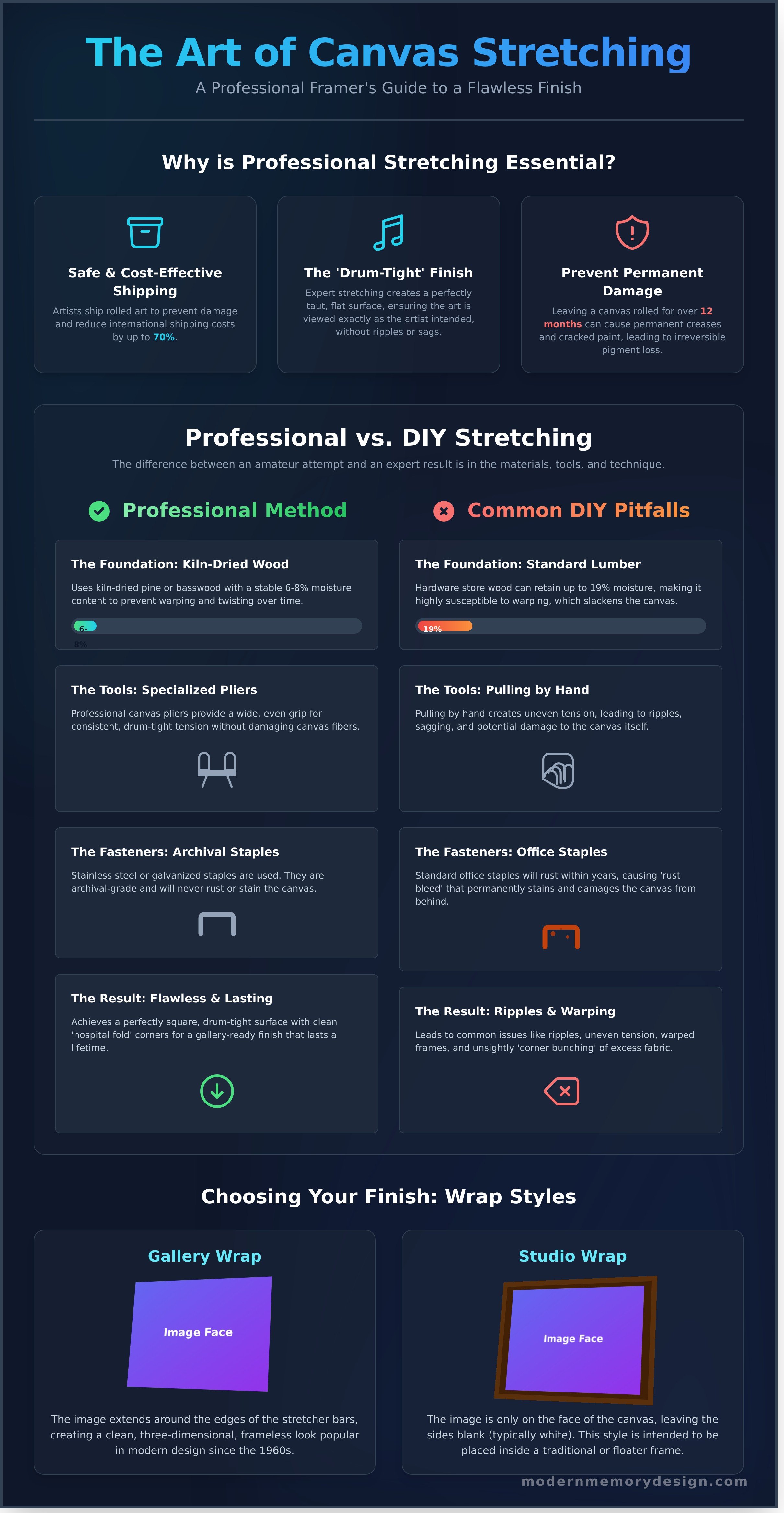
The hallmark of expert craftsmanship is achieving a 'drum-tight' surface. This means the canvas is pulled with precise, even tension across the frame, so it’s taut enough to resonate like a small drum when lightly tapped. This perfect tension ensures the artwork lies completely flat without any ripples or sagging, presenting the image exactly as it was created. Leaving art rolled for extended periods, typically more than 12 months, poses serious risks. The canvas can develop permanent creases, and the paint layers, especially thick oils or acrylics, can crack and flake, leading to irreversible pigment loss.
A professionally stretched canvas is a simple but precise assembly. The foundation is the wooden skeleton, known as the Stretcher bar frame, which provides all the structural integrity. The canvas itself, most often cotton or linen, is then stretched over it. Linen is a premium, stronger fiber that can withstand higher tension and is favored for archival, museum-quality pieces. Cotton is a more common, cost-effective option perfect for prints and many original paintings. Finally, small wooden wedges called corner keys are inserted into the frame's corners, allowing for minor tension adjustments to counteract any natural sagging that may occur over years of display.
Think of stretching as the essential first step. A canvas must be stretched before it can be placed into a traditional picture frame. However, stretching also enables the popular 'frameless' or 'gallery wrap' look, a minimalist style that has been a staple in modern interior design since the 1960s. In a gallery wrap, the image extends around the edges of the stretcher bars, creating a clean, three-dimensional object. This process also serves a vital protective function, securing the raw edges of the canvas to prevent them from fraying or suffering from environmental damage over time.
Stretching a canvas might seem straightforward, but the difference between a DIY attempt and a professional result is immediately visible. Beginners often struggle with common issues like ripples, uneven tension, and 'corner bunching'-unsightly folds of excess fabric. These problems stem from a lack of specialized tools and a misunderstanding of the material's properties. The art of proper canvas stretching is a craft built on precision, quality materials, and expert technique.
It starts with the foundation: the stretcher bars. A professional framer exclusively uses kiln-dried wood, typically pine or basswood. This process reduces the wood's moisture content to a stable 6-8%, preventing the frame from warping or twisting as your home's humidity changes. In contrast, standard lumber from a hardware store can retain up to 19% moisture, making it susceptible to distortion that slackens the canvas over time. The tools are just as critical. While a DIY-er might pull the canvas by hand, our experts use professional canvas pliers. These tools provide a wide, even grip that allows for consistent, drum-tight tension across the entire surface without damaging the canvas fibers. Finally, we use stainless steel or galvanized staples, which are archival-grade. Standard office staples will rust within a few years, causing 'rust bleed' that permanently stains the fabric from behind.
Our meticulous process begins by perfectly squaring the frame to ensure exact 90-degree angles. From there, we employ the 'Center-Out' technique. This method, which aligns with the professional canvas stretching techniques endorsed by museum conservators, involves placing the first staple in the center of one side, then pulling directly opposite and placing a staple there. We repeat this for the other two sides, working outwards toward the corners to distribute tension perfectly. This prevents distortion of the image and ensures a flawless surface. The final touch is the 'hospital fold,' a clean, tight corner fold that looks neat from every angle and allows the canvas to sit flush within a frame.
Your investment in professional service is an investment in longevity and peace of mind. Our workshop is equipped with pneumatic staplers that drive each staple to a consistent depth and heavy-duty stretching tables that provide the leverage needed for large-format art. Attempting this at home without the right equipment can damage the art. Protecting a valuable original or a sentimental print is paramount, which is why trusting a fully insured shop like Modern Memory Design is the safest choice. A typical DIY attempt can take a frustrating 2-3 hours and still yield a subpar result. Our master framers achieve a museum-quality finish with precision and efficiency, saving you time and guaranteeing your art looks its absolute best.
Not every canvas arrives at our NJ frame shop ready for a simple stretch. Art purchased on vacation, inherited pieces, or large-scale commissions often present unique challenges. Our expert framers have seen it all, and they have developed custom solutions to ensure every piece, regardless of its condition or size, can be displayed beautifully. From paintings with no extra fabric to massive canvases that could buckle under their own tension, professional canvas stretching requires more than just staples and wood; it demands problem-solving and meticulous craftsmanship.
The most common issue we encounter is the "travel art" dilemma: a beautiful painting rolled up in a suitcase, with the image extending to the very edge of the fabric. With no blank margin to wrap around the stretcher bar, standard stretching is impossible. But don't worry, your masterpiece isn't lost. We have several professional techniques to save it:
Sometimes, the canvas itself is the problem. A piece that has been rolled for years can become dry and stubborn. We use professional techniques like gentle moisturizing or heat-setting to relax the canvas fibers, making them pliable enough for a tight, smooth stretch without risking cracks in the paint.
Large-scale art makes a powerful statement, but its size creates significant structural demands. A canvas stretched over 40 inches in any direction is under immense tension, which can cause standard stretcher bars to bow or warp over time. Protecting your investment requires heavy-duty solutions.
The first line of defense is the stretcher bar itself. While 1.5-inch deep bars are great for most sizes, we recommend switching to robust, 2-inch deep heavy-duty bars for any dimension exceeding 60 inches. This added depth provides the structural integrity needed to resist bending. However, the most critical component for large-scale art is cross-bracing. While many online guides explain how to stretch a canvas for smaller projects, they often omit this vital step. A center brace, or a full cross-brace for canvases over 48x48 inches, counteracts the inward pull from all four sides, keeping the frame perfectly square and the tension even for decades. Without it, the frame will eventually collapse inward, causing the canvas to sag.
Finally, safe handling is paramount. Once stretched, these large pieces are difficult to transport. We ensure every oversized piece leaves our workshop with protective corner guards and offer guidance on safe transport and installation to guarantee your masterpiece arrives and hangs securely.
Once your canvas is ready, the next critical decision is how it will be stretched. This choice directly impacts the artwork's final appearance and how it interacts with your space. The two professional standards are the Gallery Wrap and the Studio Wrap. Your selection depends entirely on one question: do you plan to frame your art?
A Gallery Wrap creates a bold, contemporary look that is ready to hang without a frame. The canvas is stretched around deep stretcher bars, typically 1.5 to 2 inches thick, and stapled securely on the back. This gives the artwork substantial physical presence, making it feel like a three-dimensional object on your wall. It's a clean, modern presentation favored by galleries and artists for its minimalist appeal.
A Studio Wrap, in contrast, is designed specifically for framing. The canvas is stretched over thinner bars, usually 0.5 to 0.75 inches deep. Because the staples may be visible on the sides, this wrap is not intended as a finished product. Its purpose is to provide a taut, stable surface that fits perfectly inside a traditional decorative picture frame, allowing the frame to complement the artwork.
The depth of the stretcher bar dramatically changes how your art is perceived. Deep gallery wraps command attention. Their thickness creates shadows and presence, making them an ideal choice for large-scale abstract pieces or modern photography in a minimalist setting. A 48x60 inch abstract on a 2-inch deep bar becomes a powerful focal point. Thinner studio wraps allow the frame to take center stage, perfect for classic oil paintings where an ornate gold-leaf frame enhances the traditional aesthetic.
When choosing an image wrap, remember to account for the portion of the artwork that will cover the sides. For a 1.5-inch gallery wrap, you will effectively "lose" 3 inches from both the height and width of the visible image on the front. For a 24x36 inch canvas, the viewable front surface becomes 21x33 inches. Always consider if critical details lie within that perimeter before choosing this style.
The treatment of the canvas edges is just as important as the depth. Your choice defines the final character of the piece.
A gallery-wrapped canvas also pairs beautifully with a specific type of frame that enhances its depth. See our guide on Floating Frames to see how they create a sophisticated 1/4-inch shadow gap around your art.
Choosing the right finish is key to a professional result. If you're unsure which style best suits your artwork and your home, our expert framers can provide a personalized recommendation. Get a quote for your canvas stretching project today.
Finding the right artisan to handle your artwork can be a challenge. At Modern Memory Design, we combine the personal touch of a local Hasbrouck Heights, New Jersey workshop with the convenience of a national online service. We believe every piece of art deserves individual attention. That’s our ‘Handmade For You’ philosophy in action. Your painting isn’t just another job ticket; it’s a unique masterpiece that we treat with meticulous care from start to finish.
Our commitment to quality is rooted in our materials. We are proud to be a Made in the USA company, exclusively using high-quality American wood for our stretcher bars. We build our frames from kiln-dried poplar wood, which ensures they are perfectly straight and resistant to warping over time. This dedication to superior domestic materials means your stretched canvas will remain taut and beautiful for decades, providing a durable foundation that honors the art it holds.
Getting your art prepared for display is simple, whether you're around the corner or across the country. We offer two convenient options for our expert canvas stretching services:
With over 20 years of combined experience serving the NJ, NYC, and CT tri-state area, our team provides unmatched expertise. We offer professional consultations to help you decide between a gallery wrap, a museum wrap, or adding a custom float frame. Unlike traditional galleries that can take months, our standard turnaround is just 4-6 business days, delivering professional, museum-quality results without the long wait.
Our pricing is straightforward and transparent, based on your canvas dimensions and preferred wrap style. For local New Jersey residents, we offer convenient pickup and delivery options to make the process even easier. Don't let your beautiful art sit rolled up in a tube. Let our expert craftsmen prepare it for your walls. Visit our New Jersey workshop or order your canvas stretching online today!
You now understand that the right technique is essential for your art's longevity and that your choice between a Gallery Wrap and a Studio Wrap defines its final presentation. While DIY methods have their place, professional expertise is the only way to perfectly handle challenges like oversized art or canvases with short edges, ensuring a flawless, drum-tight finish every time.
Don't let your masterpiece sit unstretched. The expert team at Modern Memory Design is ready to provide the professional canvas stretching your art deserves. Handcrafted in our New Jersey workshop, our specialists use archival preservation techniques honed over more than 10,000 pieces framed and stretched. We treat every canvas with the meticulous care it needs to look its absolute best for decades.
Ready to see the difference? Start your custom canvas stretching order with Modern Memory Design today and give your artwork the foundation it needs to captivate and inspire for years to come.
Yes, most canvases can be stretched, but older or cracked pieces require expert care. For a fragile canvas from the 1980s with significant cracking, a professional framer might use a conservation-grade adhesive to stabilize the paint before applying tension. Brittle fabric often needs a supporting linen backing to prevent tears. We always recommend a professional evaluation to ensure the artwork is preserved correctly without causing further damage during the stretching process.
In 2026, professional canvas stretching typically costs between $90 for a small piece and $300 for a large one. For example, a standard 24x36 inch canvas with a 1.5-inch gallery wrap will cost approximately $150. This price reflects the use of high-quality, kiln-dried poplar stretcher bars and the 45-60 minutes of skilled labor required to ensure a perfectly taut and square finish, ready for display.
The main difference is that stretcher bars are adjustable, while strainer bars are fixed. Stretcher bars have expandable, interlocking corners that allow for re-tightening the canvas over time using small wedges called keys. Strainer bars have corners that are permanently glued or nailed, creating a rigid frame that can't be adjusted. Over 90% of museum conservators prefer stretcher bars for their long-term ability to correct sagging caused by environmental changes.
No, professional stretching won't damage a properly cured painting. Our expert framers apply gradual and even tension, which the flexible paint layer can easily handle. Damage is rare and typically only happens if the paint isn't fully cured or if the artwork is very old and brittle. For oil paintings, we recommend waiting a minimum of 6 months after the final brushstroke to ensure the paint has completely hardened before stretching.
You need a minimum of 2 inches of extra, unpainted canvas on all four sides for a 1.5-inch gallery wrap. This provides 1.5 inches to cover the side of the stretcher bar and an extra 0.5 inches to pull around the back for stapling. For a finished piece that is 20x24 inches, your canvas must measure at least 24x28 inches to achieve a clean and secure gallery wrap.
Yes, stretching a canvas after it has been painted is a very common and standard practice. Many artists prefer to paint on loose canvas because it's easier to transport, especially for large-scale pieces. Our professional canvas stretching service is designed for finished artwork. We carefully align the image and apply perfect tension to make your completed painting ready to hang without disturbing the paint surface.
A sagging canvas can be easily re-tightened by a professional in about 15 minutes. Sagging is usually caused by fluctuations in humidity that cause the canvas fibers to relax. If your art is on adjustable stretcher bars, we can tap small wedges (keys) into the corners to expand the frame slightly. This process, known as "keying out," restores the drum-tight tension and typically costs between $40 and $60.
Neither method is better; it's entirely a matter of the artist's personal workflow and preference. Painting on a pre-stretched canvas provides a rigid, responsive surface from the start. Painting on a loose canvas offers portability and is often easier for very large pieces. Both approaches lead to a beautiful final product once the art is properly stretched and ready for display. The choice doesn't impact the final quality.
{"one"=>"Select 2 or 3 items to compare", "other"=>"{{ count }} of 3 items selected"}
Leave a comment