
Made in America (NJ)
for your Wall Decor
Handcrafted Picture Frames

Last Tuesday, a local collector walked into our New Jersey workshop with a vintage lithograph that had lost its soul. The once-vibrant reds were now a dull, chalky pink. It's a heartbreaking moment many art lovers face when they realize the sun has been quietly bleaching their investment for years. Protecting art from sun damage is a common anxiety for anyone hanging a piece in a bright living room, but it's a challenge you can master with the right professional tools.
We agree that your home should be filled with light and your walls should be filled with memories. You don't have to choose between the two. In this 2026 guide, you'll learn the artisan secrets to shielding your artwork from the cumulative chemical reactions caused by UV rays and heat. We'll explain why the ISO 18902:2013 standard matters for your materials and how a $36.22 investment in Tru Vue Museum Glass can block 99% of harmful radiation. From actionable placement checklists to the latest in biophilic LED trends, you'll gain the confidence to display your collection safely in any light.
Every beam of sunlight hitting your wall carries enough energy to trigger a permanent chemical reaction. This process, known as photodegradation, is the primary enemy when you're protecting art from sun damage. It doesn't just dull the colors; it fundamentally alters the molecular structure of the pigments and the binders holding them together. In the world of art conservation and restoration, experts recognize that this damage is cumulative and irreversible.
The sun attacks your collection through two main avenues: radiation and heat. Ultraviolet (UV) radiation, specifically UV-A and UV-B, acts like a microscopic bleach that breaks the high energy bonds in dyes and inks. Meanwhile, infrared energy translates into heat. This heat accelerates the aging of organic fibers in paper and weakens the adhesives used in mounting. By the time you notice a "bleaching effect" on your favorite print, the structural integrity of the piece has already been compromised.
UV radiation is the high energy portion of the light spectrum responsible for the vast majority of irreversible color loss in artwork.
You don't need a direct spotlight from the sun to see these effects. Even indirect or ambient light bouncing around a room contains enough UV energy to cause significant harm over time. Standard window glass and cheap, non-rated picture frame glass offer almost zero protection against these rays. In fact, most basic glass only filters out a small fraction of UV-B, leaving your art completely exposed to the more penetrating UV-A radiation that leads to brittle paper and faded signatures.
While UV rays attack color, infrared heat attacks the physical foundation of the art. When sunlight hits a framed piece, it creates a "greenhouse effect" where heat is trapped between the glass and the backing. This causes materials like canvas and wood to expand and contract at different rates, eventually leading to warping or cracking. If your frame lacks proper spacers, this trapped heat can also cause the artwork to stick to the glass. To ensure long term preservation, never place your art near radiators or in the path of intense afternoon glare. Following the ISO 18902:2013 standard for archival materials is essential for protecting art from sun damage and preventing these thermal stresses from destroying your investment.
Not every piece in your collection reacts to the sun with the same level of urgency. While we've established that light damage is cumulative, the speed at which a masterpiece deteriorates depends heavily on its medium. Understanding these risk levels is the first step in protecting art from sun damage effectively. At our workshop, we often see that the most sentimental items, like family photos and diplomas, are frequently the most fragile.
Watercolors and photographs sit at the top of the danger zone. These mediums use "fugitive" pigments and dyes that aren't chemically locked into the surface. A single summer of direct exposure can wash out a sky or turn a vibrant portrait into a ghostly silhouette. There's also a persistent myth that oil paintings are invincible because of their thick varnish. While the paint itself is resilient, the organic canvas beneath is not. Sunlight makes canvas fibers brittle, leading to sagging and eventually cracks in the paint layer. The Northeast Document Conservation Center provides extensive research on how light damages collections, emphasizing that even low light levels are harmful over decades.
Paper is an organic material that often contains lignin, a natural component that turns yellow and acidic when exposed to UV light. This is why old newsprint or inexpensive diplomas become "burnt" and brittle so quickly. To prevent family photos from turning silver or washing out, you should never display the original in a sun-drenched hallway. We recommend scanning high-value originals and framing a professional copy for daily display, or ensuring the original is behind 99% UV-blocking glass.
Modern acrylics are generally more stable than watercolors, but UV light still attacks the flexibility of the acrylic polymer binders. Over time, this can lead to a loss of adhesion. For sports fans, jersey framing presents a unique challenge. Fabric is highly porous, and "ghosting" can occur where the shirt fades around the numbers, leaving a permanent, visible shadow.
When dealing with scale, large oversized picture frames require specialized materials. For these significant pieces, we often use lightweight UV-protective acrylic. This provides the necessary 99% UV shield without the extreme weight of heavy glass, ensuring the frame remains secure on your wall. If you're unsure about the safety of your current setup, our team can help you select the right archival materials for your specific medium.
Professional framing serves as the primary barrier between your collection and the environment. While the science of photodegradation is complex, the solution for protecting art from sun damage involves a multi-layered defense system. We focus on three critical components: the glazing, the matting, and the backing. Each layer must work together to neutralize UV radiation and heat before they reach the delicate surface of your artwork.
Standard glass offers very little protection, often filtering out only a fraction of the most harmful rays. Many consumer-grade frames use "UV-resistant" glass that only blocks about 75% of light, which isn't enough for long-term preservation. To meet archival standards, professional UV glass must block at least 99% of rays. As of March 2026, a unit of Tru Vue Museum Glass is priced at approximately $36.22. This premium glazing is the gold standard because it provides that 99% protection while using an anti-reflective coating that makes the glass virtually invisible.
Professional UV glass must block at least 99% of rays to be considered archival and truly effective for high-value preservation.
When selecting your glazing, you'll choose between glass and UV-protective acrylic. Acrylic, often called plexiglass, is much lighter and shatterproof, making it the better choice for oversized pieces. However, it can be prone to static and scratches. Traditional UV glass is more scratch-resistant and easier to clean but adds significant weight. Museum Glass remains the favorite for residential displays because it eliminates distracting reflections, allowing you to enjoy the art's true colors without the mirror effect common in cheaper materials.
The materials touching your art are just as important as the glass covering it. When we build custom picture frames, we insist on using alpha-cellulose or 100% cotton rag mats. These materials are naturally acid-free and lignin-free. Cheaper wood-pulp mats contain acids that migrate into the paper over time, causing a permanent brown stain known as "mat burn."
A well-designed mat also provides a necessary air gap between the art and the glass. Without this spacer, fluctuations in temperature can cause the artwork to stick to the glazing or encourage mold growth. Finally, we replace standard cardboard with archival backing boards. This prevents "acidic migration" from the back and creates a moisture barrier. By combining 99% UV-blocking glass with archival mounting, you create a sealed environment that significantly slows the aging process.
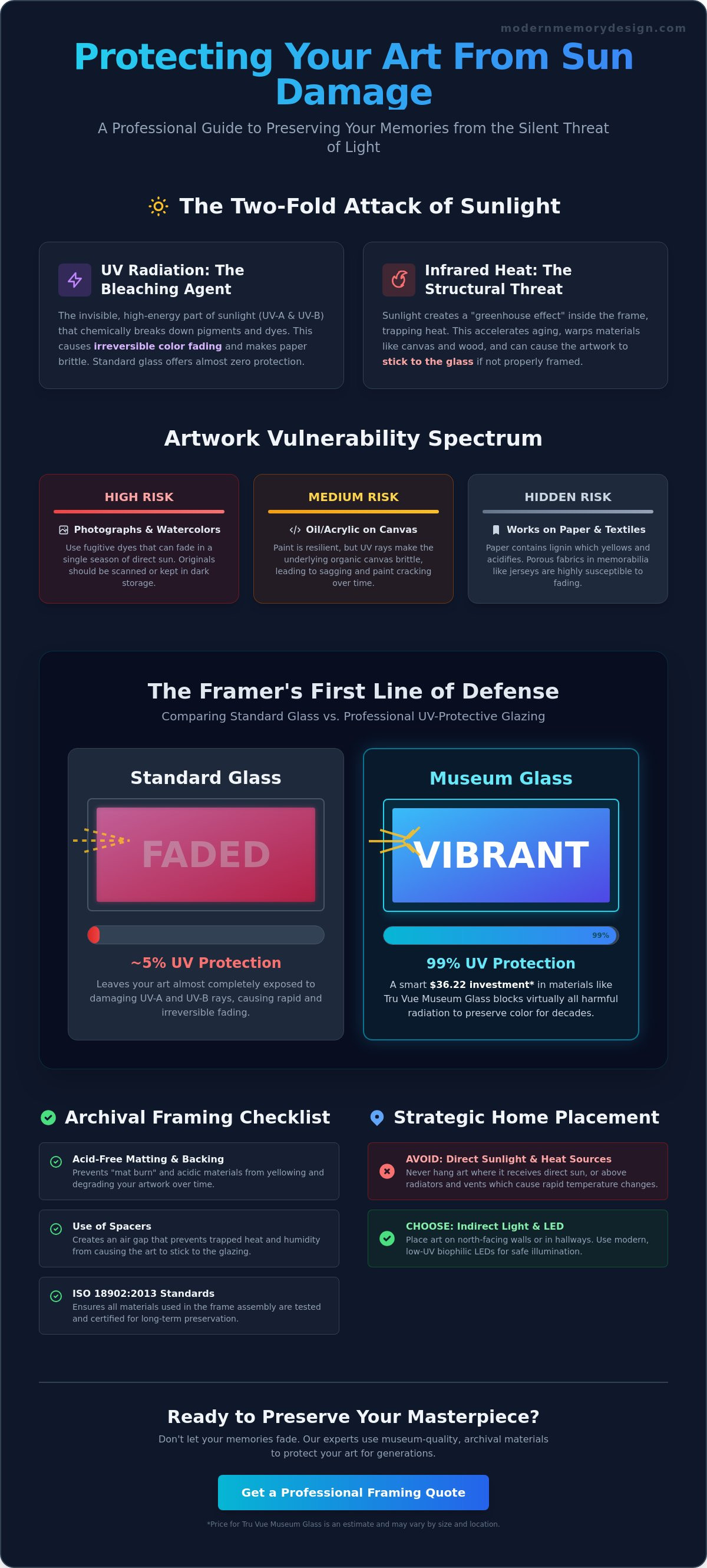
Your choice of wall is just as critical as your choice of glass. Even with the best archival materials, protecting art from sun damage requires a strategic approach to where a piece lives within your home. We recommend "mapping" the light in your living space by tracking peak sun hours. This involves observing a room at three different times of day: 10:00 AM, 2:00 PM, and 4:00 PM. If a wall receives direct, "hard" light during any of these windows, it isn't a safe spot for high-value paper works or delicate photographs.
For residents in the New Jersey and NYC area, seasonal sun angles change the safety of your walls throughout the year. During the winter months, the sun sits lower on the horizon. This means light can penetrate much deeper into your room than it does during the summer. A spot that seems safe in July might be drenched in harsh, direct light in January. To mitigate this, serious collectors often use a "Rotation Strategy," swapping pieces between bright and dark rooms every six months to limit cumulative exposure.
North-facing rooms are the safest environments for displaying sensitive artwork because they provide consistent, indirect light without the danger of direct solar rays. However, don't be fooled by "bounce light." UV radiation can reflect off white walls and light-colored flooring, still reaching your art with enough energy to cause fading. You can check the safety of your specific wall using a simple UV light meter app on your smartphone. While not as precise as professional laboratory equipment, these apps provide a helpful baseline for identifying "hot spots" in your home.
The light you choose to install inside your home matters just as much as the light coming through the windows. LED bulbs are the gold standard for 2026 gallery lighting because they emit virtually no UV radiation and produce very little heat. In contrast, halogen and incandescent bulbs act like mini heaters. When placed too close to a frame, they can cause the "greenhouse effect" we discussed earlier, leading to warped paper and brittle fibers.
If you're planning a gallery wall, position the arrangement on a wall that runs parallel to your windows rather than opposite them. This placement ensures the art is illuminated by ambient light rather than direct glare. If your room is naturally very bright, consider adding UV-filtering window films or solar blinds as a secondary line of defense. If you're ready to secure your collection with professional-grade materials, you can shop our custom frames designed for maximum preservation.
At Modern Memory Design, we believe every frame should be a masterpiece of craftsmanship and a fortress against the elements. Protecting art from sun damage isn't just a secondary service for us; it's a holistic commitment to "Museum Quality" materials in every project we touch. We don't believe in cutting corners with "cheap" frames or non-rated glass. Instead, we use archival-grade components that meet the ISO 18902:2013 standards, ensuring your investment remains as vibrant as the day it was created.
Our workshop in Hasbrouck Heights, NJ, serves as a hub for local artisans who are passionate about their craft. Because our frames are handmade in the USA, we maintain total quality control over the entire assembly process. From selecting the perfect wood molding to fitting 99% UV-blocking glazing, every step is handled by experts. We invite you to visit our New Jersey workshop for a professional UV consultation, where we can help you choose the right materials based on the specific light levels in your home.
We provide a tiered selection of glass and acrylic options to fit the unique needs of your collection. Whether you need standard UV-filter glass for a bedroom or Tru Vue Museum Glass for a sun-drenched living room, we have the expertise to guide your choice. For residents in the Tri-State area, we also offer a professional picture hanging service. This service takes the guesswork out of the strategic placement strategies we discussed earlier, ensuring your art is mounted securely and away from the most damaging light paths.
Longevity begins at the moment of creation. Our online photo printing uses a specialized giclée process with pigment-based inks. Unlike the dye-based inks used in standard consumer printers, pigment inks are chemically stable and significantly more resistant to fading. When you "Print & Frame" with us, we ensure your 100% archival result is built into the foundation of the piece.
We also help you navigate the technical side of design, such as selecting picture frame sizes that allow for generous, acid-free matting. A larger frame size isn't just about aesthetics; it provides the necessary space for thick mats that keep your artwork from touching the glass. By combining professional printing with our expert framing, you're not just decorating a wall; you're protecting art from sun damage for the next generation.
Preserving your artwork requires more than just hanging a frame; it's about creating a controlled environment where light and heat can't trigger permanent damage. You now understand that 99% UV-blocking glass and acid-free mats are the essential barriers between your memories and the sun. By mapping the light in your home and choosing archival materials, you're taking the most important step in protecting art from sun damage for the next generation.
At Modern Memory Design, our team of artisans is ready to help you implement these professional secrets. Every piece we build in our Hasbrouck Heights workshop is handmade in the USA using exclusively archival, acid-free materials. We offer several tiers of museum-quality glazing to ensure your collection stays vibrant and structurally sound. Don't let another season of harsh light dull your favorite prints. Upgrade to UV-Protective Custom Framing Today and enjoy your art with total peace of mind. Your walls deserve the highest standard of craftsmanship.
Yes, conservation-grade UV glass is highly effective because it's engineered to block at least 99% of harmful radiation. Standard glass only filters about 25% of UV rays, which isn't sufficient for long-term preservation. By using a 99% UV-blocking option like Tru Vue Museum Glass, you stop the chemical reaction that causes pigments to break down and paper to become brittle.
You can certainly display art in bright rooms if you use UV window film as a secondary defense. High-quality window films can block up to 99.9% of UV radiation at the source. However, you should still use UV-protective glazing on the frame itself to account for any light that enters through open doors or bounces off interior surfaces. This multi-layered approach is the most reliable method for protecting art from sun damage.
The easiest way to check for damage is to look for a "tide line" or color shift where the mat meets the image. Carefully lift the matting to see if the colors hidden underneath are more vibrant than the exposed area. If your reds have shifted toward a dull pink or your paper has a yellow, scorched appearance, the piece is already experiencing photodegradation. Once these molecular bonds break, the damage is permanent.
LED lights are the safest choice for illuminating your collection because they emit virtually no UV radiation and generate minimal heat. Unlike older halogen bulbs, which act as heat sources, modern LEDs help maintain a stable environment. For the best results, follow the 2026 museum standard of limiting light exposure to 50,000 lux hours per year for sensitive works on paper and 300,000 lux hours for more resilient oil paintings.
Both materials offer excellent protection if you choose conservation-grade versions. UV-filtering acrylic is the better choice for large frames because it's much lighter and shatterproof, which is a safety requirement for many public displays. Glass is often preferred for smaller pieces because it's more scratch-resistant and easier to clean. Both options are available with 99% UV-blocking capabilities to ensure you're protecting art from sun damage regardless of the material type.
Rotating your art every six months is a professional standard for serious collectors. This practice limits the cumulative light exposure any single piece receives, especially during the intense summer and winter sun cycles in the New Jersey and NYC area. If you have a particularly sensitive watercolor or photograph, consider displaying it for only three to four months before moving it to a darker room or professional storage.
Yes, indirect sunlight still carries enough UV radiation to cause significant fading over several years. UV rays reflect off white walls, mirrors, and light-colored flooring, reaching your artwork even if it's not in a direct sunbeam. This "bounce light" is often overlooked but contributes to the total lux hours your art receives daily. Consistent ambient light is just as dangerous as a direct spotlight because the damage is always cumulative.
The ideal environment for preserving framed art is a steady 70°F with 50% relative humidity. Extreme temperature fluctuations cause organic materials like wood and canvas to expand and contract, which can lead to warping or cracked paint. Avoid hanging your artwork on exterior-facing walls or near HVAC vents where temperature swings are most common. Maintaining this 70/50 balance prevents the "greenhouse effect" from building up inside your custom frame.
{"one"=>"Select 2 or 3 items to compare", "other"=>"{{ count }} of 3 items selected"}
Leave a comment