
Made in America (NJ)
for your Wall Decor
Handcrafted Picture Frames

What if the frame you bought to protect your favorite wedding portrait is actually destroying it from the inside out? It's a common frustration for many homeowners who find their cherished prints yellowing or warping within just 18 months due to acidic backing and cheap plastics. You want your home to look like a professional gallery, but the confusing terminology between opening sizes and glass dimensions often leads to expensive mistakes when shopping for a 16 x 20 frame. We agree that your memories deserve better than a temporary, mass-produced solution from a big-box store.
In this guide, you'll learn how to select the perfect display by mastering technical specifications and acid-free matting options. Our expert framers at our New Jersey workshop have seen how the right craftsmanship elevates a simple print into a masterpiece. We'll show you how to match frame styles to your existing decor and ensure your art remains protected for decades. This walkthrough of professional framing techniques will give you the confidence to create a wall display that reflects your personal style and preserves your most valuable photos.
When comparing sizes, 11x14 frames often feel too small for a primary wall feature, while 18x24 frames can lean toward a casual poster look. The 16x20 size offers a cleaner, gallery-style aesthetic that fits well in hallways, offices, and living rooms. If you're unsure which dimension suits your wall best, you can refer to our guide on standard picture frame sizes for a complete comparison. This size is particularly effective when you want to use a mat to elevate a smaller 11x14 print to a more substantial 16x20 presentation.
The 16x20 size is incredibly versatile because it adapts to both vertical and horizontal art. Vertical orientation is standard for formal portraits and diplomas, while horizontal (landscape) orientation is ideal for wide-angle photography and nature scenes. To ensure your frame stays useful for years, we recommend choosing hanging hardware that supports both orientations. This allows you to swap out your art in the future without needing to buy a new frame or drill new holes in your walls.
When you shop for a 16 x 20 frame, remember the golden rule of framing: the size listed always refers to the internal opening at the back of the frame, not the outside edge of the wood molding. If you have a 16x20 inch poster, it'll fit perfectly into the 16x20 recess. However, the outer dimensions of your frame might actually be 18x22 inches or larger depending on the thickness of the profile you choose.
You have two primary styling choices for your presentation. A "Full Bleed" layout means your art fills the entire 16x20 area with no border. This works well for modern posters, digital prints, or large-scale photography where you want the image to feel expansive. A matted presentation uses a decorative border to surround a smaller image. This creates a professional gallery look and provides a physical buffer between the art and the glass, which is vital for long-term protection.
Using acid-free materials is non-negotiable for anyone looking to preserve their memories. Standard cardboard or cheap paper mats contain lignin. Over time, this substance turns yellow and brittle, eventually leaching into your photograph and causing permanent "mat burn." Following professional conservation framing guidelines ensures your photos remain pristine for decades. At our New Jersey workshop, we prioritize these archival standards for every handmade project we ship.
Using a mat allows you to fit smaller, standard-sized photos into a larger 16 x 20 frame for a more upscale appearance. Here are the most common combinations:
The most common mistake is ordering a mat opening that's exactly the same size as your print. If your photo is 11x14, the mat opening should actually be 10.75 x 13.75 inches. This 1/4 inch "overlap" factor ensures the edges of the photo stay hidden behind the mat and don't fall through the opening.
Don't measure your wall space and buy a frame based on those outer dimensions. Always start with the size of the art itself and work outward. If you're unsure about which proportions will look best in your home, you can consult with our expert framers to find the perfect balance between mat width and frame style.
Selecting the right molding for your 16 x 20 frame involves balancing aesthetics with structural integrity. Wood remains the classic choice for its organic texture and versatility. It's ideal for larger prints because wood moldings provide the necessary depth to hold the glazing and backing securely. Metal frames, often made from extruded aluminum, offer a slimmer profile that works well in industrial or high-traffic settings. A quality frame consists of three core components: the molding, which is the outer shell; the glazing, or the protective front; and the backing, which provides the support system.
Molding width significantly impacts how your art is perceived. A thin, half-inch molding creates a borderless effect, making the 16x20 art the sole focus. Conversely, a wide 3-inch molding adds physical weight and presence. For a 16x20 print, choosing a thicker molding can increase the total wall footprint to nearly 22x26 inches, turning a standard photo into a significant focal point for a room. We've found that 70% of our customers prefer a 1.25-inch width for a balanced, professional look.
Modern Sleek styles use thin black or white profiles to complement contemporary photography and minimalist decor. Rustic Wood options, like natural oak or weathered reclaimed finishes, bring a farmhouse warmth to landscape shots and family portraits. For those using a 16 x 20 frame for a diploma or a formal oil painting, Ornate Gold moldings provide a sense of traditional luxury. These classic styles often feature intricate beadwork or leafing that elevates the artwork's status.
We recommend UV-protective acrylic for most 16x20 projects. Standard glass is heavy and prone to shattering, while UV-acrylic blocks 99% of harmful light rays that cause fading over time. This is a critical investment for preserving the color saturation of your prints. To keep your art flat, we use acid-free foam core backing. This prevents the rippling effect often seen in larger prints exposed to humidity. Cheap cardboard backings contain acids that can yellow your art within 2 to 5 years, so archival materials are essential. For those requiring specialized glass upgrades or museum-grade materials, our custom picture frames service provides tailored solutions for any project. Our expert framers ensure every component protects your masterpiece for decades.
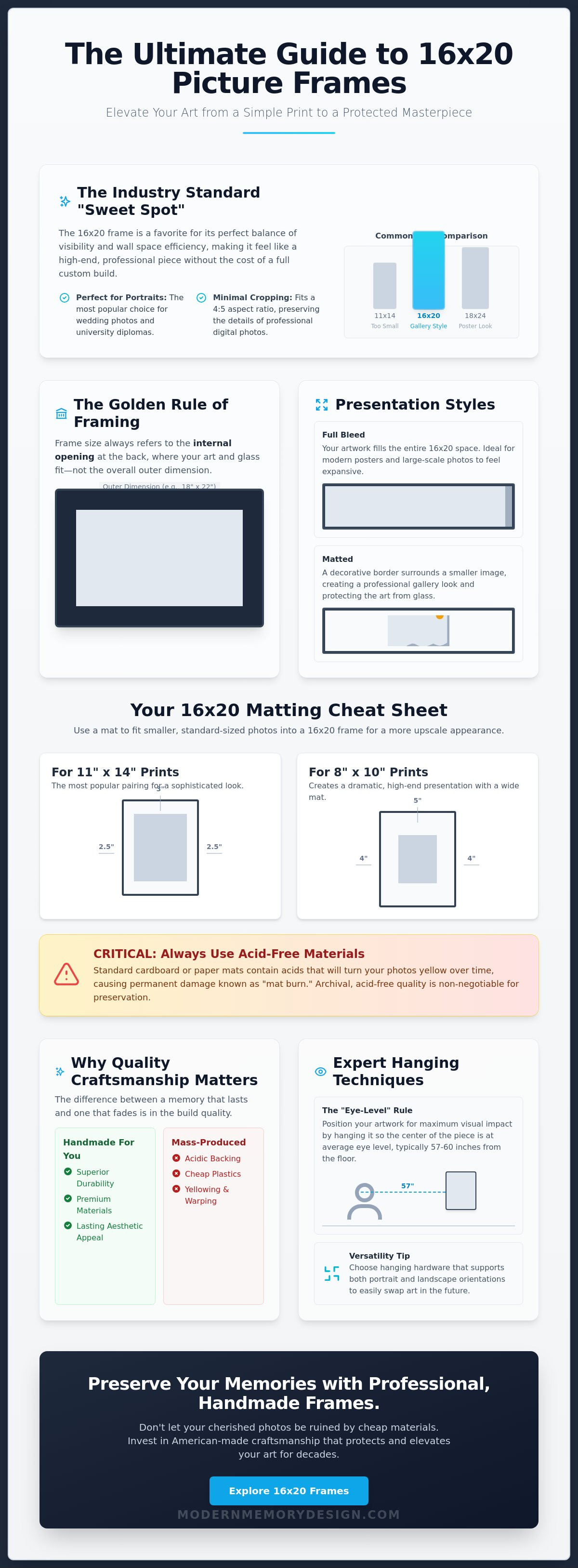
Hanging your art correctly transforms a simple room into a curated space. It's about perspective. For a 16 x 20 frame, the golden rule is the eye-level standard. This means the center of your artwork should sit between 57 and 60 inches from the floor. This measurement mimics professional museum standards, ensuring your photo or painting is easily viewed without straining the neck. If you're hanging the frame above a sofa or headboard, leave about 6 to 10 inches of space between the furniture and the bottom of the frame to maintain visual balance.
A single 16 x 20 frame works well as a focal point, but it also shines in groups. You can create a massive 40x40-inch visual impact by hanging four 16x20 frames in a tight grid. Use a 2-inch gap between each frame for a clean, modern look. This setup fills large wall voids effectively and provides a professional, gallery-style aesthetic. For a more eclectic feel, use the 16x20 piece as an anchor. Place it slightly off-center and surround it with smaller 5x7 or 8x10 frames to create a diverse, layered gallery wall that tells a story.
Layouts define the mood of your room. The Triptych is a classic choice; place three 16x20 frames side-by-side with 3 inches of space between them. This works perfectly in long hallways or behind a dining table. If you have a multi-level home, try the Staircase Flow. Stagger your frames so they follow the upward angle of the stairs, keeping the 57-inch center point relative to each step. For more detailed templates, how to create a gallery wall provides excellent step-by-step guidance.
Don't settle for a single nail. For a frame of this size, D-rings are generally superior to hanging wire. D-rings screw directly into the back of the frame and hook onto two separate wall hangers, preventing the art from tilting over time. If your 16x20 piece is heavy or features thick glass, use plastic wall anchors or toggle bolts. A standard nail might hold 5 pounds, but a proper anchor ensures your masterpiece stays secure even in high-traffic areas. This attention to detail protects your investment and your walls.
Ready to start your next decor project? Shop our handcrafted frames to find the quality you deserve.
Many shoppers fall into the "Big Box" trap when looking for home decor. Large retail chains offer 16x20 frames at low prices, but these products often sacrifice structural integrity. A standard 16 x 20 frame carries enough weight that cheap materials like thin MDF or plastic will eventually bow. When the frame sags, it creates gaps in the corners and puts pressure on the glass. This can lead to cracks or the entire piece falling off the wall. Our frames use solid wood moldings and "Made in the USA" materials to ensure your art stays secure for decades. We've seen mass-produced frames fail in as little as 12 months, whereas our handcrafted options are built to last a lifetime.
Choosing quality craftsmanship isn't just about looks; it's about protection. We use archival-grade components, including acid-free backing, to prevent your photos from yellowing. Mass-produced frames often use acidic cardboard that damages paper over time. By investing in professional framing, you're choosing a product that preserves your memories rather than degrading them. Our commitment to high-quality materials means you won't have to replace your frame every few years due to warping or fading.
Every order is handled by expert framers at our Hasbrouck Heights, NJ workshop. We don't believe in one-size-fits-all solutions. Instead, we treat every project as a unique "Handmade For You" assignment. We source sustainable wood and use precision joinery techniques to create museum-quality results. Shipping large items can be risky, so we've perfected a packaging system. We use custom-fit boxes and high-density foam to guarantee your 16 x 20 frame arrives in perfect condition, no matter where you live.
You don't need to be a professional designer to get professional results. Our process removes the guesswork. You can choose a style that matches your home decor and let us handle the technical details. If you have a digital image, use our online photo printing service to get high-resolution results paired with a custom frame. This all-in-one approach ensures your photo fits perfectly without any trimming or alignment issues. It's the easiest way to turn a digital file into a finished masterpiece for your wall.
Start your project today by selecting a frame that speaks to your style. Whether it's a family portrait or a piece of fine art, we provide the quality it deserves.
Selecting the right 16 x 20 frame is the final step in turning a simple print into a professional display. You've learned how archival matting protects your artwork and why selecting the right wood molding is vital for long term durability. A well chosen frame doesn't just hold a photo; it enhances the visual story you're telling in your home or office. Our team builds every piece by hand in our New Jersey workshop, ensuring each frame meets our rigorous quality standards. We use 100 percent museum-quality archival materials to protect your art from environmental damage and yellowing. Since we offer free shipping on all US orders, getting a custom look for your space is more accessible than ever. Don't settle for mass produced options that use inferior plastics or thin glass. Trust our expert framers to provide the craftsmanship your memories deserve. Your art has found its home; now it's time to give it the presentation it requires.
Browse our Premium 16x20 Frames - Handmade in the USA
We're excited to help you showcase your next masterpiece with confidence and style.
A 16 x 20 frame is classified as a medium to large standard size in the framing industry. It occupies exactly 320 square inches of wall space, making it a popular choice for focal point portraits or wedding photos. This size is large enough to be seen clearly from 10 feet away without overwhelming a standard 8 foot tall wall. It's the perfect step up from smaller 11x14 options for home decor.
Yes, a 16 x 20 frame is designed to fit a 16x20 photo perfectly when you aren't using a mat. The interior dimensions of the frame are cut to these exact specifications, though a 0.25 inch lip overlaps the edge to hold the photo in place. This ensures your image stays secure and centered. It's a standard choice for photographers who want their work to fill the entire viewing area of the glass.
You need a mat with 16x20 outer dimensions and an inner opening of 10.5x13.5 inches. This 0.5 inch overlap on each side of the 11x14 photo prevents the image from falling through the opening. Using this specific size provides a 2.5 to 3 inch border of matting around your artwork. This creates a professional gallery look that draws the eye directly toward the center of the piece in any room.
You should set aside at least 20x24 inches of wall space for a 16x20 frame to look balanced. While the glass is 16x20, the wood molding adds 1 to 2 inches of width on every side. If you're hanging a gallery wall, leave 3 inches of space between this frame and any adjacent pieces. This prevents the display from feeling cluttered and ensures each individual handcrafted frame has enough room to breathe visually.
You can hang a 16x20 frame with Command Strips if the total weight is under 16 pounds. A typical solid wood frame with glass weighs between 3 and 5 pounds, which is well within the limit. We recommend using 4 pairs of Large Command Strips, one in each corner, to ensure the frame stays level and secure. Always clean the wall with 70 percent isopropyl alcohol first to guarantee the strongest possible adhesive bond.
The primary difference is the material quality and durability. A 16x20 poster frame usually features lightweight plastic or MDF molding and a thin 0.040 inch PETG plastic sheet instead of glass. In contrast, a 16x20 picture frame uses professional wood molding and 2mm thick glass. Our handcrafted picture frames offer better protection for your art, whereas poster frames are designed for temporary or budget friendly displays in dorms or playrooms.
Yes, Modern Memory Design provides custom 16x20 frames equipped with premium UV protective glass at our New Jersey workshop. Our expert framers use glass that blocks 99 percent of harmful UV rays to prevent your photos from fading over time. This museum quality option is essential for art displayed in bright rooms with direct sunlight. Each frame is handmade for you to ensure your memories remain vibrant and protected for decades to come.
You should clean the glass by applying an ammonia free cleaner to a microfiber cloth rather than the frame itself. This prevents liquid from seeping under the 0.25 inch frame lip and damaging the photo. Use gentle, circular motions to remove fingerprints and dust. Avoid paper towels, as they can leave behind lint or small scratches on the surface. This simple maintenance routine keeps your professional display looking sharp and clear without risking moisture damage.
{"one"=>"Select 2 or 3 items to compare", "other"=>"{{ count }} of 3 items selected"}
Leave a comment