
Made in America (NJ)
for your Wall Decor
Handcrafted Picture Frames

Imagine you finally received that custom 11x14 print you ordered three weeks ago, only to realize the "standard" frame you bought online hides the bottom half of the artist's signature. It's a frustrating moment that happens to roughly 40% of DIY decorators who struggle to choose standard frame sizes without a guide. Your artwork deserves a professional presentation, but technical jargon often makes the selection feel like a math test.
At Modern Memory Design, we've helped thousands of clients at our New Jersey workshop simplify this selection. Mastering these dimensions allows you to stop guessing and start creating museum-quality displays. The right fit changes everything. Whether you're framing a small family portrait or a large poster, an expertly chosen fit ensures your art remains the star of the show.
This guide provides a clear cheat sheet for common dimensions, explains how mat openings work, and gives you the tools to build a gallery wall with confidence. You'll learn how to choose the perfect border and ensure your artwork is preserved for years to come.
Standard frame sizes are pre-manufactured dimensions that correspond to the most common photo and art print scales. Using standard frame sizes allows for a much faster turnaround and greater accessibility for your home gallery projects. The primary benefit of these dimensions is cost-effectiveness; because they are produced in high volumes, they are readily available for immediate shipping or pickup. Instead of waiting for a bespoke build, you can select from quality ready-made options that fit your 4x6, 5x7, or 8x10 prints without delay.
How "standard" is defined often depends on the specific medium you're using. Photography usually centers on the 4x6 format, while digital art frequently utilizes 11x17 dimensions. For larger displays, 24x36 inches remains the industry standard for posters. Your printer’s output is typically calibrated to these framing standards. This alignment ensures that when you print a photo at a local lab or on a home inkjet, it will fit into a picture frame without requiring awkward trimming or oversized mats.
Framing standards didn't appear by accident; they were dictated by the evolution of camera technology and paper manufacturing. The 35mm film format, which became a commercial standard in 1913, created the 2:3 aspect ratio. This ratio is the reason we still use 4x6 and 20x30 prints today. While the United States continues to use inches, the rest of the world follows the A-series metric system defined by the ISO 216 standard. Throughout the 20th century, frames transitioned from utilitarian protective cases to key elements of aesthetic home decor. This evolution helped establish standard frame sizes as a retail necessity for the modern home.
One of the most frequent points of confusion for our customers involves the "Inside Dimension" rule. Frame sizes always refer to the size of the glass and the backing, not the outer dimensions of the wood or metal molding. If you have an 8x10 print, you need an 8x10 frame. However, you must account for the "Lip" or "Rabbet." This is the 1/8 to 1/4 inch area of the art that stays hidden behind the frame edge to keep it secure. Orientation also matters for your final wall layout. Whether you're hanging a landscape or portrait piece, the internal measurements remain the same, but the hardware placement changes to ensure the weight is distributed properly across your wall.
Small frames are the essential workhorses of home decor. They turn cold surfaces into personal stories. The "Big Three" dimensions; 4x6, 5x7, and 8x10; dominate the market because they align perfectly with standard printing equipment and digital sensor ratios. These standard frame sizes allow you to swap photos easily without the need for custom trimming or specialized mats. They're the go-to choice for gift-giving because they're portable and fit easily into standard mailing boxes.
Using small frames helps create "moments" in tight spaces where a large canvas would feel suffocating. In a narrow hallway or a small breakfast nook, a series of 5x7 frames provides visual interest without crowding the walkway. Our New Jersey workshop often sees these sizes used for family heritage projects, where multiple generations are displayed in a cohesive row. They offer enough visual weight to be noticed but remain humble enough to sit on a crowded mantel or bedside table.
The 4x6 remains the universal choice for vacation snapshots and candid memories. It reflects the 3:2 aspect ratio that became the industry standard following the rise of 35mm film in the late 20th century. It's the most common size for physical photo prints found in family albums. If you want a touch more elegance, the 5x7 is the better option. It's the preferred size for wedding invitations and formal greeting cards because the extra inch of width provides a more balanced aesthetic.
Designers often use 5x7 picture frames to anchor smaller clusters on a side table. By placing a slightly larger 5x7 frame behind a 4x6, you create depth and layers. This technique prevents your tabletop display from looking flat or cluttered.
The 8x10 is the gold standard for school portraits and corporate headshots. It's large enough to show facial detail clearly but small enough to remain a "tabletop" size. For many, this is the first "real" piece of art they hang. Moving up, the 11x14 acts as a bridge between desk decor and wall art. It works equally well on a sturdy easel or as a standalone piece in a small bathroom or entryway.
If you're starting a gallery wall, the 11x14 is your most versatile tool. It provides enough visual weight to lead the eye without overwhelming the surrounding smaller frames. We also see a rise in 12x12 formats, which offer a modern, symmetrical look inspired by social media grids. These square frames break up the traditional rectangular patterns and add a contemporary feel to any room. If you're ready to start your collection, you can shop our handcrafted frames to find the perfect fit for your space.
Large frames do more than hold art; they define the architecture of a room. When you choose 16x20, 18x24, 20x30, or 24x36 formats, you're making a deliberate design choice to anchor a space. A 24x36 frame covers 6 square feet of wall, making it a perfect center for a living room wall or above a headboard. Scale matters because small frames on large walls often look lost or cluttered. By using these standard frame sizes, you ensure your art feels intentional and professional.
At this scale, material choice is vital for longevity. Solid wood frames provide the structural integrity needed to prevent bowing over time. For any frame larger than 20x30, we often recommend high-quality acrylic over traditional glass. Acrylic is shatter-resistant and significantly lighter. A standard glass pane for a 24x36 frame can weigh over 5 pounds, while acrylic provides the same clarity at a fraction of the weight, reducing stress on your hanging hardware and wall.
The 16x20 size remains the top choice for wedding portraits and professional photography. It's large enough to capture detail without requiring a massive amount of wall space. The 18x24 format is the go-to for medium-sized digital art prints and limited edition posters. These standard frame sizes work exceptionally well in hallways or smaller offices. They create a focal point that draws the eye without making a room feel cramped or overwhelmed.
The 24x36 frame is the "Commanding" size. It's the universal standard for movie and music posters. If your art exceeds these dimensions, you'll need to look into large picture frames designed for oversized displays. When installing a 24x36 solid wood frame, always check your wall type. A frame of this size can weigh between 8 and 12 pounds depending on the thickness of the molding. Use a stud finder or heavy-duty wall anchors rated for at least 25 pounds to ensure your masterpiece stays secure on the wall for years to come.
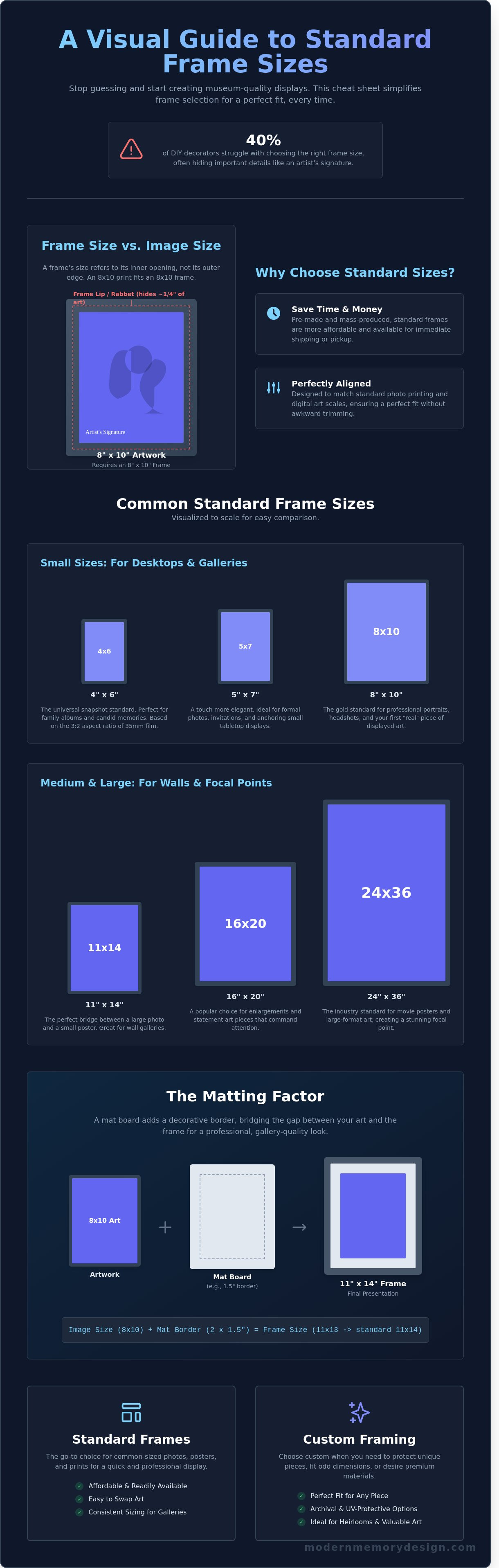
Choosing the right mat is just as critical as selecting the frame itself. The mat serves as a visual bridge between your artwork and the border. To ensure a professional look, you must follow the fundamental rule of matting: the opening should be 1/4 inch smaller than your artwork on all sides. For a standard 8x10 print, an opening of 7.5x9.5 inches ensures the edges don't peek through or slip behind the matting material.
Matting provides essential "breathing room" for your piece. It draws the eye inward while creating a physical barrier. This gap prevents your art from touching the glass directly. In environments with 50% or higher humidity, photos can stick to the glass and sustain permanent damage. A mat creates a pocket of air that preserves the integrity of your work over time.
For a true gallery feel, experts often use the "weighted bottom" technique. This involves making the bottom border of the mat slightly wider than the top and sides, usually by 10% to 15%. This offset compensates for an optical illusion where the eye perceives the art as sinking if the borders are perfectly even. It's a subtle adjustment that makes standard frame sizes look like custom museum installations.
Off-the-shelf mats found in retail stores often have slightly different opening dimensions than custom-cut versions. A pre-cut mat for an 11x14 frame is typically designed for an 8x10 photo, but the actual hole is usually 7.5x9.5. When you select custom picture frames, you gain the freedom to choose neutral whites for a clean look or bold accents that highlight specific colors in your art.
| Frame Size | Mat Opening | Fits Image Size |
|---|---|---|
| 8x10 | 4.5x6.5 | 5x7 |
| 11x14 | 7.5x9.5 | 8x10 |
| 16x20 | 10.5x13.5 | 11x14 |
| 20x24 | 15.5x19.5 | 16x20 |
Not every piece requires a mat. A "full bleed" mount, where the art goes edge-to-edge, works best for modern minimalist prints or large 24x36 posters. This style emphasizes the scale of the work and fits well in contemporary spaces. However, a mat is essential for original watercolors and charcoal drawings. These mediums are fragile; without a mat, the glass can smudge the charcoal or trap moisture that ruins delicate paper fibers.
If you want to add extra depth, consider double matting. This involves layering two mats with the bottom one showing just 1/8 to 1/4 inch of color. It's an excellent way to add a subtle pop of color that ties the entire display together without overwhelming the subject matter. Using standard frame sizes with a double mat can make a small 4x6 photo feel like a significant piece of decor.
Ready to elevate your artwork with a professional finish? Shop our collection of handcrafted frames to find your perfect match today.
Standard frame sizes offer a quick solution for common snapshots, but they aren't a universal fix for every piece of art. Many items require a more tailored approach to preserve their visual integrity. Vintage prints from the 1940s, for example, often feature unique dimensions that don't align with modern retail shelves. Square photos popular on social media or wide 10x30 panoramas also fall outside the typical 4x6 or 8x10 categories. When you force a unique piece into a generic frame, you risk cropping out essential details or creating awkward empty spaces that ruin the composition.
Modern Memory Design bridges the gap between mass-market convenience and artisan quality. We don't believe you should settle for "good enough" when it comes to your memories. Our approach combines the efficiency of online ordering with the meticulous care of a local NJ frame shop. Every frame is handmade for you in our New Jersey workshop, ensuring your art receives a professional finish that big-box retailers simply can't replicate.
The difference between a mass-produced frame and a handcrafted one starts with the materials. Most standard retail frames use plastic or MDF (medium-density fiberboard) which can warp when humidity levels exceed 60 percent. We use real wood molding for every project. This provides superior structural integrity and a premium feel. We also prioritize the longevity of your art by using archival materials. This includes acid-free backing and UV-protective glass that blocks 99 percent of harmful rays. Even when you order standard frame sizes from us, you get the same museum-quality materials used in our most complex custom projects.
Success begins with an accurate measurement. Use a metal tape measure instead of a ruler to record the height and width of your art to the nearest sixteenth of an inch. Don't guess the dimensions based on the packaging; measure the actual paper or canvas. If you're local, visit our Bergen County workshop for an expert consultation. Seeing the molding options in person helps you visualize how the final piece will look on your wall. For those outside of New Jersey, our online platform makes it easy to select the perfect style from home.
Whether you have a standard print or a one-of-a-kind heirloom, we provide the expertise to make it shine. Our team ensures that every standard frame sizes order meets our high standards for craftsmanship and durability. Stop settling for flimsy plastic and give your art the home it deserves.
Ready to elevate your space? Shop our collection of standard and custom frames today.
Selecting the right display for your home starts with mastering the basics of dimensions. You can now distinguish between a standard 5x7 inch photo print and a 24x36 inch architectural poster with ease. Don't forget that adding a 2 inch archival mat will change your final frame requirements, often shifting you into a larger category. Choosing from standard frame sizes saves you time, but the quality of the build determines how long your art stays protected. At Modern Memory Design, we build every frame by hand in our New Jersey workshop. We use museum-quality archival materials that meet professional preservation standards. Every order includes free shipping, so you can focus on decorating your space instead of calculating delivery fees. It's time to take your favorite prints off the screen and get them onto your walls. Explore Our Handcrafted Standard & Custom Frames and start your next home project today. Your art is a masterpiece; let's make sure it looks like one.
The most common standard frame sizes for tabletop and wall displays include 4x6, 5x7, 8x10, 11x14, 16x20, and 24x36 inches. These dimensions match standard photography print ratios like 2:3 and 4:5. At our New Jersey workshop, we find that the 8x10 size is our most requested dimension for family portraits. Choosing these standard options ensures you can easily find pre-cut mats and acid-free backing for your project.
Yes, a 4x6 frame is designed specifically to hold a 4x6 inch photo. The interior opening is exactly 4 by 6 inches, though the frame's lip covers about 0.25 inches of the image on each side to keep it secure. This means your visible art area will be approximately 3.5 by 5.5 inches. It's a perfect fit for standard snapshots from most modern digital printers used at home or in retail labs.
You'll need an 11x14 frame to display an 8x10 photo with a standard 1.5 to 2 inch mat border. This combination provides a balanced, professional look that highlights the artwork rather than the frame itself. Our expert framers recommend using acid-free mats to prevent yellowing over time. This setup increases the total wall footprint by 40 percent compared to a frame without a mat, creating a more impactful display.
The standard size for a modern theatrical movie poster, often called a One-Sheet, is 24x36 inches. Older posters from before 1985 might measure 27x41 inches, so it's important to measure your specific print first. For these large formats, we use high-quality wood moldings and UV-protective glass to prevent fading. A 24x36 frame is the industry standard for 95 percent of commercial posters sold in the US today.
Frame sizes are based on the inside dimensions, which match the size of the glass and the artwork. For example, a 16x20 frame has a 16 by 20 inch opening on the back. The outside dimensions vary based on the molding width. A modern sleek frame might only add 1 inch to the total width, while an ornate vintage style could add 4 inches to each side of your display.
A successful gallery wall typically uses a mix of standard frame sizes like 5x7, 8x10, and 11x14 to create visual interest. Using at least 3 different sizes prevents the display from looking flat or repetitive. We suggest starting with one large 16x20 anchor piece and building outward. This variety allows you to fill a 5-foot wide wall space effectively while maintaining a cohesive, handmade look that reflects your personal style.
Your frame should be 2 to 4 inches larger than the picture if you plan to use a mat. An 8x10 photo looks best in an 11x14 frame, which adds 3 inches to the width and 4 inches to the height. If you're framing without a mat, the frame size should match the picture size exactly. This ensures the 0.25-inch rabbet lip holds the print securely without obscuring important details of your artwork.
You can use a standard frame for a custom-sized print by using a custom-cut mat to bridge the gap. If you have a 7x9 print, you can place it inside an 11x14 standard frame with a mat cut specifically for your artwork. This is a cost-effective way to get a professional, museum-quality look. At our NJ frame shop, we hand-cut mats to fit any unique dimension into our high-quality, American-made wood frames.
{"one"=>"Select 2 or 3 items to compare", "other"=>"{{ count }} of 3 items selected"}
Leave a comment