
Made in America (NJ)
for your Wall Decor
Handcrafted Picture Frames

Last Sunday, a client brought a 1954 wedding portrait into our workshop, only to find the edges had already turned a brittle, ghostly yellow from decades in a standard retail frame. It's a heartbreaking moment when you realize a one-of-a-kind family legacy is literally disappearing before your eyes. You want to honor your history, but the fear of accidentally ruining an original or getting lost in technical jargon often keeps these treasures tucked away in dark boxes.
We understand that you need more than just a pretty border; you need a solution that stops the clock on aging. This guide to archival framing for vintage photos explains how museum-quality materials and professional techniques protect your heritage from environmental damage. You'll learn exactly which UV-filtering glass and 100 percent cotton rag mats to request so your display remains vibrant for the next 100 years. We'll clear up the confusion between "acid-free" and true archival standards, giving you the peace of mind that your family's story is safe for the next generation.
Archival framing for vintage photos is a specialized preservation system designed to protect family history from chemical and environmental damage. It isn't just about choosing a decorative border. It's a rigorous standard that uses chemically inert materials and reversible mounting techniques to ensure a photograph remains in its original state for centuries. While a standard picture frame focuses on aesthetics, an archival build prioritizes the physical integrity of the paper and emulsion.
Many families still have memories trapped in "magnetic" photo albums from the 1970s. These albums were notorious for using acidic adhesives and PVC plastic covers that turned photos yellow and brittle within 15 years. Modern archival standards represent a complete rejection of those damaging methods. Today, we understand that "acid-free" is merely the bare minimum. True preservation requires materials that are lignin-free and buffered to maintain a neutral pH, preventing the slow chemical "burn" that destroys vintage prints.
The primary enemy of vintage paper is lignin, a natural polymer found in wood-pulp paper. When exposed to oxygen, lignin creates an acidic environment that causes the characteristic yellowing and "brittling" of old photos. UV rays act as a catalyst, breaking down the delicate photographic dyes and silver halides. Environmental factors also play a role. When humidity levels rise above 60 percent inside a frame, it triggers foxing. These are the reddish-brown spots caused by fungal growth or the oxidation of iron bits within the paper fibers. Our NJ workshop uses UV-filtering glass and breathable backing to combat these specific threats.
The golden rule of archival framing is reversibility. Any treatment or mounting technique applied to a vintage original must be able to be undone without leaving a trace or causing damage. This is why permanent dry-mounting is the biggest mistake you can make with a 19th-century heirloom. Dry-mounting uses heat and permanent adhesive to flatten a photo, which instantly kills its historical and monetary value. Instead, we use Japanese paper hinges or archival photo corners. These methods secure the image firmly while allowing a professional conservator to remove the photo safely in the future if needed. At Modern Memory Design, we treat every heirloom with the meticulous care required to keep it a masterpiece for the next generation.
True archival framing for vintage photos relies on a synergy of four distinct components: glazing, matting, mounting, and backing. Each layer serves as a functional barrier against environmental degradation. At our New Jersey workshop, we treat every project as a preservation mission rather than a simple decor task. One of the most critical elements is the air gap. You should never allow your photo to touch the glass. This 'buffer' space prevents moisture from being trapped against the emulsion, which can cause the image to fuse to the glazing over time; a disaster that's often impossible to reverse.
The frame itself requires specialized preparation. Since wood is an organic material, it naturally releases acidic vapors, a process known as outgassing. To protect your history, we apply internal sealing tapes to the frame's rabbit. This prevents those gases from migrating into the paper fibers of your 100 year old heirloom. Finally, a professional dust cover is applied to the back. This isn't just for a finished look; it creates a stable microclimate that resists humidity shifts and prevents insect intrusion.
UV-filtering glazing acts as a sunscreen for your art, blocking the specific wavelengths that cause pigment fading. For archival framing for vintage photos, 99% UV protection is the non-negotiable industry standard. You'll typically choose between two premium options. UV-filtering acrylic is lightweight and shatterproof, which is a safer choice for large frames or homes with high activity. Museum Glass provides that same 99% protection but includes an anti-reflective coating. This makes the glass nearly invisible, allowing the fine details of a 1920s portrait to shine without distracting glare.
Materials matter when you're aiming for longevity. Standard 'acid-free' mats are often just wood pulp treated with chemicals that eventually wear out. We recommend 100% cotton rag mats because they're naturally pH neutral and won't yellow your photos over time. Following conservation framing practices, you should use reversible mounting techniques like Japanese tissue hinges or archival photo corners. These methods secure the photo without permanent adhesives. A mat is functional, not just decorative, as it provides the essential physical separation between the art and the glass. If you're ready to protect your collection, you can order custom archival frames tailored to your specific dimensions.
Choosing between standard and archival options often feels like a balancing act between your budget and your history. It's a choice between immediate savings and long-term preservation. While a standard frame might save you money today, the acidic components in wood-pulp mats can begin to "burn" your photograph within five to ten years. This damage manifests as yellowing, brittle edges, and fading colors. Professional photo restoration services often charge between $150 and $500 to repair a single damaged print. Investing in archival framing for vintage photos acts as an insurance policy, preventing these costs before they occur.
Many people worry that museum-quality protection means sacrificing style. This is a common misconception. Archival materials don't look "stuffy" or "old-fashioned" by default. You can house a 1920s portrait in a "Modern Sleek" black frame or a "French Gold Leaf" profile while still using 100% acid-free internals. The protection happens behind the scenes, leaving you with a masterpiece of design and craftsmanship that fits your home decor perfectly.
| Material Type | Standard Option | Archival Option |
|---|---|---|
| Mat Board | Wood pulp (Acidic, yellows over time) | Cotton rag (pH neutral, lignin-free) |
| Glazing | Regular glass (Blocks less than 50% UV) | UV-filtering acrylic (Blocks 99% UV rays) |
| Backing | Cardboard (Off-gasses and stains) | Acid-free foam core (Inert and stable) |
Not every snapshot requires museum-grade materials, but specific items demand the highest level of care. You should prioritize archival framing for vintage photos in the following scenarios:
Our expert framers at our NJ frame shop specialize in identifying these needs. We focus on outstanding craftsmanship to ensure your family heirlooms remain as vibrant as the day they were taken. It's about more than just a frame; it's about keeping your story alive for the next century.
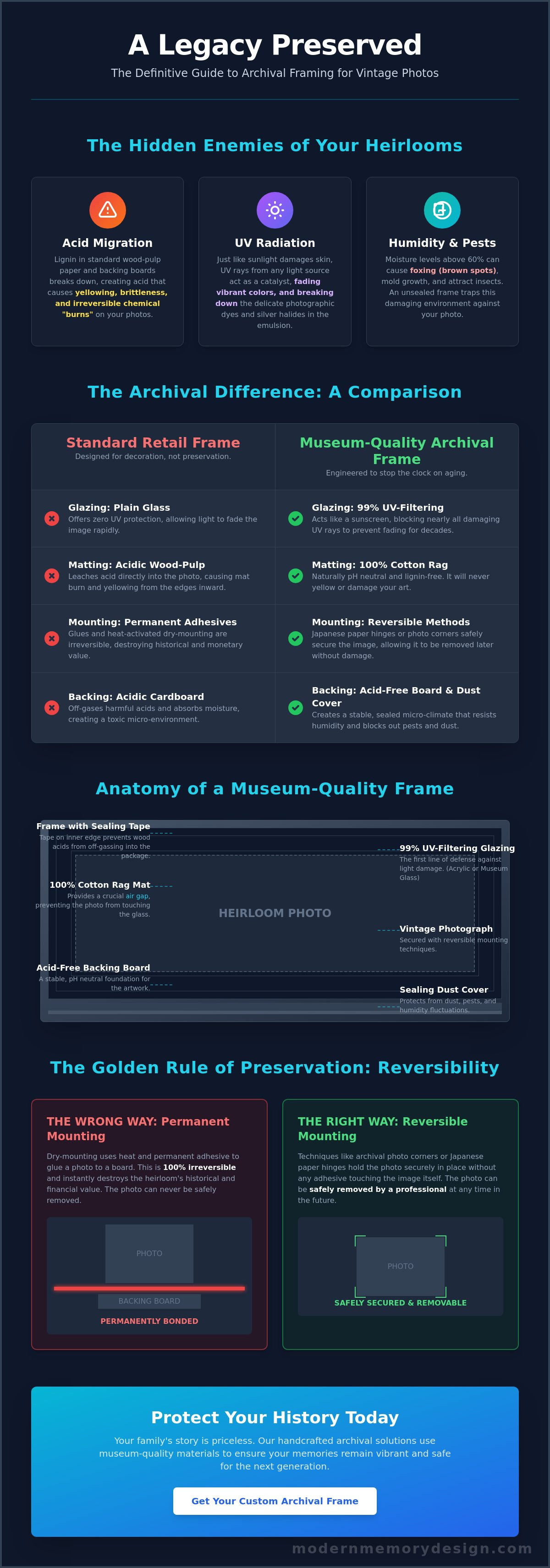
Preserving a family heirloom requires a meticulous approach and the right materials. Using archival framing for vintage photos ensures these fragile memories don't yellow, brittle, or fade over the next several decades. Follow these four professional steps to secure your history.
Many collectors now choose to frame a professional reprint instead of the original 19th-century photograph. By using Online Photo Printing, you can create a "display duplicate" that looks identical to the original. This allows you to keep the authentic vintage photo in a dark, climate-controlled storage box, which is the gold standard for preservation. When choosing a frame, match the era of the shot. A "French Gold Leaf" frame complements a Victorian-era portrait, while a "Modern Sleek" wood frame works well for mid-century snapshots.
While DIY framing is popular, it carries risks for one-of-a-kind items. Common mistakes include using "acid-free" materials that aren't actually museum-grade or trapping humidity inside the frame during assembly. When you visit a professional NJ frame shop, ask if they use 100% cotton rag mats and reversible hinging techniques. Our craftsmen at Modern Memory Design focus on archival framing for vintage photos using materials that meet Library of Congress standards. For design inspiration and layout ideas, check out our Custom Picture Frames Guide.
Ready to protect your family legacy with museum-quality materials? Shop our handmade archival frames and give your vintage photos the protection they deserve.
Modern Memory Design operates from a specialized workshop in Hasbrouck Heights, New Jersey. Every frame we produce is handcrafted in the USA, ensuring we maintain total control over the quality and materials used. We don't believe in mass-produced solutions for one-of-a-kind history. Our framers possess years of experience handling delicate, brittle, and fading materials that require a steady hand and specialized knowledge. When you trust us with archival framing for vintage photos, you're choosing a team that treats your family legacy with professional respect.
Our process relies on museum-grade components. We use UV-filtering acrylic in every custom build to block up to 99% of the light rays that cause irreversible fading. This is paired with acid-free mats and backings to stop the chemical "burning" that often occurs with standard retail frames. Whether you visit our Bergen County shop for a face-to-face consultation or use our digital tools, the goal remains the same: total preservation.
We prioritize structural integrity by using high-quality wood molding rather than composite or plastic materials. Wood provides a stable, long-lasting housing for your prints. Each frame includes an acid-free foam core backing to prevent moisture buildup and structural warping. If your original photo is too fragile for display, our Print & Frame service provides a perfect solution. We can scan and restore your vintage project, framing the new print while providing advice on how to store the original safely. For residents in the NJ, NY, and CT areas, we also offer a professional Picture Hanging Service to ensure your newly preserved memories are installed safely and level on any wall surface.
Preserving your history shouldn't be a difficult chore. Our easy online interface allows you to customize your archival frame in minutes. You can select your dimensions, choose your wood finish, and specify your glass type with a few clicks. We stand behind every product with a strict guarantee of craftsmanship. Shipping is handled with extreme care; we use reinforced packaging to ensure your order arrives in perfect condition, no matter where you live in the country. Don't let your family history fade away in a drawer or a basement box. Protect your memories with a custom archival frame from Modern Memory Design and ensure they last for the next century.
Your family's history deserves more than a standard store-bought frame that often leads to irreversible yellowing within 5 to 10 years. By choosing archival framing for vintage photos, you're investing in materials that meet Library of Congress standards for long-term permanence. Our team at Modern Memory Design uses 100 percent acid-free matting and UV-filtering acrylic as a standard feature to block 99 percent of harmful light rays. These museum-quality components ensure that your 20th-century heirlooms remain as vibrant as the day they were captured.
Every piece is handmade in our New Jersey workshop by artisans who prioritize structural integrity and chemical stability. We don't settle for shortcuts because we know these images are irreplaceable. Whether you're preserving a 1920s wedding portrait or a mid-century snapshot, our handcrafted solutions provide a shield against environmental damage. It's the most reliable way to turn a fragile memory into a lasting masterpiece that your grandchildren will enjoy. Your past is worth protecting with the right expertise.
Design Your Custom Archival Frame Today
Acid-free materials have a pH of 7.0 or higher at the time of production, while archival materials are designed to remain chemically stable for over 100 years. True archival framing for vintage photos meets the ISO 18916 standard to ensure no chemical reactions occur between the photo and the mount. Our NJ workshop uses these museum-quality components to prevent the yellowing often seen in basic retail frames.
You shouldn't use regular glass because it only blocks about 45 percent of harmful UV rays. Vintage emulsions are extremely sensitive to light. We recommend using conservation-grade glass that filters 99 percent of UV radiation. This protects your family history from the irreversible bleaching and brittleness caused by daily exposure to natural and indoor light sources.
It's usually best to frame a high-quality reproduction while storing the original in a dark, temperature-controlled environment. Digitizing your image at a minimum of 600 DPI allows you to display a beautiful copy without risking the primary artifact. If you choose to frame the original, our expert framers use reversible mounting techniques to ensure the piece remains untouched and preserved for future generations.
You can tell a frame is damaging your photo if you see brown edges or mat burn on the image. This happens when acidic wood pulp in standard mats migrates into the paper. If a pH testing pen shows a reading below 7.0, the materials are actively degrading your heirloom. Our handmade frames use 100 percent cotton rag mats to eliminate this risk entirely.
The best way to mount a photo without adhesive is using archival polyester photo corners. These clear Mylar corners hold the image securely in place by its edges without any glue or tape touching the actual paper. This method is 100 percent reversible. It allows the photo to expand and contract with humidity changes, which prevents the buckling often caused by permanent mounting tapes.
Professional archival framing costs depend on the dimensions of your piece and the specific materials chosen, such as UV-filtering glass or specialty wood molding. The Professional Picture Framers Association notes that custom framing involves labor-intensive techniques like hand-mounting and precision cutting. At our Bergen County workshop, we provide transparent quotes based on the specific conservation needs of your project to ensure you get the best value.
Archival framing doesn't stop all fading, but it reduces the rate of damage by up to 99 percent when using conservation glass. Even with the best materials, visible light can still cause pigments to shift over several decades. To maximize the life of your archival framing for vintage photos, don't hang your display directly opposite a south-facing window or under high-intensity halogen bulbs.
Museum glass is a premium glazing option that offers 99 percent UV protection and less than 1 percent light reflection. It's worth the investment for dark or highly detailed vintage photos because it makes the glass virtually invisible. This allows you to see the true colors and textures of your handmade masterpiece without the distracting glare found in standard or non-glare glass options.
{"one"=>"Select 2 or 3 items to compare", "other"=>"{{ count }} of 3 items selected"}