
Made in America (NJ)
for your Wall Decor
Handcrafted Picture Frames

What if the frame you bought to display your art is actually destroying it from the inside out? It's a painful reality for many collectors who realize, often 18 months too late, that cheap acidic backing has turned their vibrant prints into yellowed relics. You've likely spent hours finding the perfect piece, yet the technical side of art framing feels like a maze of confusing glass types and mounting techniques. It's stressful to choose between UV protection and non-glare finishes when you aren't sure which one actually protects your investment.
We know you want a gallery-ready look without the fear of damaging your favorite pieces. This guide transforms that uncertainty into confidence by showing you how professional materials preserve your collection for decades. You'll learn why 99% UV-protective glass is essential to stop fading and how to choose acid-free mats that prevent permanent mat burn. We'll also break down frame styles that offer the best aesthetic ROI for your specific space. From our New Jersey workshop to your home, here's how to turn any piece into a protected, handcrafted masterpiece.
Art framing is the intentional creation of a controlled environment for your artwork. While some see it as a simple border, its true function is dual; it showcases the piece and shields it from decay. The History of picture frames shows that even early artisans understood that a frame acts as a physical barrier against the elements. A high-quality frame isn't just a decorative accessory; it's a structural necessity. When you invest in professional art framing, you're securing the longevity of your piece for decades to come.
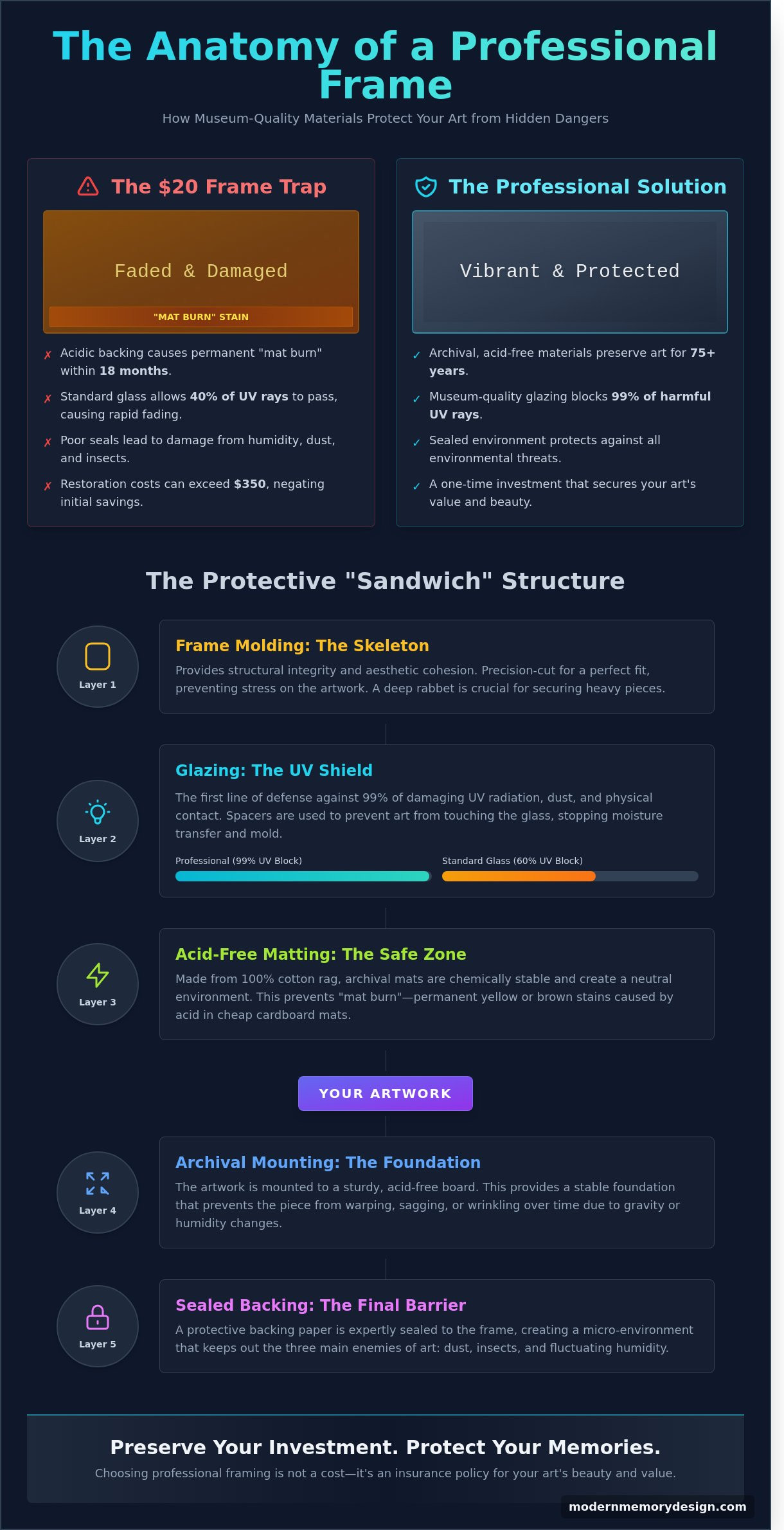
Buying a $20 ready-made frame for a $500 print is a common mistake that leads to regret. Cheap frames often use cardboard backing or non-UV glass that fails to protect the art. Within 18 months, acidic materials in low-grade backing can cause "mat burn," which is permanent brown staining on the paper. Repairing this damage through professional restoration can cost $350 or more, far exceeding the initial savings of a budget frame. Choosing quality art framing is an investment in the future of your collection.
The difference between ready-made frames and custom solutions comes down to precision and materials. At our NJ frame shop, we see how 1/16th of an inch makes a difference in structural integrity. Custom frames are "Handmade For You" to the exact millimeter of your artwork. Ready-made frames use standard sizes that often force you to trim your art or use ill-fitting mats, which immediately drops the resale value by up to 40%. Our "Made in the USA" frames prioritize the specific needs of the art over mass-market convenience.
Professional design creates a bridge between the artwork and your living space. Using a 3-inch mat on a 5x7 photograph can increase its visual footprint by 200%, making a small memory feel like a focal point. Color theory also dictates our choices; a cool-toned silver molding can pull out the blue hues in a landscape, while a warm wood grain grounds an earthy abstract. We use scale and proportion to ensure the frame doesn't overwhelm the art but rather elevates it.
Art faces three main enemies: UV light, fluctuating humidity, and acid. Standard glass allows 40% of UV rays to pass through, causing colors to fade in as little as 24 months. Humidity levels above 60% can trigger mold growth on paper within 48 hours if the frame isn't properly sealed. Archival framing is the use of chemically stable materials to prevent degradation. "Museum-quality" isn't just a buzzword; it's a technical standard that requires 99% UV-protective glazing and 100% cotton rag mats. These materials ensure that your investment stays in pristine condition for 75 years or more.
The molding acts as the skeleton of the piece. Wood molding, often preferred for its warmth and traditional feel, offers superior structural support for heavy canvases. At our New Jersey workshop, we prioritize quality by using American-made wood molding. This ensures the grain is tight and less prone to expansion in humid environments. For a contemporary look, metal molding provides a slim profile without sacrificing strength. Artisanal finishes like French Gold Leaf or hand-stained walnut add a level of craftsmanship that mass-produced frames lack. The choice depends on the art's weight; a heavy oil painting requires the deep rabbet of a sturdy wood frame to stay secure.
Glazing is the first line of defense against dust and UV radiation. Standard UV-protection glass filters out 99% of harmful rays, which is the industry benchmark for preventing pigment fading. For those seeking the highest clarity, Museum Glass is the gold standard. It features an anti-reflective coating that reduces reflection to less than 1%, making the glass virtually invisible. Acrylic is a better choice for frames larger than 30x40 inches or for art displayed in high-traffic areas. It is shatter-resistant and weighs about 50% less than traditional glass. If you're unsure which materials suit your project, you can explore our handcrafted frame styles to find the perfect match for your piece.
The interior of the frame is where true preservation happens. We use acid-free and lignin-free mat boards with a pH level between 7.0 and 8.5 to prevent "mat burn," which is a yellowing effect caused by acidic migration. A critical principle in framing techniques for paintings and paper works is the "breathe room." This 1/8 inch gap created by the mat ensures the art never touches the glazing. This prevents moisture trapped inside from causing mold or sticking to the glass.
Mounting should always be reversible to maintain the artwork's value. Using T-hinges or Japanese paper hinges allows the art to be removed unharmed in the future. We avoid permanent adhesives because they can cause irreversible damage to the fibers of the paper. By focusing on these archival details, we ensure your art framing remains a masterpiece of design and craftsmanship for years to come. Our expert framers in our Bergen County workshop treat every project with this level of meticulous care.
Every piece of art possesses a unique physical profile that dictates its framing requirements. A 100-year-old silver gelatin photograph reacts differently to environmental changes than a digital poster printed in 2024. Stability is the goal of professional art framing. At our New Jersey workshop, we prioritize the structural integrity of the medium to prevent degradation over time. Wood moldings must be sturdy enough to support the weight, while the internal components must account for the natural expansion and contraction of the artwork's substrate.
High-value items like original watercolors or historical documents demand a higher level of technical precision. If you use the wrong mounting technique, you risk permanent damage. We focus on reversible methods that protect your investment. Whether it's a family heirloom from the 1920s or a modern limited edition print, the frame serves as a protective shell that balances aesthetics with long-term preservation.
Works on paper are susceptible to "buckling" or "cockling" when humidity levels fluctuate. This wavy appearance occurs because paper is a natural fiber that breathes. To manage this, we utilize t-hinge mounting. This technique allows the art to hang freely within the mat window rather than being taped down on all four sides. It's a method supported by Library of Congress preservation guidelines to ensure the paper doesn't tear as it moves. For photographs, maintaining a 1/8 inch gap between the image and the glazing is vital. Photo emulsions are sensitive; if they touch the glass directly, they can fuse to the surface, leading to irreversible damage during future art framing updates.
Canvas art requires a different structural logic. We start with kiln-dried wooden stretcher bars that have a moisture content below 10%. This specific dryness level prevents the wood from warping or twisting after the art is hung on your wall. You can choose between a 0.75-inch standard wrap for traditional frames or a 1.5-inch gallery wrap for a more contemporary look. For modern canvases, floating frames are the preferred choice. These frames leave a 0.25-inch "float" space between the edge of the canvas and the inner frame lip. This design choice ensures the entire painting remains visible, including the painted edges, providing a clean and sophisticated gallery aesthetic.
Three-dimensional objects require the specialized depth of a shadow box. When we frame sports memorabilia or jerseys, we build custom boxes with depths ranging from 1 to 4 inches. We use stainless steel pins for fabric mounting to prevent rust spots from forming over the next 20 years. Professional diplomas and certificates need similar care. These documents often use heavy vellum or parchment that yellows quickly if exposed to acidic backing boards. We use 100% acid-free mats to ensure your credentials remain pristine. By creating a narrative display for heirlooms, we turn loose objects into protected, wall-ready stories that withstand the test of time.
Choosing between a standard 8x10 frame and a custom-built solution depends on your art's value and dimensions. Standard frames are affordable and readily available for common sizes like 4x6, 5x7, or 11x14. They're a practical choice for replaceable prints or temporary decor where the budget stays under $50. However, these mass-produced options often fail to accommodate the unique aspect ratios of original photography or vintage posters. If your artwork measures 13x19 inches, forcing it into a standard 16x20 frame requires a bulky, poorly proportioned mat that distracts from the focal point.
Custom art framing becomes mandatory when dealing with non-standard sizes or specific depths. For example, 85% of original oil paintings on stretched canvas require a deeper rabbet than what's found in a retail store. Customization allows you to specify every detail:
The financial return on custom work is also significant. A 2023 study of secondary art markets indicated that professionally framed pieces sell for 18% to 25% more than unframed works. This increase happens because professional framing signals to buyers that the art has been preserved using archival standards. It transforms a simple piece of paper into a durable asset that's ready to hang for decades.
Off-the-shelf frames often prioritize low costs over long-term preservation. Most use high-acid cardboard backings that cause "mat burn" or permanent yellowing on your art within 24 to 36 months. These frames typically feature thin 1mm glass or cheap plastic that offers no protection against sunlight. Because they're built in bulk, the corner joins often show gaps or structural weakness after just one year of hanging. Finding a unique style is also difficult; you're usually limited to basic black, white, or faux-wood finishes that don't complement high-end interiors.
Our process begins with a professional consultation to align the frame style with your existing home decor. We don't guess measurements; we use computerized precision cutting to ensure a fit within 1mm of your artwork's edge. This accuracy prevents the art from shifting or buckling over time. Since we operate our own workshop in Hasbrouck Heights, New Jersey, we control the entire production line. You won't wait months for your order. Most custom projects are completed and ready for pickup or shipping in 4 to 6 business days. Every frame is handmade in the USA using solid wood moldings and acid-free materials to guarantee museum-quality results.
Ready to give your art the professional treatment it deserves? Shop our custom picture frames and protect your investment today.
Selecting the right art framing is a vital step in preserving your collection, but the process doesn't end at the workshop. A frame is only half the battle; the way you display it determines whether the piece looks like a museum masterpiece or a cluttered afterthought. Even the most expensive custom frame loses its impact if it hangs two degrees crooked or sits at the wrong eye level. Proper installation bridges the gap between a simple object and a focal point that defines your living space.
Safety is a primary concern for homeowners, especially when dealing with oversized pieces. A 48x60 inch framed mirror or canvas can easily weigh over 40 pounds. Relying on a single nail or a flimsy wire often leads to disaster. Professional installers use load-bearing hardware designed for specific wall types, whether you have modern drywall or historic lath and plaster. This precision prevents unsightly wall damage and ensures your investment remains securely fastened for years to come.
Creating a gallery wall allows you to tell a story through your collection. You don't need matching frames to achieve a professional look. In fact, mixing an "Ornate Vintage" gold frame with a "Modern Sleek" black profile creates a sophisticated, eclectic aesthetic. To maintain balance, use a consistent matting color, such as a crisp 2-inch off-white border, across all pieces. We recommend the "floor first" method; lay your arrangement on the ground and adjust the spacing until the layout feels balanced before you touch the wall.
For clients in the New Jersey, New York City, and Connecticut areas, DIY hanging often results in "Swiss cheese" walls from multiple failed attempts. Our professional team eliminates this frustration by using precision tools like laser levels and T-head security bolts. We specialize in secure, museum-style hanging that keeps art perfectly level even in high-traffic hallways. Whether it's a single heavy shadowbox or a complex grid of 20 photos, we bring the right hardware for a permanent, flawless fit. Learn more about our professional picture hanging service.
Quality control is the heartbeat of our business. Every frame we produce is handcrafted in our Hasbrouck Heights, New Jersey workshop. By keeping production local, we ensure that every corner join is seamless and every piece of glass is free of imperfections. We don't rely on mass-produced imports that warp over time. Instead, we use premium American materials that stand up to the humidity and temperature shifts of the Tri-State area. This dedication to local craftsmanship means your art framing project receives the personal attention it deserves from start to finish.
Supporting a local NJ frame shop means you're investing in a tradition of excellence that spans generations. Our framers treat every project with the same meticulous care, whether it's a child's drawing or a high-value oil painting. Ready to elevate your home decor with expert craftsmanship? Start your custom framing project with Modern Memory Design today.
Your collection deserves more than a standard store-bought solution. Proper art framing is about more than aesthetics; it's a commitment to preserving your investment for decades. By choosing museum-quality archival materials, you prevent yellowing and deterioration caused by acid and UV light. Whether you're framing a delicate watercolor or a heavy canvas, the right structure ensures your piece stays flat and secure.
At Modern Memory Design, we handle every step of the process in our Hasbrouck Heights, NJ workshop. We use 100% acid-free components to guarantee your work remains in pristine condition. Most custom orders are ready in just 4 to 6 business days, providing a fast turnaround without sacrificing quality. If you're local to Bergen County, our 5-star rated team can even handle the heavy lifting with professional hanging services. It's time to take your art off the floor and put it where it belongs.
Order Your Custom Art Frames Online from Our NJ Workshop and give your home the gallery-style finish it needs. You've spent time finding the perfect art; now let's make sure it lasts forever.
Professional art framing typically costs between $50 and $500 depending on the dimensions and materials you select. A standard 8x10 photo in a basic wood frame starts around $45, while a large 24x36 masterpiece with museum-grade glass often exceeds $275. Factors like the complexity of the wood picture frame molding and archival mounting techniques will influence your final investment.
Acid-free matting has a neutral pH level that protects your art from yellowing or becoming brittle over time. Regular wood-pulp mats contain lignin, which releases harmful gases that cause brown "mat burn" on paper within 5 to 7 years. We use 100% alpha-cellulose mats to ensure your art framing remains in pristine condition for decades without chemical degradation.
You need UV-protection glass if your artwork sits in a room with windows or fluorescent bulbs, as it blocks 99% of harmful rays. Standard glass only filters about 45% of UV light, which leads to noticeable fading of pigments in as little as 24 months. For original paintings or family photos, upgrading to conservation-grade glass is a necessary step for long-term preservation.
Most custom framing orders at our New Jersey workshop are completed in 4 to 6 business days. More complex projects, such as hand-joined French Gold Leaf frames or deep jersey shadow boxes, usually require 10 to 14 days for completion. We focus on handcrafted quality in every piece, ensuring your frame is built to last before it's shipped or ready for pickup.
Yes, you can upload your digital files directly to our site for professional printing and framing. We use large-format printers with archival inks that carry a 200-year lightfastness rating. Once your image is printed on premium paper or canvas, we handcraft your frame in our Bergen County shop, providing a complete solution that arrives at your door ready to hang.
A floating frame is a style where the artwork sits inside the frame with a 0.25-inch gap between the canvas and the interior wood edge. This creates a visual illusion that the art is hovering. You should use this for 1.5-inch thick gallery-wrapped canvases when you want to showcase the entire painted edge without any part of the frame overlapping the front.
We provide professional picture hanging services for residential and corporate clients throughout Bergen County and the Tri-State area. Our installation team has successfully mounted over 1,500 pieces of art in the last 12 months, including heavy mirrors and complex gallery walls. We use weight-appropriate hardware to ensure every piece is level and stays securely on your specific wall type.
Frame your canvas if you want a polished, traditional look, but leave it as a gallery wrap for a minimalist, contemporary feel. A 1.5-inch deep gallery wrap is structurally sound enough to hang alone, while a thin 0.75-inch canvas often requires a frame to prevent the wood bars from warping. Adding a frame increases the protection of the canvas corners by 100%.
{"one"=>"Select 2 or 3 items to compare", "other"=>"{{ count }} of 3 items selected"}