
Made in America (NJ)
for your Wall Decor
Handcrafted Picture Frames

A stunning piece of canvas art can lose its tension and begin to sag in as little as 24 months if it isn't professionally stretched over kiln-dried wood. It's frustrating to invest in a beautiful image only to find it looks dwarfed on a large wall or lacks that polished, gallery finish you see in high-end design magazines. Don't settle for a sagging frame. You likely want your home to reflect a sense of permanence and quality, yet the technical side of sizing and installation often feels overwhelming.
We promise to show you exactly how to select, size, and professionally frame your pieces to transform any room into a museum-quality space. You'll learn how to achieve archival durability that prevents aging and why a piece should typically cover 75% of your available wall width for maximum impact. This guide details the expert craftsmanship used in our New Jersey workshop, giving you the confidence to curate a professional collection that stands the test of time in 2026 and beyond.
Canvas art is more than a simple image. It is a multi-dimensional decor piece that changes how a room feels. While paper prints sit flat, canvas stretches over a wooden frame to create physical depth. This structure adds a sculptural element to your walls. To understand the foundation of this medium, What is Canvas? explains how woven fabrics like cotton and linen have served artists for centuries. Today, canvas art remains the standard for modern statement decor because it lacks the glare of glass. You can view the piece from any angle without reflections blocking the view. The absence of glass means light interacts directly with the pigment. This creates a softer, more organic appearance that draws the eye and invites people to look closer at the texture.
There is a clear distinction between an original oil-on-canvas and a modern print. Original works feature physical layers of paint applied by hand. Modern Giclée prints use advanced technology to recreate those details with incredible accuracy. Both provide a professional, gallery-ready look for your home or office. While originals are unique, high-quality prints allow you to bring museum-grade aesthetics into your space at a more accessible level.
High-resolution inkjet technology revolutionized how we reproduce art. In the past, prints often looked pixelated or dull. By 2026, industry standards require at least 12-color pigment systems to ensure professional results. These systems utilize specific shades like chromatic red and orange to capture nuances that standard home printers miss. Giclée is the industry standard for archival reproductions. This process ensures the colors stay vibrant for decades. Our New Jersey workshop focuses on these high-end systems to produce museum-quality results for every customer.
The choice between canvas and paper depends on your specific needs and the room's environment. Each medium offers distinct advantages for different types of installations.
For a 40x60 inch statement piece, canvas provides a professional look without the logistical challenges of oversized glass. It offers a clean, modern aesthetic that fits perfectly in any contemporary space. Whether you're decorating a quiet bedroom or a busy office hallway, choosing the right medium ensures your art lasts for years.
High-quality canvas art begins with what you can't see. The "Sag Test" is the industry standard for checking structural integrity. Press your finger firmly into the center of the canvas; it should feel tight like a drum and snap back instantly. If it leaves a temporary indentation, the internal frame is likely weak or the tension is poor. At our NJ frame shop, we prioritize hand-stretching because machines often apply uneven pressure. A human expert feels the resistance of the fabric, ensuring the corners are crisp and the tension remains consistent for decades.
To achieve archival painting quality, the materials must be acid-free. Acidic canvases turn yellow and brittle within 5 to 10 years. We use poly-cotton blends that offer the texture of traditional cotton with the structural stability of polyester. This combination prevents the fabric from expanding or contracting when humidity levels change. By 2026, advanced UV-protective coatings have become essential. These invisible layers filter out 99% of harmful rays, preventing the vibrant colors of your canvas art from fading even in sun-drenched rooms.
Premium products typically feature a heavyweight GSM (grams per square meter) of 380 or higher. This thickness ensures the canvas won't tear or thin out during the stretching process. While 100% cotton is a classic choice, it's prone to "breathing" and losing tension over time. A poly-cotton blend is the professional choice for modern homes because it stays taut. You can also choose textures based on your image; smooth weaves suit detailed portraits, while coarse weaves add depth to abstract designs.
Low-grade wood contains moisture that eventually evaporates, causing the frame to warp and pull away from the wall. This "wall-ghosting" effect ruins the aesthetic of your display. We use kiln-dried wood to lock the moisture content below 8%. For oversized pieces exceeding 36 or 40 inches, finger-jointed wood is a necessity. This engineering technique joins smaller pieces of premium wood into a single, ultra-strong bar that resists twisting.
You'll also need to decide on depth. A standard 0.75-inch bar fits most decorative frames, while a 1.5-inch Gallery Wrap creates a bold, standalone look that doesn't require an external frame. If you're ready to create a lasting piece, you can upload your photo for custom stretching at our workshop. Our team ensures every bar is cut to the millimeter for a perfect fit.
Traditional "lip" frames were originally designed for thin paper prints or flat panels. When you place a deep 1.5-inch canvas into one of these frames, the inner edge often hides nearly a quarter inch of your artwork on all sides. This overlap can obscure an artist's signature or cut off critical details near the perimeter. The floating frame solved this problem by mounting the canvas art from the back rather than the front. It leaves a precise gap, typically between 1/8 and 1/4 inch, between the canvas edge and the frame wall. This creates a sophisticated visual effect where the artwork appears to be suspended in mid-air.
At Modern Memory Design, we've found that a frame adds necessary physical weight and perceived value to a piece. A bare canvas is lightweight and can sometimes feel unfinished in a formal living room or executive office. Adding a handcrafted wood or metal frame provides a structural border that grounds the art. Our expert framers prioritize structural integrity. Since canvas is a textile, it naturally reacts to environmental changes. Applying modern canvas conservation techniques is essential for long-term display. A floating frame allows the material to breathe and expand without the restrictive pressure points found in old-fashioned mounting styles.
A gallery wrap is an excellent choice for minimalist spaces or budget-conscious projects. You can opt for mirrored edges, which repeat the image pattern on the sides, or solid color edges for a high-contrast look. While these look clean, custom picture frames elevate a simple print into a museum-quality masterpiece. A frame signals that the art is a permanent, valued part of your collection. It bridges the gap between the soft texture of the canvas art and the hard lines of your home's architecture.
The right frame color acts as a transition between the art and your wall. We see several trends dominate the 2026 design landscape:
Every frame we produce is made in the USA at our New Jersey workshop. We ensure that the materials, whether kiln-dried wood or brushed metal, meet our high standards for craftsmanship and durability.
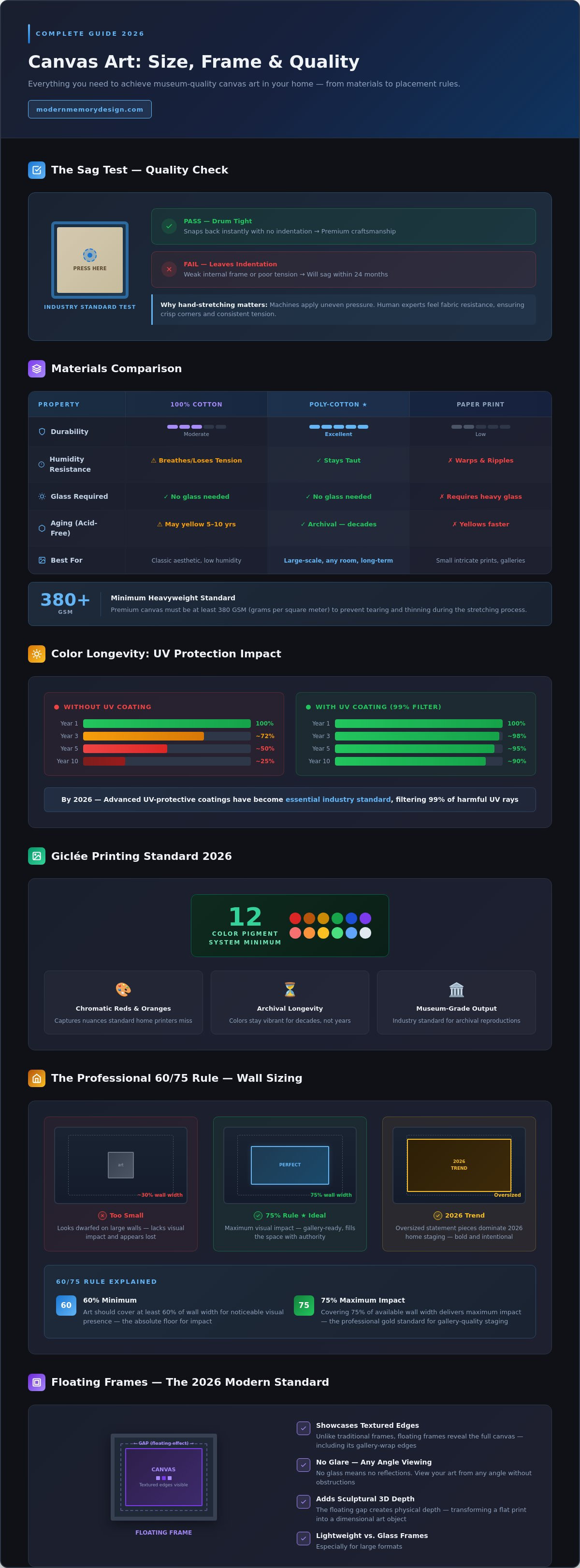
Choosing the right dimensions for your canvas art is just as critical as the image itself. To avoid a piece looking lost or overwhelming, follow the 60/75 rule. This industry standard dictates that your artwork should occupy 60% to 75% of the width of the furniture it hangs above, such as a sofa or a headboard. If you have an 80-inch sofa, aim for a canvas or a grouping that spans 48 to 60 inches. This ensures your decor feels anchored rather than floating aimlessly on the wall.
In 2026, the dominant trend in professional home staging is the "Oversized" look. Designers are moving away from clusters of small frames in favor of massive, single-impact pieces. A 48x72 inch canvas creates an immediate focal point that makes a room feel larger and more intentional. You can still maintain a cohesive aesthetic by mixing these large elements with standard picture frame sizes for a curated, layered effect that adds visual interest to your home.
Don't forget the breathability factor. White space is essential for visual comfort. Aim to leave at least 6 to 10 inches between the bottom of the frame and the top of your furniture. If the art is too high, it disconnects from the room; if it's too low, it feels cramped. Professional installers typically hang the center of the piece 57 to 60 inches from the floor to meet eye level.
The scale of your room should dictate your choice. A 24x36 canvas is a versatile workhorse that provides significant impact in small hallways or entryways without crowding the walkway. However, for great rooms or spaces with 10-foot vaulted ceilings, you'll need 30x40 inches or larger to maintain a sense of proportion. At Modern Memory Design, we see a 40% increase in requests for large-format prints as homeowners embrace open-concept living.
A gallery wall doesn't have to be uniform. You can create a sophisticated look by mixing textures. Pair the matte, tactile surface of canvas art with the polished look of framed photography under UV glass. This contrast adds depth that a single medium cannot achieve. For layout inspiration and technical tips, follow our step-by-step guide on how to create a stunning gallery wall.
To keep the arrangement from looking cluttered, maintain a strict 2 to 3-inch gap between every frame. This consistent spacing is what separates a DIY project from a professional installation. It provides enough room for each piece to stand alone while still functioning as part of a collective masterpiece. Using a level and painter's tape during the process ensures your 2026 gallery wall looks sharp and intentional.
Ready to find the perfect dimensions for your space? Shop our custom canvas sizes to get a handcrafted fit for your home.
At Modern Memory Design, we live by a "Handmade For You" philosophy. Every project starts as a digital file or a raw artist's canvas and transforms into a finished masterpiece inside our New Jersey workshop. We don't rely on mass production. Instead, our expert framers handle each piece with the care it deserves. By keeping the entire process in-house, we maintain total control over the quality of your canvas art from the first print to the final backing.
The Print and Frame advantage gives you professional-grade results without the guesswork. We use premium canvas materials and archival inks that resist fading for over 75 years. Our services include:
Transforming a digital memory into a physical heirloom is now a seamless process. Our online photo printing platform uses advanced color calibration to ensure the tones on your screen match the final product perfectly. You can select a custom frame and preview the results in less than 3 minutes. Our Bergen County workshop acts as the heart of our operations. Here, every frame is hand-assembled and inspected against strict quality standards before it leaves our doors. This local oversight ensures that your canvas art arrives exactly as you envisioned it.
We provide specialized support for clients throughout the Tri-State area. For residents in New Jersey, New York City, and Connecticut, we offer a professional picture hanging service. This is a critical resource for heavy canvases that require secure wall anchors and precise leveling. Because every frame is Made in the USA, we avoid the long transit times and potential damage associated with international shipping. Our local roots allow us to deliver a level of craftsmanship that big-box retailers can't match. Visit our Hasbrouck Heights shop to see our molding selection in person, or order your custom canvas today through our digital storefront.
Choosing the right canvas art requires a balance of high-quality materials and precise installation. You've learned that museum-quality archival materials and UV protection are vital to prevent fading over time. A professional floating frame adds the necessary depth to make your piece stand out; meanwhile, correct scaling ensures the art fits your room's dimensions perfectly. At Modern Memory Design, we handle every step of this process with an artisan's touch. Our experts perform hand-stretching on every order within our New Jersey workshop to guarantee a tight, gallery-ready finish. For clients in NJ, NYC, and CT, we also offer professional hanging services to ensure your new focal point is level and secure. We don't just create prints. We build lasting pieces of home decor that tell your unique story through superior American craftsmanship. It's time to move your best photos from your screen to your walls with confidence.
Transform your favorite memories into custom canvas art today
We look forward to helping you create a masterpiece that your family will cherish for years to come.
Use a dry, soft microfiber cloth or a soft-bristled brush to gently wipe away dust from the surface. Avoid using water or chemical cleaners, as liquids can smear the archival inks used in high-quality canvas art. For stubborn spots, a slightly damp cloth with filtered water is the maximum limit. Professional restoration is recommended for 100% of deep stains to ensure the integrity of the piece remains intact.
Yes, natural fluctuations in humidity can cause canvas to lose tension over several years, but it's easily fixable. Most professional frames use wooden stretcher bars with adjustable keys in the corners. You can tap these keys to tighten the fabric instantly. If your frame lacks these, our NJ workshop can restretch the material onto a new kiln-dried frame to ensure it stays taut for 50 years or more.
You don't need glass or acrylic because canvas is a breathable material that requires constant airflow to prevent mold growth. Modern pieces are typically finished with a UV-protective coating that blocks 99% of harmful rays. Adding glass can trap moisture between the surface and the glazing. This often leads to visible damage over a 5 to 10 year period in humid environments.
A gallery wrap features the image or a solid color wrapped around the sides of 1.5-inch thick stretcher bars, hiding the staples on the back. In contrast, a studio wrap uses thinner 0.75-inch bars and is intended to be placed inside a traditional frame. Gallery wraps are ready to hang immediately. Studio wraps are the industry standard for 90% of custom framing projects that require an outer border.
Yes, you can transform high-resolution digital files into museum-quality canvas art using our professional large-format printing services. We recommend a minimum resolution of 300 DPI to ensure your 24x36 inch prints remain sharp and clear. Our team checks every file to ensure the 8.3 million pixels in a standard 4K photo translate perfectly to the textured surface of the cotton material.
Most custom canvas stretching and framing orders are completed within 4 to 6 business days at our local workshop. This timeline includes the precise hand-stretching of your art and the assembly of your chosen wood molding. Shipping adds another 2 to 5 days depending on your location. We offer local pickup for our New Jersey customers to save time and ensure the safest possible transport of your order.
Canvas isn't recommended for bathrooms where humidity levels frequently exceed 60% because the cotton fibers can absorb moisture and expand. This absorption leads to warping of the wooden frame or potential mildew growth on the back of the fabric. For kitchens, keep the art at least 10 feet away from stovetops. This distance prevents grease buildup that ruins the ink over time.
A floating frame is a style where the artwork sits inside a wooden border with a 0.25-inch gap between the art and the frame edge. This creates the illusion that the piece is suspended in mid-air within the frame. It's recommended because it protects the corners of the fabric while allowing 100% of the image to remain visible without being covered by a traditional frame lip.
{"one"=>"Select 2 or 3 items to compare", "other"=>"{{ count }} of 3 items selected"}