
Made in America (NJ)
for your Wall Decor
Handcrafted Picture Frames

The most expensive frame in the world can't save a photo if the matting looks cheap or outdated. You've likely spent hours picking the perfect artwork, only to feel paralyzed by the math of mat openings or the fear of picking a color that will yellow your print within a few years. It's frustrating when you want a gallery-quality finish for your home but aren't sure how to avoid an amateur look that detracts from your decor.
Learning how to choose the right picture frame mat is about more than aesthetics; it's about preserving your legacy. At Modern Memory Design, our New Jersey artisans believe every piece deserves the same care as a museum masterpiece. We understand you want protection for your sentimental items without the confusion of complex measurements. This guide will show you how to master the art of matting using professional design secrets, from selecting archival materials like 100% cotton rag to nailing the math for a perfect fit. You'll learn exactly how to order a custom mat online that protects your memories and makes your artwork pop.
A picture frame mat is much more than a decorative border. It's a precision-engineered component that sits between your artwork and the glass. When you're learning how to choose the right picture frame mat, you must consider two primary elements: the "window" and the "border." The window is the actual opening cut into the center where your image is displayed, while the border refers to the width of the matting material surrounding that image. At Modern Memory Design, we treat every mat as a functional tool that balances visual appeal with long-term preservation.
Many people ask, What is a picture frame mat? and assume it's purely for style. While it does provide a finished look, its structural role is equally important. It serves as a physical barrier that prevents your art from coming into direct contact with the glazing. This is vital because environmental changes can cause paper to ripple or ink to soften. Without a mat, your memories are vulnerable to the elements trapped inside the frame.
A mat transforms a simple photograph into a masterpiece of design by providing "breathing room." This empty space allows the viewer's eye to rest before focusing on the details of the artwork. If you place a print directly into a frame without a mat, it often results in a "retail look" that feels cramped or temporary. In contrast, a "gallery look" typically utilizes wider matting to give the piece a sense of importance and scale.
Professional framers use mats to bridge the gap between the art's style and your room's decor. If you have a modern, high-contrast photo but a traditional home, a neutral mat can soften the transition. This intentional design choice makes the artwork feel like it belongs in the space rather than just hanging on the wall. It's an easy way to add sophistication to any room in your house.
The most important reason to use a mat is protection. When artwork touches the glass, it's susceptible to "ferrotyping," a process where the image surface sticks to the glass. This often happens in humid environments and can lead to the total destruction of the print if you ever try to move it. A mat creates a pocket of air that prevents this bonding and allows the paper to breathe as it reacts to temperature shifts.
The spacer function is the critical role of any 4-ply mat, acting as the primary defense against environmental damage. By creating this small but significant gap, you ensure that your sentimental items remain in pristine condition for the next generation.
Selecting a color is often the most stressful part of the process, but the "Third Color Rule" simplifies the decision. Instead of matching the most dominant color in your artwork, look for the third most prevalent shade. If you have a landscape with a blue sky and green grass, look for the tiny hint of ochre in a field or the soft grey in a cloud. Matching the primary color often makes the artwork disappear into the border. By pulling out a subtle detail, you create a visual conversation between the piece and the frame. This technique is a fundamental secret of how to choose the right picture frame mat without making the final product look "cheap" or dated.
The core of the mat board also plays a significant role in the final aesthetic. When we cut a mat at our New Jersey workshop, the 45-degree bevel reveals the "core" color. A white core provides a crisp, clean pinstripe around your image. Conversely, a black core mat creates a bold, dark outline that adds immediate drama and depth. Professional designers often use black cores for high-contrast photography or modern digital prints to emphasize sharp lines and provide a sophisticated, layered look.
Neutrals aren't just "white." A cool, bright white is the standard for modern photography and black-and-white prints, providing a high-contrast, clinical finish. For vintage documents or sepia-toned photos, a warm cream or "off-white" is necessary to prevent the art from looking yellowed or dirty by comparison. When selecting these materials, it's helpful to review professional mat board specifications to ensure the pigments are light-fast and won't fade over time. Grey remains the secret weapon for vibrant, multi-colored pieces. It acts as a visual "reset," allowing the colors in the art to pop without competing for attention.
While paper mats are standard, specialty textures like linen and suede offer an elevated, custom look that standard retail frames simply can't match. Linen mats provide an organic, woven feel that complements botanical prints or oil-on-paper works. Suede mats, with their deep, light-absorbing nap, create a sense of luxury perfect for shadow boxes or valuable collectibles. For formal items, such as those found in our diploma framing collection, metallic mats with gold or silver leaf edges provide a prestigious border that signifies achievement. These textures add a tactile dimension that draws viewers in, making your display feel like a curated gallery installation rather than a simple wall decoration.
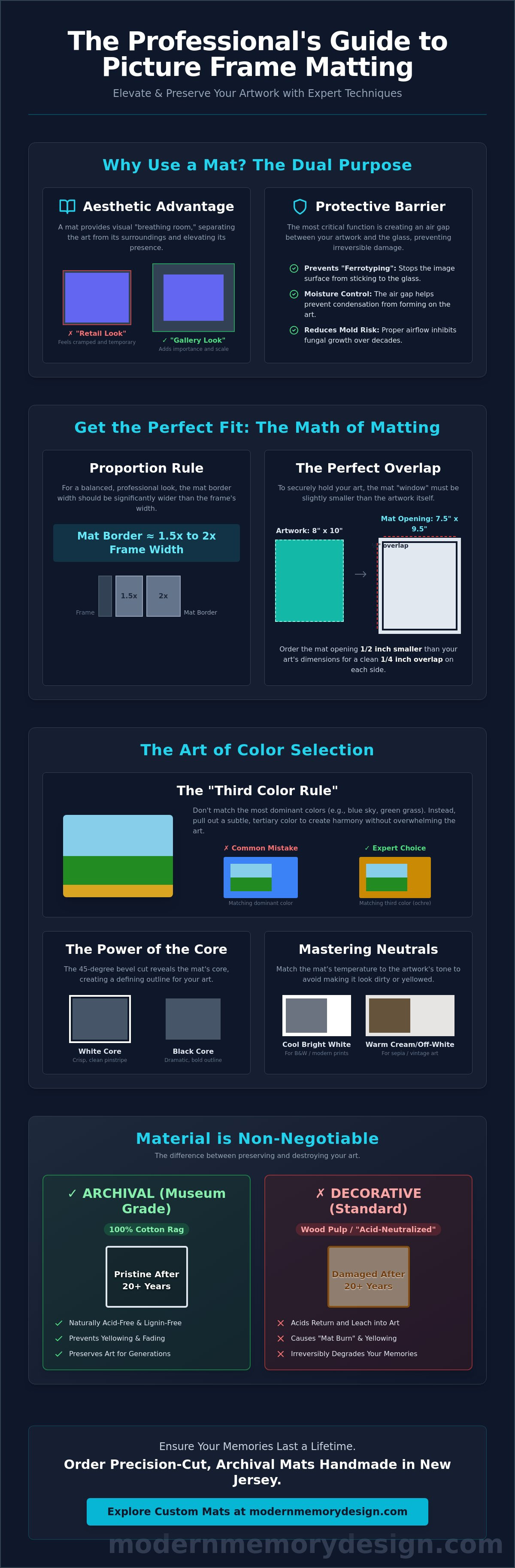
Calculating the correct dimensions is often the most intimidating part of learning how to choose the right picture frame mat. To achieve a balanced look, you must follow a simple formula: (Print Width + Mat Width x 2) = Total Frame Size. If you have an 8x10 inch photo and want a 2-inch mat border, your final frame size will be 12x14 inches. This ensures the matting is even on all sides, providing the visual "breathing room" discussed in previous sections. At our New Jersey workshop, we use digital precision to ensure these cuts are perfect to the millimeter, preventing the lopsided look common in mass-produced retail frames.
One critical technical detail is the "overlap." A professional mat opening is always cut 1/4 inch smaller than the actual print size. For an 8x10 print, the mat window is typically cut to 7.5x9.5 inches. This 1/8 inch overlap on every side ensures the mat rests securely on top of the image, hiding the paper edges and preventing the artwork from falling through the opening. Without this overlap, you'd see the white edges of the photo paper or gaps where the art meets the mat board.
For those seeking a traditional gallery finish, consider "bottom-weighting." This technique involves making the bottom border of the mat slightly wider than the top and sides. Our eyes naturally perceive the bottom of a frame as narrower than the top due to an optical illusion. Adding an extra 1/2 inch to the bottom border corrects this perception and gives the piece a grounded, professional appearance. As a general rule of thumb, your mat border should be at least 1.5 to 2 times the width of the frame molding to prevent the frame from "overpowering" the art.
Matching your print to the right frame size doesn't have to be guesswork. Use this guide for standard pairings that create a balanced aesthetic:
For more detailed dimension context, you can explore our Standard Picture Frame Sizes guide. When you're working with large-scale art, such as posters or oversized photography, don't be afraid to jump to a 3 or 4-inch mat border to maintain the sense of scale.
A double mat involves stacking two boards to create a 1/4 inch "reveal" of a second color around the artwork. This is a popular choice for diploma framing or sports jerseys, where you can use a secondary school or team color to add a professional "pop." It's important to remember that double matting adds 1/8 inch to the total thickness of the stack. This extra depth creates a beautiful bevel effect that draws the viewer's eye directly into the center of the piece, making the memories feel more substantial and layered.
Don't be fooled by the "acid-free" sticker found on mass-market retail frames. This term is often a marketing myth. Most cheap mats are made from wood pulp that has been chemically treated to neutralize acids. Over time, the natural lignin in the wood pulp returns to an acidic state, leading to what experts call "acid burn." You'll recognize this by the tell-tale yellow or brown stains appearing on the mat's bevel edge or the artwork itself. Brittle edges that snap easily are another sign of low-quality materials. At Modern Memory Design, we prioritize materials that stay pristine for decades, not just months.
Understanding the chemical makeup of your materials is the most technical part of how to choose the right picture frame mat. Professional framers distinguish between alpha-cellulose and cotton rag. Alpha-cellulose is wood pulp that has been purified to remove all lignin and acids, meeting the Library of Congress preservation guidelines for long-term storage. Cotton rag is the gold standard. It's naturally lignin-free and has been the preferred choice for museum-quality works for centuries. Choosing the right material ensures your sentimental items aren't slowly destroyed by the very frame meant to protect them.
Original art and limited edition prints demand 100% cotton rag matting to maintain their value. For maximum security, some archival mats incorporate zeolites, which are molecular traps that catch and hold airborne pollutants before they can reach the art surface. This level of protection is essential for items that will be displayed in rooms with high sunlight or city environments. If you want to dive deeper into preservation, check out our The Ultimate Guide to Framing for professional archival best practices.
Matboard thickness is measured in "ply." A standard 4-ply board is approximately 1.4 mm thick and provides the necessary air gap between art and glass. For a more sculptural look, many designers now choose 8-ply mats. At 2.8 mm thick, an 8-ply mat creates a deep, dramatic bevel that adds an immediate sense of luxury. While a 2-ply board is sometimes used for backing, it lacks the depth required for a window mat. If you want a bold contrast, the black core option offers a dark bevel edge. This creates a sharp, modern line that is especially effective for bright photography, as it prevents the image from bleeding into the mat.
Ready to protect your memories with museum-quality materials? Shop our archival-quality custom frames and give your art the professional finish it deserves.
At Modern Memory Design, we believe a frame is only as good as the hands that assemble it. Our Hasbrouck Heights workshop combines the speed of digital mat cutters with the discerning eye of an expert framer. While large retailers often prioritize speed over substance, our "Handmade For You" promise means every cut is inspected for flaws before it ever reaches your door. Knowing how to choose the right picture frame mat is the first step toward a gallery-quality display, but professional execution ensures those choices translate into a lasting legacy. We use only acid-free, museum-quality materials to guarantee your art remains protected from the common yellowing and brittleness discussed in previous sections.
Every project we handle is treated as a masterpiece of design and craftsmanship. Whether you are framing a family photo or a valuable collectible, our team ensures the matting provides the exact "breathing room" required for visual balance. We bridge the gap between digital convenience and local artisan quality, allowing you to order from the comfort of your home or visit our Bergen County shop for a personal consultation. This hybrid approach ensures that you never have to sacrifice professional expertise for the sake of convenience.
Our online platform is designed to make custom design accessible to everyone. You can use our interactive builder to visualize different mat and frame combinations in real-time. For those looking for a complete solution beyond just matting, our custom picture frames service provides a seamless way to finish your project. We offer free shipping on all orders and utilize an "expertly packed" guarantee. This ensures your custom glass and matting arrive in perfect condition, regardless of your location in the United States.
For clients in our local community, we provide a level of service that faceless online retailers cannot match. You can visit our workshop for one-on-one consultations on complex or oversized projects. This is especially helpful for high-value items like jersey frames, where the depth and mounting of the garment require an artisan touch. Our commitment to the NJ and NYC area extends to our professional picture hanging service, which is available across New Jersey, New York City, and Connecticut. Choosing a local, American-made frame shop ensures higher quality control and supports the craftsmanship of your own community.
Mastering how to choose the right picture frame mat is the definitive step toward achieving a professional gallery display. You've learned that a precision-cut mat is a functional shield that prevents moisture damage while the "Third Color Rule" ensures your art remains the focal point. By selecting archival, acid-free materials instead of cheap wood pulp, you ensure your memories remain vibrant for 75 years or more. These small but critical design choices create a cohesive look that elevates your entire home decor.
At Modern Memory Design, we bring these professional standards to every project. Our Bergen County, NJ local workshop uses only museum-quality materials to provide the ultimate protection for your sentimental items. Every piece is proudly handmade in the USA to your exact specifications, ensuring your custom mat fits perfectly down to the millimeter. We take the guesswork out of the process so you can focus on the stories behind the frames.
Design your custom mat and frame masterpiece at Modern Memory Design. Don't let your favorite prints stay hidden. Give them the professional finish they deserve and start decorating your space with confidence today.
A mat should typically be a different shade than the most dominant color in your artwork to create necessary contrast. Using a shade that is slightly darker can add immediate drama, while a lighter shade provides an airy, open feel. Following the "Third Color Rule" ensures that the matting complements the image without making the subject matter disappear into the background.
A professional mat covers exactly 1/8 inch of the artwork on all four sides, resulting in a total 1/4 inch reduction in the visible area. This overlap is required to secure the print and hide any uneven paper edges. When learning how to choose the right picture frame mat, remember that this small overlap ensures the artwork stays centered and doesn't fall through the window opening.
The most common border width for an 8x10 photo is 2 inches on all sides, which requires a 12x14 inch frame. This 2-inch standard provides enough visual breathing room to satisfy the traditional rule of making the mat wider than the frame molding. For a more dramatic gallery appearance, many designers increase the border to 3 inches, utilizing a 14x16 inch frame instead.
It's almost always better to frame a photo with a mat because it provides a necessary air gap between the art and the glass. This physical space prevents condensation and ink transfer, which can destroy a print over a 10-year period. Beyond protection, a mat adds a professional finish that makes a standard photograph look like a gallery-quality centerpiece.
You can add a mat to an existing frame if the "rabbet" or inner depth of the frame is at least 1/2 inch. Most standard frames have enough room for a 4-ply mat, which is approximately 1.4 mm thick. However, if your frame is very shallow, adding a mat might make it difficult to secure the backing clips without putting dangerous pressure on the glass.
The difference lies in the color revealed by the 45-degree bevel cut around the artwork. A white core mat stays crisp and bright indefinitely, while a cream core mat is made from wood pulp that may eventually yellow due to lignin content. For long-term preservation, our New Jersey workshop uses purified alpha-cellulose or cotton rag to ensure the bevel stays white for decades.
You should always use an archival-quality mat for a diploma to prevent the paper from yellowing over time. Since these documents are often made of heavy parchment or bond paper, a double mat is a popular choice to add depth and prestige. Using a 4-ply top mat with a 1/4 inch reveal of a secondary color is the industry standard for professional certifications.
Choose a neutral white or light grey mat to maintain the classic, high-contrast look of a black and white photo. A bright white mat makes the blacks in the photo appear deeper, while a dark grey or black mat can create a moody, modern aesthetic. Understanding how to choose the right picture frame mat for monochrome art involves matching the mat's "temperature" to the cool or warm tones of the silver halide or ink.
{"one"=>"Select 2 or 3 items to compare", "other"=>"{{ count }} of 3 items selected"}