
Made in America (NJ)
for your Wall Decor
Handcrafted Picture Frames

The frame often gets all the credit, but it’s the mat that does the real work. Think of it as the unsung hero of custom framing; a subtle yet powerful detail that can transform a simple picture into a professional display. It’s the single element that creates breathing room, draws the eye inward, and makes your art truly stand out.
We understand the hesitation. You’ve finally chosen the perfect piece of art, but now you’re facing a wall of color swatches and confusing terms like "opening size" versus "outer size." The fear of picking a color that clashes, or worse, discovering your cherished print has yellowed after just a few years, is completely valid. This is precisely why getting the matting right is so critical.
This guide will give you the confidence of an expert framer. We’ll demystify the entire process, showing you how to choose the perfect picture frame matting to achieve a stunning, gallery-quality look while ensuring your art is protected for decades. Get ready to learn how to select complementary colors, understand archival materials, and measure correctly for a flawless, custom fit every time.
Picture frame matting is far more than just a decorative border. At its core, it’s a thin, high-quality board, typically made from paper or cotton, placed between your artwork and the frame's glass. Its job is twofold: to enhance the visual presentation of your piece and to provide critical, long-term protection. While many resources offer a technical answer to What is Picture Frame Matting?, our expert framers see it as the essential bridge between your art and its final, polished display.
Think of the alternative: a "full-bleed" frame, where the artwork presses directly against the glass and extends to the very edge of the frame. While this style can work for certain posters or casual prints, it sacrifices the professional finish and vital protective qualities that matting provides. A matted piece feels complete and intentionally designed. It shows that care has been taken not just to hang the art, but to truly showcase it.
A well-chosen mat guides the viewer’s eye directly to the artwork, creating a clear focal point. For busy or highly detailed prints, the mat provides visual "breathing room," a quiet space that prevents the art from feeling cramped by the frame. This separation allows the details within the piece to stand out. Color is also a powerful tool; a mat can pull a subtle color from within your artwork to make it pop, or it can be chosen to match your room's decor, seamlessly integrating the framed piece into your home. For smaller photos, like a 4x6 print, placing it within an 8x10 mat instantly adds a sense of importance and value, transforming a simple snapshot into a cherished display.
The most crucial function of a mat is creating a small air gap, usually 1/16 to 1/8 of an inch, that separates the surface of your art from the glazing (glass or acrylic). This space is non-negotiable for preservation. Here’s why it matters:
Furthermore, professional picture frame matting made from archival, acid-free materials acts as a crucial barrier, absorbing atmospheric pollutants that could otherwise reach your art and cause it to yellow or degrade. True archival matting is your art's first line of defense against the environment.
The mat board is more than just a decorative border; it's the first line of defense for your artwork. The material you choose for your picture frame matting directly determines not only how your art will look in five years, but whether it survives for fifty. While a budget frame from a big-box store might look fine initially, its acidic paper components can cause irreversible damage over time.
The primary culprit is a compound called lignin, a natural polymer found in wood pulp. When exposed to UV light and air, lignin breaks down and releases acid. This process causes the tell-tale yellow or brown discoloration known as "mat burn," which can leach into your photograph or artwork, permanently staining it. Standard paperboard mats can contain up to 30% lignin, making them a poor choice for anything you want to preserve.
To avoid this, professional framers use two primary grades of high-quality mat board:
The term "acid-free" simply means the mat board had a neutral pH of 7.0 at the time of manufacturing. For true long-term protection, you need "archival" or "conservation-grade" mats. These are not only acid-free but are also buffered with an alkaline substance like calcium carbonate, raising the pH to around 8.5. This buffer actively neutralizes environmental acids that can attack your art over the years, ensuring it remains pristine.
The 45-degree bevel cut into a mat's window opening is a hallmark of professional craftsmanship. This angled cut reveals the mat's inner core, creating a fine line that frames the art. The precision required for a clean bevel is a skill that experts like the National Park Service detail in their guide on how to create window mats. The color of that core significantly impacts the final look:
Finally, consider the mat's thickness, or "ply." Standard 4-ply board is about 1.4 mm thick and offers a classic look. For added visual drama, an 8-ply mat (2.8 mm thick) creates a much deeper, more luxurious bevel, giving smaller artworks a greater sense of presence and importance. Choosing the right material is the first step in creating a piece that lasts. At Modern Memory Design, all our custom matting options are conservation-grade, ensuring your memories are protected with expert care.
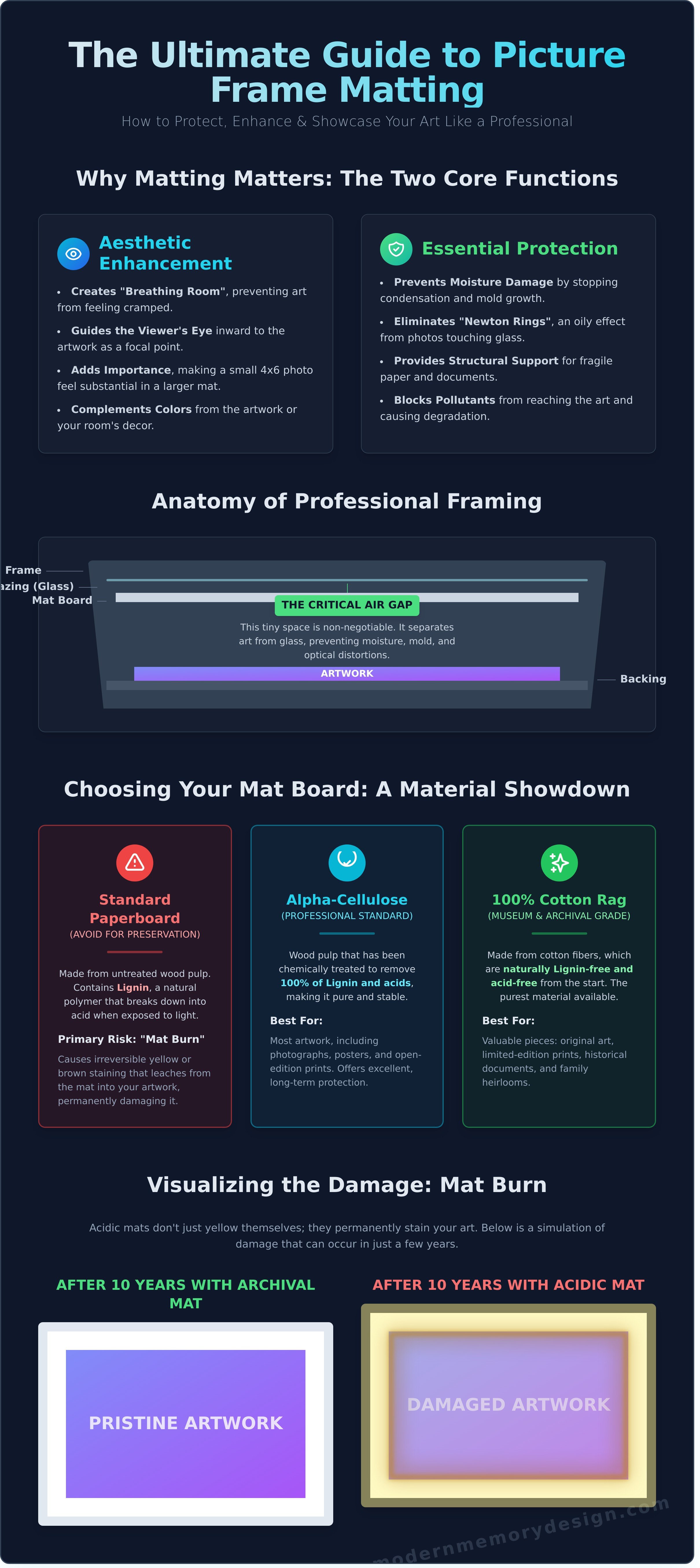
Once you’ve chosen the right material and color, the next step is selecting a design style. The right picture frame matting technique does more than just fill space; it directs the viewer’s eye, enhances the artwork’s features, and contributes to the overall presentation. Beyond pure aesthetics, proper matting creates a crucial air gap between your art and the glazing (glass or acrylic). This practice is essential for long-term preservation, a principle backed by the Library of Congress Preservation Guidelines, which detail the importance of using archival, acid-free materials to protect valuable pieces. Let’s explore four key styles to find the perfect match for your project.
Single Matting: The Classic Choice
A single mat is the most common and versatile option. It provides a clean, uninterrupted border that draws the eye directly to the artwork. This minimalist approach is the standard for modern gallery walls and professional photography exhibits because it doesn't compete with the art. A single, well-proportioned mat, typically in a neutral like white, off-white, or black, offers a timeless look that complements nearly any piece, from a vibrant abstract painting to a classic black-and-white photograph.
Double Matting: Adding Depth and Accent
A double mat uses two stacked mat boards, with the bottom mat showing just slightly to create a thin, decorative border around the artwork. This "reveal" introduces a secondary color, adds visual depth, and gives the final piece a more customized, high-end finish. It’s an expert technique for making your art truly stand out.
Double matting is exceptionally effective when you want to highlight a subtle color within your artwork. Using a bottom mat with a 1/4-inch or 1/8-inch reveal can pull out a specific hue, tying the art and frame together. For a dramatic "shadow" effect, place a darker mat (like charcoal) beneath a lighter one. You can also create a sophisticated look by pairing a metallic inner mat with a traditional wood frame, adding a touch of elegance to diplomas or classic portraits.
Multi-opening Mats: Telling a Cohesive Story
Do you have a collection of smaller, related images? A multi-opening mat is the perfect solution for creating a custom collage within a single frame. This style features multiple windows cut into one mat board, allowing you to display a series of family photos, travel snapshots, or small art prints together. It’s an organized and polished way to tell a visual story, turning a collection of moments into one impactful, handmade masterpiece.
Floating Mats: A Modern, Three-Dimensional Effect
For a truly unique presentation, consider a floating mat. In this technique, the artwork is mounted on top of the mat board using a hidden pedestal, making it appear as if it's levitating within the frame. This creates a distinct shadow and a three-dimensional effect that adds drama and sophistication. Floating is an ideal choice for artwork with deckled or unique edges that you want to display fully, rather than cover with a traditional mat.
The right picture frame matting strategy is key to a stunning gallery wall. For a structured, professional look, use uniform matting across all pieces, for instance, placing 8x10 photos in identical 11x14 frames. To achieve a high-art, museum-quality feel, try oversized matting. Placing a small 5x7 photo inside a large 16x20 frame with a wide mat creates negative space that commands attention and elevates the piece. For more inspiration, explore these Gallery Wall Ideas to Transform Your Space and see how matting can define your display.
Achieving a museum-quality finish starts with precise measurements. A mat that is even a fraction of an inch off can disrupt the entire presentation of your artwork. Fortunately, the process is straightforward when you follow the same four steps our expert framers use every day in our New Jersey workshop. Getting this right is the most critical part of custom picture frame matting.
Follow this expert guide to ensure your measurements are perfect every time.
Avoid the "Even-Border Trap," where all borders are exactly the same width. While it sounds logical, it can make the artwork appear to be sliding down. Instead, professional framers use a "weighted bottom," adding 10-15% extra width to the bottom mat border. For a piece with 3-inch borders on the top and sides, the bottom border would be approximately 3.3 inches, creating a subtle, grounded look. A good rule of thumb is to ensure your mat border is also wider than your frame molding; a 1.5-inch wide frame often pairs beautifully with a 2.5-inch mat or wider.
Precision is everything in custom framing. A single mistake can compromise the entire project. Here are the most common errors we see:
Getting these calculations perfect is key to a professional result. If you want guaranteed precision, let our expert framers handle the math for you when you upload your photo for custom framing.
After learning about the principles of matting, the final step is bringing your vision to life. While standard options exist, true preservation and aesthetic harmony come from custom solutions. It’s the difference between simply hanging a picture and creating a professionally curated display. At Modern Memory Design, every mat is handmade for you, right here in our New Jersey workshop. We move beyond the limitations of pre-cut, off-the-shelf products to offer a service where precision, quality, and your unique vision are the only priorities.
Big-box stores offer a limited menu. We offer a design studio. Our commitment to true customization means you are never forced to compromise. We believe your art should dictate the mat's dimensions, not the other way around. With us, you get exactly what you need:
The Modern Memory promise is simple: every order receives the same museum-quality treatment. We exclusively use 100% acid-free and lignin-free mat boards from the industry's most trusted suppliers. This isn't an optional upgrade; it's our standard for every piece of picture frame matting we produce. These archival materials actively prevent the yellowing and acid burn that can permanently damage your art over time, ensuring its value and vibrancy are preserved for generations. Your memories deserve nothing less.
Our professional framers approach each project as a masterpiece of design. We pair advanced digital cutting technology with the trained eye of an experienced artisan. It's not just about cutting a board; it's about understanding the balance, proportion, and color theory that make a framed piece truly memorable. This dedication to craft is why customers across the NJ/NYC area trust us with their most complex picture frame matting projects. Our heritage as a local NJ frame shop, with our workshop proudly based in Hasbrouck Heights, Bergen County since 2011, is built on this foundation of expertise and trust.
Ready to get started? Ordering your custom mat or fully matted frame online takes just a few minutes. For a complete, seamless solution, our "Upload & Frame" service is the perfect choice. Just upload your digital photo, and our interactive design tools will help you visualize the final piece with different mat and frame combinations in real-time. If you have a unique item like a sports jersey, diploma, or treasured family object, contact our team directly. We specialize in creating custom matting solutions for these challenging and meaningful projects.
Don't let a generic mat detract from your art. Elevate your piece with a custom-cut, archival-quality mat made with passion and precision. Explore our options and begin designing your perfect frame today.
Shop Custom Frames with Professional Matting
You now have the professional knowledge to elevate your artwork. You understand that a mat does more than create a visual border; it creates a vital air gap that protects your piece from moisture damage for years. You also know that material choice is critical, with archival boards offering long-term preservation that standard paper simply can't match. Putting this knowledge into practice is the final step, and professional picture frame matting ensures a flawless result every time.
At Modern Memory Design, our expert framers turn these principles into practice daily. Every custom frame is handmade in our New Jersey workshop using only 100% archival-quality, acid-free materials to guarantee your art is preserved for decades. With free shipping on all custom orders, there's no better time to give your art the stunning, museum-quality presentation it deserves. Design Your Custom Matted Frame at Modern Memory Design today.
There isn't one single standard width for picture frame matting; the ideal size depends on your artwork. However, a common range is between 2 and 3.5 inches. For a standard 8x10 photo, a 2.5-inch mat provides excellent balance. The goal is to give the artwork breathing room without overwhelming it. Our expert framers can recommend the perfect custom width to ensure your piece looks professionally balanced and visually appealing in its final presentation.
A mat should almost always be lighter than the artwork. Using a neutral, off-white, or cream-colored mat is a classic technique used in over 90% of professional framing projects. This approach draws the viewer's eye inward to the art itself. While a dark mat can create a bold, dramatic effect for specific pieces, it risks overpowering the image. Choosing a light, complementary neutral is the safest way to enhance your art without competing with it.
A mat should overlap your picture by 1/4 inch on all sides. This industry-standard overlap is crucial for securing the artwork and ensuring its edges don't show. For example, if you have an 8x10 inch photograph, the mat's window opening should be precisely cut to 7.5x9.5 inches. This small overlap provides a clean, professional border and prevents the artwork from slipping or showing any unprinted edges over time.
The key difference is the material's composition and its long-term archival quality. Acid-free, or conservation-grade, mats are made from wood pulp (alpha-cellulose) that is chemically treated to neutralize acids and will protect art for over 100 years. Museum-grade matting is made from 100% cotton rag, which is naturally acid-free and lignin-free. It offers the highest level of protection available, lasting for several hundred years, and is specified for priceless or historically significant works.
Yes, you can add a custom-cut mat to a frame you already own. The most important factor is the frame's rabbet depth, which is the channel where the glass, mat, and backing board sit. You must ensure the frame is deep enough to hold the new, thicker package without putting pressure on the glass. A typical 4-ply mat is about 1/16-inch thick. We can easily cut a new mat to fit your art and your existing frame's dimensions.
A "weighted bottom" is a professional design choice where the bottom border of the mat is intentionally made wider than the top and side borders. This technique creates a subtle visual anchor, preventing the artwork from appearing to slide down within the frame. The bottom border is typically made 15-20% wider than the other sides. For a mat with 2-inch borders, a weighted bottom would be approximately 2.5 inches, adding a classic, gallery-quality finish.
Never use liquid cleaners, as they will stain and warp the paper matboard. For light surface dust, a can of compressed air held at a distance is the safest method. For minor smudges or pencil marks, use a special-purpose dry cleaning pad or a white vinyl eraser. Gently rub the affected area to lift the mark without abrading the mat's surface. Always test on an inconspicuous spot first to ensure it doesn't alter the color.
Yes, a double mat will require a frame with a slightly deeper rabbet to accommodate the extra thickness. A standard 4-ply matboard is about 1/16-inch thick, so using two boards doubles that thickness to 1/8-inch. This extra depth is added to the total "stack" of glass, artwork, and backing. Most quality frames can handle it, but it's essential to ensure the frame's rabbet is at least 1/2-inch deep for a secure, professional fit.
{"one"=>"Select 2 or 3 items to compare", "other"=>"{{ count }} of 3 items selected"}