
Made in America (NJ)
for your Wall Decor
Handcrafted Picture Frames

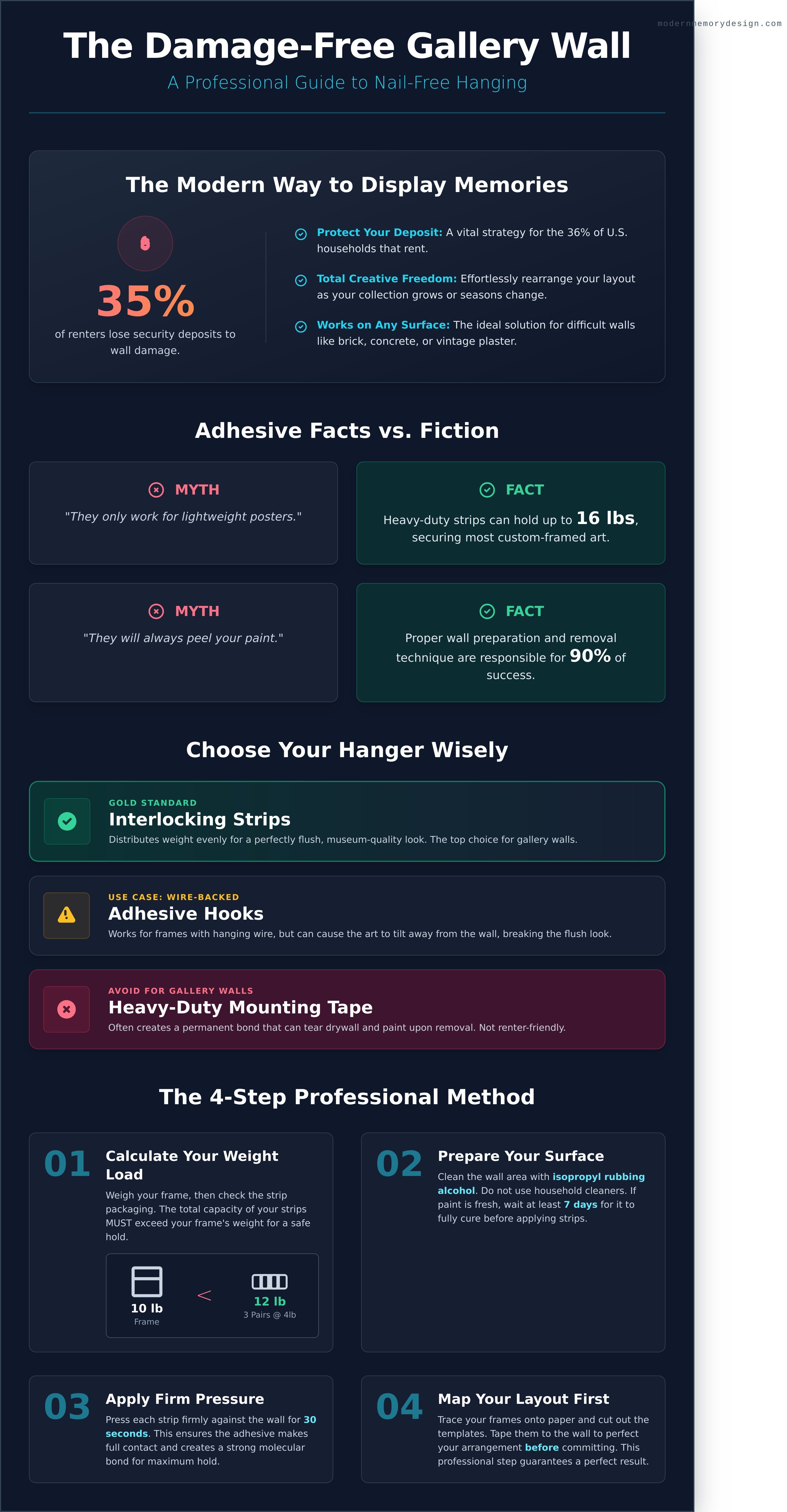
Did you know that an estimated 35% of renters forfeit a portion of their security deposit due to wall damage from nails? It’s a frustrating reality. You’ve invested in beautiful, handmade custom frames to showcase your memories, but the thought of drilling holes, patching plaster, and getting the spacing just right feels completely overwhelming. The fear of a treasured frame crashing down is enough to leave your walls bare.
That’s why we've created this definitive 2026 guide. We'll show you exactly how to design, map out, and securely hang a stunning gallery wall without nails, giving you the confidence to display even your most valuable pieces with professional, damage-free results. From selecting the right adhesive hooks for specific frame weights to creating a flawless layout with paper templates, you'll learn the expert techniques we use in our own New Jersey workshop to achieve a perfectly level, museum-quality display.
A gallery wall does more than just decorate a room; it turns your space into a personal narrative, showcasing your memories, travels, and artistic taste. For years, the hammer and nail were the default tools for this project, often leading to hesitation and a wall full of commitment. Today, a shift towards damage-free decor empowers homeowners and renters alike to create stunning displays without the permanent marks. Opting for a gallery wall without nails isn't about compromise; it's a strategic choice for modern living.
The benefits are immediate and practical, especially for the 36% of U.S. households that rent. With the average security deposit often equal to a full month's rent, avoiding wall damage from nails is a direct investment in getting your money back. Beyond finances, this approach offers unparalleled creative freedom. You can easily adapt your layout as your collection of art and photos grows, or refresh your decor with the changing seasons. This flexibility also solves a common problem for those with challenging wall surfaces. Homes with brick, concrete, or vintage plaster walls make drilling a difficult, and often irreversible, task. A nail-free method bypasses these obstacles completely.
Your curated wall is a visual journal, a tangible collection that preserves your "Modern Memory." Each piece tells a story, and the arrangement itself communicates a unique personality. The fear of making a permanent mistake, like a misplaced nail hole, can be a significant barrier that stops many people from starting. A damage-free approach removes that pressure, transforming the project from a stressful commitment into an enjoyable, creative process.
The idea of trusting your treasured, custom-framed pieces to an adhesive strip can feel uncertain, but today's products are engineered for reliability. Let's address two common myths:
The success of these products is rooted in science. Modern adhesive hanging technology relies on creating a strong, stable molecular bond between the strip and the wall surface. Achieving this bond means proper wall preparation is responsible for 90% of your success. For a flawless application, always clean the surface with isopropyl rubbing alcohol to remove any dust or oils. If your walls are freshly painted, wait at least seven days for the paint to fully cure before hanging anything. When you apply the strip, press firmly for about 30 seconds to ensure the adhesive makes full contact. This meticulous approach ensures your gallery wall without nails is both beautiful and secure.
Creating a beautiful gallery wall without nails isn't magic; it's a matter of applied physics. The success of any damage-free display hinges on understanding the forces at play and choosing technology designed to work with them, not against them. At the core of modern adhesives are two key principles: tensile strength and shear force. Tensile strength is the resistance to a force pulling straight out from the wall, while shear force is the resistance to a force sliding down the wall's surface. Picture-hanging strips are engineered for immense shear strength to counteract gravity, but lower tensile strength. This is why you can remove them cleanly by pulling the tab down along the wall, breaking the bond without tearing off paint.
Understanding this science helps you select the right product. Adhesive hooks, strips, and mounting tapes are not interchangeable. While hooks work for wire-backed frames, they can cause art to tilt away from the wall. Heavy-duty mounting tape often creates a permanent bond that can damage drywall upon removal. For a flush, professional-looking gallery wall, interlocking picture-hanging strips are the gold standard. They distribute weight evenly and keep your frames perfectly flat against the surface.
Always check the packaging for weight ratings, but read the details carefully. A package rated to hold "up to 16 pounds" typically contains four pairs of strips. This means each individual pair is rated for only 4 pounds. A common mistake is using only two pairs for a 10-pound frame. For maximum security, weigh your framed art and use enough strip pairs to exceed that weight. For that 10-pound frame, you should use three or even four pairs to build in a reliable safety margin.
Beyond standard adhesives, several expert tools can achieve a sophisticated look. For a versatile and robust solution, consider these options:
The effectiveness of any adhesive is only as good as the surface it's on. On textured walls, like those with an "orange peel" finish, the adhesive's surface contact can be reduced by as much as 50%, weakening its hold. To counteract this, always clean the specific spot with isopropyl alcohol and press the strip firmly for at least 30 seconds. For "difficult" surfaces like unpainted brick, concrete, or vinyl wallpaper, standard strips will likely fail. You'll need to seek out specialty adhesives or opt for a non-adhesive solution like a picture rail.
Finally, patience is critical. After applying the wall-side strip, you must wait before hanging your frame. While some believe a 24-hour period is necessary, 3M officially recommends waiting just one hour for the adhesive to build a sufficient bond with the wall. This curing time is non-negotiable for a secure hold. In high-humidity environments, like a bathroom, this becomes even more important. Standard adhesives can fail in steamy conditions, so look for water-resistant products rated for temperatures up to 125°F to ensure your art stays put. The right hanging method is just as important as the art itself, and choosing lightweight, expertly crafted frames can make the entire damage-free process even simpler.
The secret to a secure, long-lasting gallery wall isn't just the adhesive you choose; it begins with the frame itself. Before you even think about hooks or strips, you must consider the weight and construction of your frames. The most common mistake is selecting a beautiful, heavy frame that overloads the adhesive, leading to a crash in the middle of the night. True success in creating a gallery wall without nails comes from striking a perfect balance: achieving a "museum quality" aesthetic without the museum-level weight.
At Modern Memory Design, we've spent years perfecting this balance. Our custom frames are handcrafted by experts in our New Jersey workshop, not just for their visual appeal, but for their structural integrity and practical weight. We help you choose materials that ensure your art stays on the wall, not on the floor.
Your frame's material is the single most important factor in its final weight. While a heavy, ornate frame has its place, it's not suited for adhesive solutions. For a damage-free display, you need to think light and strong. Here’s a quick comparison of common choices:
The biggest weight culprit in any frame isn't the molding; it's the glazing. Swapping traditional glass for acrylic is the most effective way to reduce weight without sacrificing quality. A 2mm thick sheet of standard glass weighs about 1.02 lbs per square foot. In contrast, a high-quality acrylic sheet of the same thickness weighs just 0.49 lbs per square foot, cutting your glazing weight by over 50%. Modern acrylic offers crystal-clear viewing with 92% light transmission and the added benefit of being shatter-resistant, providing superior protection for your artwork.
For an adhesive strip to work, it needs maximum surface contact. A frame's backing must be completely flat and smooth. Our expertly crafted custom picture frames are built with solid, smooth backing that is ideal for any hanging method. Before applying adhesives, always remove pre-installed hardware like sawtooth hangers, D-rings, or hanging wire. These create an uneven surface and a pivot point, concentrating the frame's weight on a small area and guaranteeing failure for your gallery wall without nails.
A successful gallery wall without nails depends entirely on meticulous planning and installation. Rushing this stage is the number one reason damage-free displays fail. At Modern Memory Design, we treat every installation with expert precision, and you should too. The secret is a simple but effective technique we call the "Floor First" method, which ensures your vision translates perfectly from concept to reality.
Before a single adhesive strip touches your wall, lay all your framed pieces on the floor. This gives you a full-scale preview of the final composition, allowing you to experiment with arrangements, spacing, and flow without consequence. You can see how textures and colors interact, ensuring a balanced and professional result long before the final commitment.
Start by deciding between a structured grid or a more free-flowing organic cluster. For adhesive-based installations, a grid layout is often easier to execute, as it relies on straight, measurable lines. Organic layouts require a more artistic eye to feel balanced. Whichever you choose, maintain consistent spacing. A good rule of thumb is the "2-inch rule," keeping a gap of 2 to 3 inches between each frame to prevent a cluttered look. Once you've perfected your floor layout, create paper templates by tracing each frame onto kraft paper or newspaper. Tape these templates to the wall to create a flawless guide for installation.
With your paper templates in place, you are ready for a professional, damage-free installation. Follow these four steps precisely for a bond that lasts.
Starting with the right materials is just as important as the process. Lightweight yet durable frames put less stress on adhesives, guaranteeing a longer-lasting display. For a masterpiece of design and craftsmanship, explore our collection of custom, handmade frames built right here in our NJ frame shop.
You’ve learned about the best adhesive strips and clever hooks, and for many standard frames, they are a fantastic, damage-free solution. But what happens when your vision gets bigger? What about that oversized abstract art for the foyer, the sentimental value of a heavy sports jersey, or a perfectly symmetrical nine-frame grid? While creating a gallery wall without nails is achievable for lighter items, there are moments when DIY solutions reach their practical and safe limits. For projects that demand precision, security, and a flawless finish, professional expertise is not a luxury; it’s a necessity.
Consider one of our most popular custom pieces: a Jersey Shadow Box. These keepsakes are heavy, often weighing between 12 and 20 pounds, and hold irreplaceable memorabilia. Trusting an adhesive strip rated for 16 pounds in ideal lab conditions is a significant risk. Factors like wall texture, humidity, and time can degrade the bond, leading to a crash that can destroy the frame, the memorabilia, and your wall. Professional installation uses hardware, like security hangers anchored directly into wall studs, ensuring your cherished items are safe and secure for years to come. That’s why we offer a dedicated, expert hanging service for our clients across New Jersey, New York City, and Connecticut.
Oversized frames, especially those exceeding 30x40 inches, require specialized hardware to prevent warping and ensure they hang perfectly flush. Our technicians use professional-grade tools, including laser levels that guarantee every frame in a grid is aligned with precision down to 1/16 of an inch. Forget the hassle of a tape measure, pencil marks, and a wobbly level. We ensure your large-scale gallery wall is a perfect, museum-quality installation. For these complex projects, our Professional Picture Hanging Service delivers peace of mind and impeccable results.
A truly breathtaking gallery wall starts with a cohesive vision, not just with how it’s hung. We make achieving that vision simple with a complete, turnkey solution. Our "Upload & Frame" service allows you to transform your digital photos into a unified collection of beautifully framed art. You select the photos, and we handle the archival-quality printing and custom framing. Every frame is handmade right here in our Bergen County, NJ, workshop, ensuring a level of craftsmanship that mass-produced frames can’t match. This "Made in the USA" quality means your gallery wall without nails will not only look stunning but will also be built to last, protecting your memories with acid-free materials and UV-protective glass.
Why juggle different vendors for printing, framing, and installation? We bring it all together for a seamless experience from start to finish. Let us help you create a display that reflects your style with the quality it deserves.
Start building your custom gallery wall today!
You're now equipped with the expert knowledge to transform your space. The two most important takeaways are meticulous planning and trusting the technology. Modern adhesive strips, now engineered with a 99% damage-free removal rate and holding capacities up to 16 pounds, have truly revolutionized home decor. With these tools and techniques, you can confidently create a stunning gallery wall without nails that reflects your unique style and can be changed whenever inspiration strikes.
While a DIY approach is rewarding, partnering with a professional ensures a flawless, lasting result. For a truly elevated finish, consider the expert NJ-based craftsmanship of Modern Memory Design. Every single frame is handmade in the USA, built with museum-quality archival materials designed to protect your art and photos for generations. We don't just build frames; we preserve your most important memories with meticulous care.
Create your custom masterpiece with Modern Memory Design and let our passion for quality bring your vision to life. Your beautiful, damage-free walls are just a click away.
The total weight depends on the adhesive strips used for each frame. High-quality strips, like the Command™ Large Picture Hanging Strips, can hold up to 16 pounds per frame when four pairs are used correctly. To find your wall's total capacity, you must calculate the load on a frame-by-frame basis. Always consult the manufacturer's packaging for specific weight limits, as using a product rated for 5 pounds on a 10-pound frame will eventually fail.
Adhesive strips may damage delicate surfaces like vinyl or fabric wallpaper upon removal. For painted walls, it is critical to allow fresh paint to cure for at least 7 days, though waiting 28 days is recommended by most paint manufacturers. Applying strips too early can cause the paint to peel during removal. We always advise testing a strip in a hidden spot, like behind furniture, to ensure it won't harm your specific wall surface.
You can use your smartphone as a highly accurate level. Most phones have a level function built into a "Measure" or "Compass" app, or you can download one of hundreds of free leveling apps. Another expert method is to stretch a piece of painter's tape across the wall where you want the tops of your frames to align. Use a tape measure to ensure both ends of the painter's tape are an equal distance from the ceiling.
Yes, you can hang moderately heavy wood frames using high-strength adhesive strips designed for the task. For frames weighing between 5 and 16 pounds, a product like Command™ Large Picture Hanging Strips is an excellent choice. Using four pairs per frame provides a secure hold up to that 16-pound limit. For any custom frame weighing over 16 pounds, we recommend using traditional hardware like stud-mounted hooks to ensure your art is displayed safely.
The best removal technique is to pull the exposed tab straight down, keeping it parallel to the wall. Never pull the tab out towards yourself. You must stretch the tab slowly and continuously until the strip releases from the wall; this stretching action can extend up to 15 inches. If a tab breaks, you can gently warm the adhesive for 20-30 seconds with a hairdryer on low heat and use dental floss to saw through it.
Standard adhesive picture strips are not designed for wire hangers, as the wire concentrates all the weight onto one small point, which can cause failure. For a secure hold, use a product specifically made for this, like the Command™ Universal Picture Hanger, which has a hook. A better professional solution is to remove the wire and install two D-rings on the back of the frame, allowing you to use two separate adhesive hooks for a more stable mount.
For the strongest bond, clean the wall surface with a lint-free cloth and a 50/50 solution of isopropyl rubbing alcohol and water. Gently wipe down the specific spots where you'll place the strips and let the wall air dry completely, which typically takes about 5 minutes. Do not use household cleaning sprays or wipes, as over 90% of them leave behind slick residues that will prevent the adhesive from bonding securely to the wall surface.
Adhesive strips require a smooth, flat surface for a secure bond and are not recommended for heavily textured walls like "popcorn" or stucco. For these surfaces, a professional picture rail system is the best option for a gallery wall without nails. This involves a track installed at the ceiling line from which you can hang frames on adjustable cords. For very lightweight pieces under 1 pound, a moldable product like Gorilla Mounting Putty may conform to the texture.
{"one"=>"Select 2 or 3 items to compare", "other"=>"{{ count }} of 3 items selected"}