
Made in America (NJ)
for your Wall Decor
Handcrafted Picture Frames

What if the beautiful frame you chose is secretly damaging the masterpiece inside? It’s a startling thought, but improper framing with non-archival materials can cause irreversible fading and acid burn in as little as five years. You’ve invested in a piece of art, a family photograph, or a cherished diploma, and it’s completely understandable to feel overwhelmed by the choices in moulding, matting, and glass. You just want to be certain you're making the right decision to protect that memory.
This guide is your answer. We'll give you the expert knowledge to confidently select the perfect custom frame that not only complements your decor but also provides museum-quality protection for decades. We’ll walk through everything from understanding acid-free materials and UV-protective glass to mastering design principles that will turn your cherished piece into the centerpiece of any room.
At its core, picture framing is the art and science of enclosing an image or object in a protective and decorative border. It’s a craft that balances three critical functions: structural support, long-term protection, and aesthetic enhancement. When people search for "framing," they might be thinking of the structural beams of a house, but what we do is entirely different. We focus on the expert craftsmanship required to present and preserve art, photos, and cherished memorabilia.
The practice isn’t new. The earliest frames weren't separate objects at all; they were integrated directly into the architecture of 12th and 13th-century European churches, carved into the same panel as the painting itself. The concept of a detachable picture frame as a distinct, portable item only began to gain traction during the Renaissance. Patrons wanted to display art in their homes, and the frame evolved into a piece of furniture in its own right, reflecting the style and status of its owner.
Today, that tradition continues. Choosing the right frame does more than just hang something on a wall; it completes the piece. There’s a powerful psychological effect when an item is framed. A loose concert ticket becomes a treasured memory. A child’s drawing transforms into a work of art. This final step signals that an object is valued, finished, and ready to be seen, elevating its presence in your home and giving it a permanent place of honor.
Beyond its beauty, a professionally crafted frame serves as the primary guardian of your artwork. Its job is to ensure the piece lasts for generations, shielded from the subtle but constant threats of its environment. This vital role is fulfilled through several key functions:
While protection is critical, the visual impact of a frame is what truly brings a piece to life. It’s the bridge between the art and its surroundings, carefully chosen to enhance the viewing experience. An expert framer uses the moulding, mat, and color to achieve specific artistic goals.
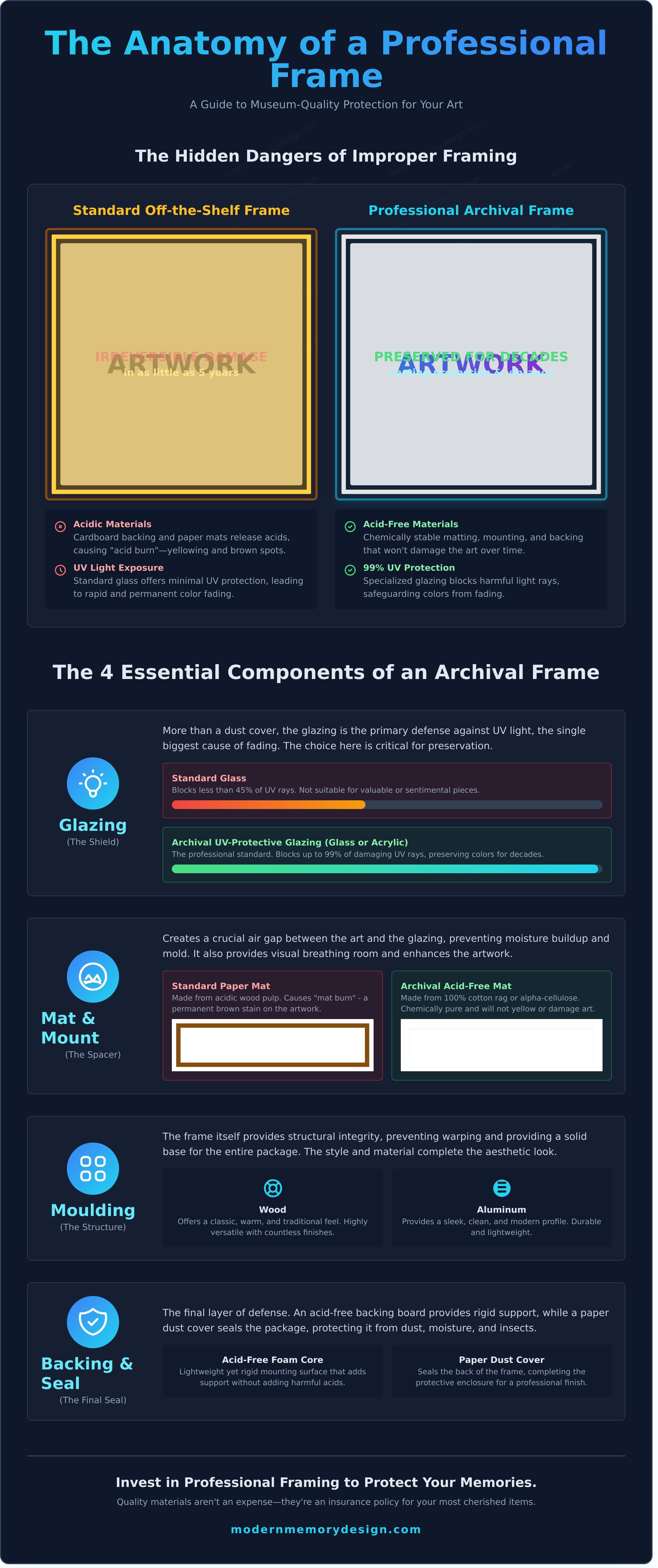
A truly professional frame is more than just four pieces of wood and a sheet of glass; it’s a complete preservation system designed to protect your art for decades. The quality of a custom frame is determined by its four essential components: the moulding, the glazing, the matting, and the mounting. Choosing the right materials is the single most important factor in the lifespan of your artwork, diploma, or jersey.
The invisible enemy in cheap, off-the-shelf frames is acid. Materials made from acidic wood pulp, like standard cardboard and paper mats, slowly release chemicals that cause irreversible damage. This results in the tell-tale yellowing of paper, brittle textures, and brown spots known as "foxing." To prevent this, professionals adhere to a simple principle. Archival framing is the use of chemically stable materials that do not damage art over time.
The moulding and glazing are your first line of defense against physical damage, dust, and light. The moulding, or the frame itself, provides structural support and aesthetic style. Natural wood offers a classic warmth, while sleek aluminum provides a modern, clean profile. The glazing, or cover, is far more than a simple dust barrier. Your choice here directly impacts the clarity and protection of your piece.
What happens inside the frame is just as important as the exterior. The matting and backing materials are in direct contact with your art, making their chemical composition critical. For any valuable or sentimental piece, acid-free matting is non-negotiable. We use only 100% cotton rag or alpha-cellulose mats, which are completely free of the acidic compounds that cause burn marks and deterioration. These standards are outlined by conservation experts who specify which preservation framing materials are required to ensure longevity.
The mat also serves a vital mechanical purpose: it creates a small gap of air between the artwork and the glazing. This "breathable" space prevents moisture from getting trapped against the art, which could lead to mold growth or cause photos to stick to the glass. Finally, the backing board provides rigid support. Never use corrugated cardboard, which is highly acidic and structurally weak. We use professional, acid-free foam board to ensure your art stays flat and protected from the back. Understanding these components is the first step, and our experts can guide you through selecting the right combination for your piece. Explore our custom framing options to see how we protect what you love.
Choosing the right frame often comes down to a single question: are you simply covering a picture, or are you preserving a memory? The answer directly impacts the ideal balance of cost, quality, and personalization for your piece. While a ready-made frame offers immediate, low-cost appeal, a custom solution provides long-term value that protects and enhances your art for a lifetime.
The most immediate challenge with off-the-shelf frames is their rigid sizing. They are mass-produced for a few specific dimensions, typically 8x10, 11x14, or 16x20 inches. This system fails the moment you have something unique, like a panoramic iPhone photo, a square print from your social media feed, or a vintage poster with non-standard dimensions. Forcing art into a pre-made frame often requires cropping the piece or using a poorly proportioned mat, compromising the artist's original vision.
Personalization is another critical difference. A typical retail store may offer fewer than 10 styles, usually limited to basic black, white, or faux-wood finishes. In contrast, a professional custom framing shop provides an expert-guided design experience with thousands of options. At our New Jersey workshop, you can select from over 2,000 handcrafted wood and metal moulding profiles and hundreds of mat colors to create a truly unique presentation that complements your art, your home, and your personal style.
Of course, the number one objection to custom work is the price. A custom frame is a bigger upfront cost than a $20 ready-made alternative, but it should be viewed as the only cost. A cheap frame with a standard paper mat contains acids that can cause permanent "mat burn" and yellowing on your art in as little as three years. A professional custom frame is a one-time investment in preservation. We use only archival, acid-free materials that meet the strict Library of Congress preservation guidelines, protecting your piece from environmental damage for decades. It’s the difference between a temporary covering and permanent protection.
For easily replaceable 4x6 photos or posters meant for temporary spaces like a dorm room, a ready-made frame is a practical, budget-friendly choice. They offer immediate results for common print sizes. Just be mindful of DIY assembly pitfalls like trapping dust under the glass, using damaging tape on your art, or dealing with flimsy backing that can warp over time and fail to support the piece properly.
Custom work is non-negotiable for irreplaceable and sentimental items. This includes diplomas, wedding portraits, signed memorabilia, and family heirlooms that deserve museum-quality protection. It is also the only professional solution for art with non-standard dimensions. For specialty projects like creating a jersey shadow box, floating a canvas, or mounting delicate textiles, expert craftsmanship is absolutely essential to achieve a polished, lasting result that honors the item within.
Selecting the right frame is more than just a finishing touch; it’s an essential part of the art itself. At our New Jersey workshop, our expert framers follow a core set of design principles to ensure every piece achieves its full potential. The most important of these is the "Art-First" rule: the frame must serve the artwork, not the decor. A frame chosen to match a sofa becomes obsolete when you redecorate, but one that complements the art is a timeless investment.
Color theory plays a crucial role in professional custom framing. The matboard isn't just a spacer; it's a tool for enhancing the piece. By selecting a mat color that pulls out a subtle, secondary tone from the artwork, you can add depth and make the entire piece more vibrant. For example, a thin inner mat of deep slate blue can make the sky in a landscape photograph feel more expansive. For ideal visual balance, the mat width should typically be at least 1.5 times the width of the frame moulding. This prevents the frame from overpowering the art and gives the piece room to breathe.
Scale and proportion are just as critical. The frame's visual weight must be appropriate for the artwork's size and style. A delicate 5x7 inch charcoal sketch would be lost in a heavy, 3-inch ornate frame, but it gains presence and importance with a more modest 1.5-inch frame and a generous 3-inch mat. Conversely, a large 36x48 inch abstract canvas often looks best in a minimalist 1/2-inch floater frame that doesn't compete with the art's bold statement.
A well-executed gallery wall turns a blank space into a personal story. Your first decision is choosing a theme: cohesive or eclectic. A cohesive wall uses identical frames for a clean, uniform grid. An eclectic approach mixes different styles, sizes, and textures for a curated, collected-over-time feel. To keep a mixed collection from looking chaotic, find a common element, like a consistent color palette in the art or a single frame color mixed among different styles.
Proper spacing is the key to a professional-looking layout. We recommend the "Rule of 3 Inches"-maintaining a consistent gap of approximately 3 inches between each frame. This creates visual harmony and prevents the wall from feeling cluttered. You can easily integrate different formats by using a large canvas or framed print as an "anchor" piece and arranging smaller photos, art, and even 3D shadow boxes around it to create a balanced composition.
Our expert designers can help you apply these principles to your unique pieces. Upload your photo or schedule a consultation to get started on your custom frame design today.
In a world of mass production, we believe your memories deserve a personal touch. That's the principle our New Jersey workshop was built on. Modern Memory Design began as a local, family-owned shop dedicated to expert craftsmanship. Today, we bring that same local expertise to customers nationwide through a seamless online experience. We've bridged the gap between the convenience of digital ordering and the irreplaceable quality of a traditional frame shop. Every order you place is a direct connection to our Bergen County, NJ, team, where real artisans handle your cherished items with professional care.
Our commitment to protecting your memories is absolute. We use exclusively museum-grade, archival materials to ensure your art and photos are preserved for decades, not just years. This means every component is chosen for longevity. We use acid-free mat boards that won't yellow or degrade your artwork over time and UV-protective acrylic glazing that blocks over 99% of harmful ultraviolet rays, preventing fading and discoloration. Your piece is protected from the inside out.
This dedication is central to our "Handmade For You" promise. Your frame isn't pulled from a warehouse shelf; it's custom-built from scratch the moment you order. Our expert framers personally cut and join every piece of wood molding, ensuring perfect corners and a sturdy, lasting build. This hands-on approach to custom framing allows for a level of quality control and precision that automated assembly lines simply can't match. It’s a difference you can see and feel.
Beyond standard photo printing and framing, we offer a range of expert services to handle your most unique pieces. Our team is equipped to tackle complex projects with professional skill.
We combine the skill of a traditional workshop with the efficiency you expect. When you trust us with your memories, you get more than just a frame; you get a promise of quality and service.
You now understand that a frame is much more than a simple border; it’s a carefully constructed home designed to protect and elevate your most cherished pieces. From recognizing the importance of archival materials to choosing a design that complements your art, you're equipped to make a confident choice. This level of professional framing is exactly what we deliver at Modern Memory Design.
Every piece is handmade with meticulous care in our New Jersey workshop. We use only museum-quality, archival materials to ensure your masterpiece is preserved for decades, a promise trusted by over 10,000 happy customers. Don't let your important memories fade in a forgotten folder or a low-quality frame.
It's time to give your art the stunning, lasting presentation it deserves. Shop our collection of handcrafted custom frames and experience the difference true American craftsmanship makes.
Custom framing for a standard 8x10 photo typically costs between $120 and $250, while larger or more complex projects like jersey framing can range from $350 to $700. The final price depends on four key factors: the size of your piece, the frame moulding material you choose, the type of protective glass (like standard or 99% UV-protective), and the matting options. Our expert framers can provide a precise quote based on your specific artwork and design choices.
The primary difference is preservation. Acid-free matting, also called archival or conservation-quality matting, is made from 100% cotton or purified alpha-cellulose. It won't yellow or degrade your artwork over time. Regular matting contains an acidic wood pulp that releases chemicals, causing a brown stain known as "mat burn" on your art within 5 to 7 years. For any treasured piece, we exclusively recommend using acid-free materials to ensure its longevity and value.
To measure your art, lay it on a flat surface and use a steel tape measure for accuracy. Measure the exact height and width of the image area you want to be visible. Don't include any white borders unless you want them to show. Measure in at least two places for both height and width to ensure the piece is square. Provide these exact dimensions to us; our professional framers will calculate the necessary allowances for the mat and frame lip.
Yes, the right type of framing absolutely protects photos from fading. The key component is the glazing. While standard glass blocks about 45% of UV light, our conservation-grade UV-protective glass and acrylic block over 99% of the harmful rays that cause colors to fade and paper to become brittle. Choosing UV-protective glazing is the single most important step you can take to preserve your photos and art for decades to come.
A shadow box is a deep, enclosed frame designed to display three-dimensional objects. You should use one whenever the item you're framing has depth, such as a sports jersey, military medals, a wedding bouquet, or your child's first pair of shoes. The added depth of the shadow box creates space between the object and the protective glass, ensuring your treasured memorabilia is displayed safely and professionally without being flattened or damaged.
Yes, a stretched canvas is ready for framing. The most popular and modern option is a floater frame. This style is designed so that the canvas appears to "float" inside the frame with a small, uniform gap around the edges. This unique presentation allows the entire front surface and the painted sides of the canvas to remain visible, offering a clean, gallery-quality look that doesn't cover any part of the original artwork.
Most of our custom framing orders are handcrafted and completed within 7 to 10 business days. This timeline can vary based on the complexity of your project and the availability of materials. For example, a multi-opening mat or a large jersey shadow box may require a few extra days. If you have a specific deadline, please let us know when you place your order and we will do our best to accommodate your request.
The safest method is to spray an ammonia-free glass cleaner onto a clean, soft microfiber cloth, not directly onto the glass itself. Spraying the glass can allow cleaner to seep behind the frame and damage your artwork or matting. Gently wipe the glass with the dampened cloth. If your frame has acrylic instead of glass, use only a cleaner specifically formulated for acrylic to prevent scratching and ensure a crystal-clear view.
{"one"=>"Select 2 or 3 items to compare", "other"=>"{{ count }} of 3 items selected"}