
Made in America (NJ)
for your Wall Decor
Handcrafted Picture Frames

The earliest artwork ever discovered — cave paintings — had no borders, no lines, and absolutely no frames. Art existed in raw, unbounded form on rock walls. Over centuries, as paintings moved onto canvas and wood panels, something changed: artists and patrons began placing borders around their work. That simple act became the origin of one of the most enduring decorative traditions in human history.
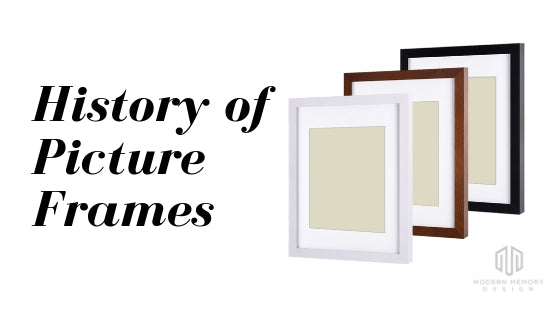
The concept of framing art first emerged with intention during the early Renaissance period. Artists in Florence and Siena began using decorative borders not just for aesthetics, but to separate their painted narratives from the surrounding world. The frame, in a philosophical sense, created a threshold — a window through which a viewer could observe a different reality.
The influential Dutch impressionist Vincent van Gogh captured this beautifully when he said: "A picture without a frame is like a soul without a body."
Picture frames became a distinct artistic category during the Florentine Renaissance, which began in the 14th century and lasted through the 17th century. During this transformative era, framing was deeply tied to religious belief. The prevailing idea — that "the eyes are the window to the soul" — gave frames a spiritual significance far beyond their decorative function.
Altar frames became particularly prominent in churches and cathedrals across Italy. These elaborate structures incorporated gold leaf, precious gems, and intricate mosaics. The craftsmanship was extraordinary, reflecting a desire to literally recreate heaven on earth. Artists such as Donatello and Michelozzo greatly influenced other craftsmen of the era, establishing the frame as a complete and independent art form in its own right.
Over time, picture frames took on broader cultural significance. They were used to elaborate and extend the narrative of the artwork they surrounded — carrying symbols, providing context, or serving as a field where additional meaning could be expressed without interrupting the primary image.
Artists and scholars began to view the frame as the ideal threshold between the static world of painting and the continuous, moving world of the viewer. In this sense, a well-chosen frame doesn't just protect a painting — it mediates the relationship between the artwork and the person standing before it.
Today, picture frames exist in an enormous variety of architectural styles — antique, industrial, bohemian, classic, minimalist, and farmhouse. They're crafted from wood, metal, acrylic, and reclaimed materials. The "box-shaped" standard frame has evolved into tabernacle styles with elaborate tops, round tondo frames, panoramic frames, and more.
The function, however, remains the same as it was in the 14th century: to protect, elevate, and focus attention on what matters most.
At Modern Memory Design, we believe every photograph, diploma, artwork, or poster deserves a frame that honors it. Our handcrafted wood frames are built in-house at our Hasbrouck Heights, NJ studio — the same artisan attention to detail that defined Renaissance-era framing, brought to the 21st century.
Not sure what size you need? Our custom picture framing service lets you choose your exact size from 3×3 inches up to 48×48 inches. Upload your photo or artwork and we'll print, mat, and frame it — delivered ready to hang.
From its spiritual origins in Renaissance altarpieces to the gallery walls of modern homes, the picture frame has always served one essential purpose: to say that what's inside is worth preserving. We'd love to help you do exactly that.
{"one"=>"Select 2 or 3 items to compare", "other"=>"{{ count }} of 3 items selected"}
Leave a comment