
Made in America (NJ)
for your Wall Decor
Handcrafted Picture Frames

Framing an original newspaper is a race against chemistry. When you're preserving a newspaper article in a frame, you're essentially trying to stop the natural acidity of the paper from destroying itself. You likely have a specific clipping that means the world to you, but the fear of ruining it with a non-archival frame is a valid concern. It's often confusing to navigate technical terms like UV-filtering acrylic or pH-neutral mats when you just want your memories to last.
This guide provides the professional techniques and archival secrets needed to stop yellowing and preserve your history for a lifetime. We'll show you how to achieve a museum-quality display that lasts 20 years or more. You'll learn about the "Holy Trinity" of archival materials, why blocking 99% of UV rays is essential, and how to determine if your project requires the meticulous touch of a professional artisan or a high-quality DIY kit.
Newsprint is inherently fragile. Because it's produced for mass distribution and rapid disposal, the chemical composition of the paper isn't designed to withstand the test of time. It's essentially a low-grade paper pulp that contains high levels of acids and lignin. When you're considering the best method for preserving a newspaper article in a frame, you're fighting a chemical battle against the paper's own ingredients. Standard store-bought frames often accelerate this process because they lack the protective barriers needed to neutralize these internal threats.
Lignin is the organic polymer that holds wood fibers together, acting as a natural glue within the wood pulp. While it provides structural integrity to a tree, it's the primary culprit in newsprint's short lifespan. Once the paper is exposed to oxygen, a chemical reaction called oxidation begins. This process transforms lignin into acidic compounds that literally eat the paper from the inside out.
You can see this decay happening in real-time through several visual indicators:
Following established Archival preservation principles is the only way to slow this inevitable degradation. Without intervention, the very structure of the document will eventually turn to dust.
Even if the paper were acid-free, external environmental factors would still pose a significant risk. UV radiation from natural sunlight and even indoor fluorescent bulbs acts as a powerful catalyst. It provides the energy needed to break down paper molecularly, causing ink to fade and the paper to yellow rapidly. This is why a document kept in a dark drawer survives much longer than one hung on a wall in a standard frame.
Humidity is another silent destroyer. When a newspaper is sealed in a standard frame without proper spacers, moisture can become trapped against the glass. This creates a "greenhouse effect" that encourages mold growth and causes the paper to ripple or stick to the glazing. Additionally, cheap cardboard backings often found in mass-produced frames lead to acid migration. This occurs when the acids from the backing board seep into your newsprint, doubling the speed of decay. Truly preserving a newspaper article in a frame requires materials that block these external threats while providing a stable, acid-free environment for the document to rest.
To successfully halt the decay described in the previous section, you must move beyond standard decorative framing. Professional archivists rely on the "Holy Trinity" of preservation: UV-filter glazing, acid-free matting, and archival mounting. These components work together to create a stable micro-climate inside the frame. This environment acts as a barrier against atmospheric pollutants and fluctuating humidity, which is the secret to preserving a newspaper article in a frame for 20 years or more. Without these specific materials, the frame becomes a trap for the very gases that destroy the paper.
The gold standard for any newsprint project is 99% UV protection. Standard glass only filters about 45% of harmful rays, which is insufficient for high-lignin paper. Using conservation-grade glazing ensures that the chemical energy from light doesn't trigger the oxidation of the cellulose fibers. If you are unsure about the specific steps of handling your clipping before it reaches the frame, reviewing a guide on how to preserve a newspaper can help you prepare the document for its new environment.
Conservation Clear glass is the industry baseline for professional results. It features a microscopic coating that blocks nearly all UV light while maintaining perfect clarity. For larger newspaper spreads or front pages, acrylic (often called Plexiglass) is a superior choice. It's lighter than glass and shatterproof, which is critical for protecting the original document from physical trauma. Many high-end displays also utilize anti-reflective coatings. These specialized finishes reduce glare and improve the legibility of tiny newspaper print, making the article easier to read from any angle in the room.
Your article must never touch the glass. When paper makes direct contact with the glazing, it risks sticking due to condensation, leading to permanent damage. Archival mats create a necessary air gap. We recommend using alpha-cellulose matboards, which are purified to remove lignin and can actually absorb acidic pollutants from the air. For the mounting process, avoid adhesive tapes. Instead, use hinge mounting with Japanese rice paper and wheat starch paste. This method is fully reversible and allows the paper to expand and contract naturally without tearing. For those seeking a professional finish, choosing bespoke custom framing ensures these meticulous standards are met by experienced artisans.
Finally, consider the chemical balance of your materials. Buffered matboards contain calcium carbonate to neutralize acids, making them ideal for most newsprint. However, some historical inks react poorly to high alkalinity, so non-buffered options are sometimes required for specific artifacts. For an extra layer of defense, deacidification sprays can be applied to the original fibers. These sprays provide a temporary alkaline shield that slows the internal breakdown of the paper, buying you even more time before the document requires further attention.
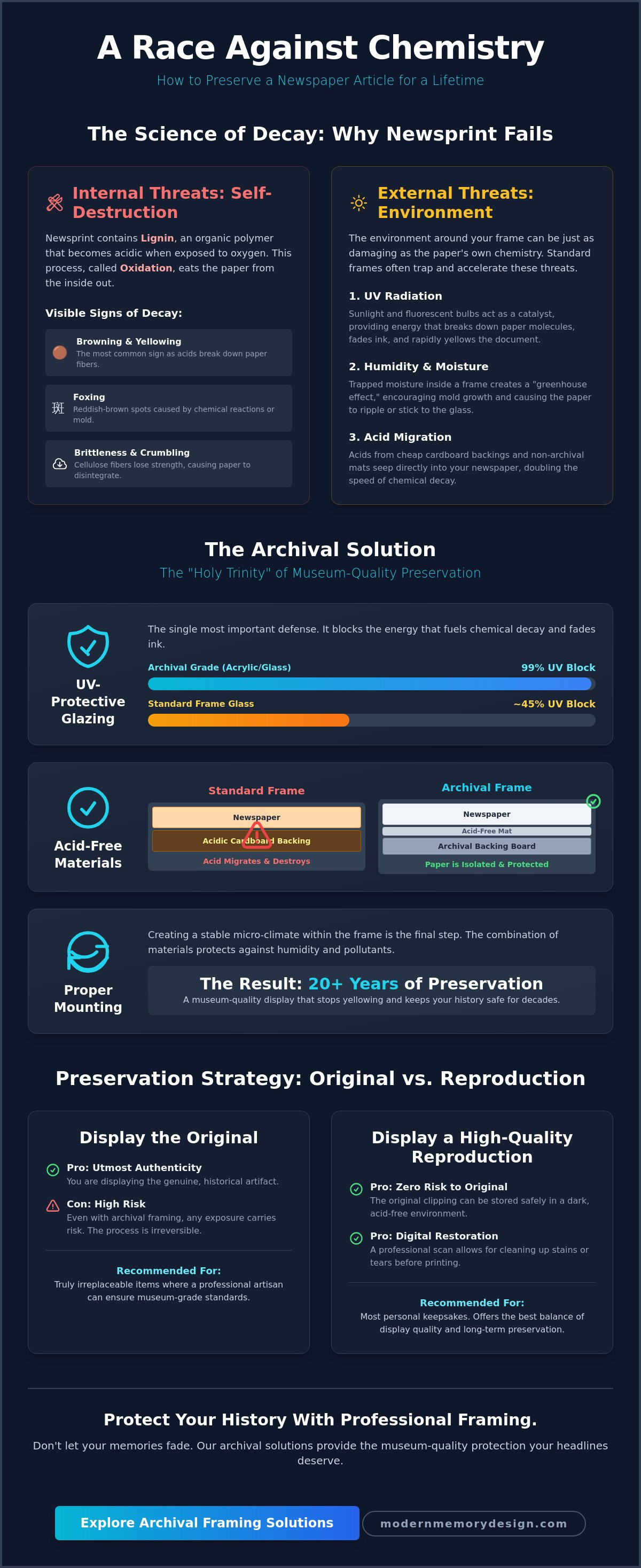
Displaying a piece of history involves a fundamental choice between sentiment and longevity. This is often called the "Sacrifice Dilemma" because exposing an original newspaper to any light source, even with 99% UV protection, will cause some degree of fading over several decades. When you are preserving a newspaper article in a frame, you must decide if the physical paper itself is the artifact or if the information it contains is what truly matters. Professional scanning offers a way to "stop time" by creating a digital master of the article before the chemistry of the newsprint takes its toll.
Digital restoration can go a step further than physical preservation. Skilled artisans can digitally remove existing yellowing, tea-colored foxing, or deep creases that occurred before the article was properly stored. Printing this restored image on archival, acid-free photo paper ensures the display remains vibrant for 100 years or more; this far outlasts the fragile wood-pulp original.
There are specific instances where framing the original is the only acceptable path. If the article features a hand-signed autograph, an embossed official seal, or holds immense sentimental value as a physical object, you should proceed with the original. To do this safely, you must prepare the document by ensuring it is flat and free of loose debris. Don't attempt to clean the paper yourself with liquids, as this can liquefy the acids and cause immediate staining.
Choosing a high-quality custom picture frame equipped with a buffered mat is essential here. The mat helps neutralize the acids we discussed in the previous sections. However, owners of high-value originals should also have a "dark-storage" plan. This might involve displaying the frame in a room with no direct sunlight or rotating the item out of display every few years to minimize light fatigue.
For most people, the "scan and frame" method is the superior preservation strategy. While some online forums suggest using a home scanner, these devices often lack the 600 to 1200 DPI resolution required for professional-grade results. A professional scan captures every fiber and ink bleed, allowing for a reproduction that is indistinguishable from the original newsprint.
Modern online photo printing services allow you to enlarge small, hard-to-read columns into a more impactful display piece. You can choose papers that are entirely acid-free and lignin-free but still mimic the matte texture of newsprint. This approach provides the best of both worlds. You can keep the original article safe in a flat, dark, acid-free folder in a climate-controlled area while the museum-quality reproduction hangs proudly on your wall. This strategy is the most effective way of preserving a newspaper article in a frame without risking the loss of the primary source material.
Successfully preserving a newspaper article in a frame starts with proper preparation. Newsprint is notoriously reactive, so you can't treat it like a standard photograph. Before you begin, ensure your workspace is clean, dry, and free of oils. You'll need archival-grade materials, specifically those labeled as acid-free and lignin-free, to counteract the chemical decay we explored in earlier sections.
The first step is flattening. If your article has been folded for years, don't use heat or moisture. Instead, place the clipping between two sheets of acid-free tissue paper and weigh it down with heavy, flat books for 48 hours. Once flat, measure the article carefully. Always leave an extra 1/8 inch of space in your mat opening. This allows the paper to expand and contract with temperature changes without buckling against the mat edges.
Layout becomes more complex when dealing with multi-page articles or stories that jump to different sections. You might choose a single-opening mat for a clean look or a multi-opening "collage" style to display the headline alongside the continued text. When selecting your frame, consider if you can use standard picture frame sizes or if the unique dimensions of a broadsheet require custom work. A frame style that complements the era of the article, such as a sleek black wood for modern news or a classic gold leaf for historical pieces, adds a professional aesthetic touch.
When you are preserving a newspaper article in a frame, every layer of the "archival sandwich" matters. Start by cleaning your glass or UV-acrylic with an ammonia-free cleaner. Ensure it's completely dry to avoid trapping moisture. Place the glass down, followed by the mat. Instead of using tape, which is destructive to newsprint over time, secure the article using archival photo corners. These clear, adhesive-free sleeves hold the paper in place without touching the fibers.
Perform a final inspection for "inclusions" like dust, lint, or hair before adding the acid-free backing board. Once satisfied, seal the back of the frame with a dust cover. This paper barrier prevents insects and environmental pollutants from entering the display. If you prefer a professional touch for your most precious headlines, explore our custom framing options to guarantee a museum-quality result that lasts for generations.
While DIY methods offer a starting point, the stakes are high when you're handling a one-of-a-kind original. At Modern Memory Design, we specialize in the meticulous work required for preserving a newspaper article in a frame at a museum-grade level. Our New Jersey workshop is built on the foundation of artisanal craftsmanship, where we combine modern preservation technology with traditional framing techniques. We provide a comprehensive "Full Service" experience that begins with high-resolution professional scanning and ends with a stunning, ready-to-hang display.
For those looking to showcase a historic headline or a personal milestone, our large picture frames are specifically engineered to support the weight and dimensions of full-page front-page news. These frames are constructed to prevent the sagging or warping often seen in mass-market alternatives. Whether you're decorating a corporate lobby or protecting a family heirloom, our team ensures every component, from the UV-filtering acrylic to the acid-free mounting, meets the highest professional standards.
Newspapers don't come in standard sizes. We handle everything from oversized broadsheets to smaller tabloid-style clippings with precision. Our artisans understand that some historical documents have heavy folds or bound edges that require more than a simple flat mount. In these cases, we design specialized shadow boxes that accommodate the depth of the paper without putting pressure on fragile creases. Every document that enters our NJ workshop receives white-glove treatment, ensuring that no oils or contaminants touch the original fibers during the assembly process.
A museum-quality frame deserves a professional presentation. We offer a dedicated picture hanging service for clients in our local service area. This is particularly valuable for large office displays or complex gallery walls where alignment and secure mounting are critical. If you're managing a corporate archive or a series of framed headlines, our team can handle the installation to ensure the safety of both the art and the wall.
For customers outside of our immediate region, we provide secure, specialized shipping for all custom orders placed through our online store. We use robust packaging materials designed to protect glass and fragile frames during transit. Your history is irreplaceable, and we treat it with the respect it deserves from the moment it arrives at our workshop until it's safely on your wall. Contact us today to start your newspaper framing project and let our experts help you choose the perfect archival solution for your most important headlines.
Your newspaper clippings represent more than just ink on paper; they're tangible links to your most significant milestones. Successfully preserving a newspaper article in a frame requires a proactive approach to neutralizing internal acidity while blocking external threats like UV radiation. By choosing museum-grade materials and considering a digital reproduction strategy, you ensure these fragile documents remain vibrant for decades rather than yellowing within a few short years.
At Modern Memory Design, we take pride in our expert NJ-based craftsmanship. Every frame we build utilizes archival-grade materials to create a stable environment for your history. If your original is already showing signs of age, our professional scanning and printing services can revitalize the image before it's set behind conservation glass. Don't leave your legacy to chance with standard store-bought options that lack protective barriers.
Design your custom newspaper frame today at Modern Memory Design. We look forward to helping you create a display that honors your story with the meticulous care it deserves.
Newspaper articles will eventually yellow even in a frame if they aren't protected by archival materials. Newsprint contains lignin, which reacts with oxygen and light to create acid. While you can't stop time, using UV-protective glass and acid-free mats slows this process by decades. Without these barriers, the paper's internal chemistry will cause it to become brittle and dark within a few years.
You can use a standard store-bought frame, but it often lacks the necessary components for long-term preservation. Most mass-market frames include cardboard backings and standard glass that offer no protection against acid migration or UV damage. If you choose this route, it's essential to replace the backing with an acid-free board and add a spacer to prevent the paper from touching the glass.
The best type of glass for preserving a newspaper article in a frame is Conservation Clear glass or UV-filtering acrylic that blocks 99% of harmful rays. Standard glass allows nearly half of the sun's UV energy to pass through, which quickly breaks down the fragile fibers of newsprint. Museum-grade acrylic is also an excellent choice because it's shatterproof and provides superior clarity for reading small print.
Framing a high-quality digital copy is generally better for longevity, while the original should be reserved for items with high sentimental or historical value. Displaying a copy allows you to keep the original safely stored in a dark, climate-controlled environment. If the article features an original signature or unique embossed seal, framing the original with full archival protections is the appropriate choice.
To flatten a newspaper safely, place it between two sheets of acid-free tissue and weigh it down with heavy, flat objects for several days. Never use a clothes iron or steam, as heat and moisture can permanently damage the ink and accelerate the paper's decay. This slow, dry pressure method is the safest way to remove deep creases without risking a chemical reaction.
You should never laminate a newspaper article that you intend to preserve. Lamination is a permanent process that uses heat and adhesives that will eventually destroy the paper fibers. Once applied, the plastic cannot be removed without tearing the article. Archival framing provides a protected environment that is fully reversible, which is the standard for professional document preservation.
Acid-free matting is a specialized board that has been chemically treated to have a neutral pH level. It's essential for preserving a newspaper article in a frame because it prevents "acid migration," where acids from the frame components seep into the paper. Using a buffered mat is even better for newsprint, as it contains a small amount of calcium carbonate to neutralize acids as they form.
The cost of professional framing depends on the size of the clipping, the type of UV-protective glazing selected, and the complexity of the mat design. Prices vary significantly between standard small columns and full-page broadsheets. Investing in museum-quality materials typically involves higher costs than basic decorative framing, but it provides the specialized protection needed to ensure the article doesn't fall apart over time.
{"one"=>"Select 2 or 3 items to compare", "other"=>"{{ count }} of 3 items selected"}
Leave a comment