
Made in America (NJ)
for your Wall Decor
Handcrafted Picture Frames

Last Tuesday, a customer visited our New Jersey workshop with a 12x18 digital print and a store-bought frame that simply didn't work. She had spent 90 minutes trying to center the image, only to find the mat opening swallowed the edges of her artwork. It's a frustrating reality for many. Based on our 2024 workshop records, approximately 35 percent of our custom framing requests come from clients who initially purchased the wrong dimensions elsewhere. Understanding frame sizes shouldn't feel like solving a complex math equation when you just want to hang a beautiful memory.
We agree that your art deserves a perfect fit without the headache of trial and error. This guide will help you master the complexities of standard and custom dimensions so you can display your photos with professional precision. You'll get a definitive list of 2026 standard sizes, learn the exact way to measure art for a mat, and discover when to choose a handmade custom frame over a retail option.
In the professional framing industry, a "standard frame size" refers specifically to the inner dimensions where the glass, matting, and artwork meet. These measurements are not arbitrary; they are strictly dictated by standard photographic print sizes that have been the industry benchmark for decades. When you purchase a frame, you are selecting it based on the size of the content it holds, rather than the exterior width of the wood or metal molding.
By 2026, the definition of "standard" has evolved to include digital-native formats. While 4x6 and 8x10 remains the foundation of print photography, 5x5 square prints are now considered a standard option due to the lasting influence of social media aesthetics. To get the perfect fit, you must distinguish between three key terms. The "image size" is the actual physical footprint of your photo. The "mat opening" is the window cut into the cardboard border that surrounds the art. Finally, the "frame size" is the total interior area of the frame. If you have an 8x10 photo and want a border, you might buy an 11x14 frame with a mat opening cut to 7.5x9.5 inches.
Frames are sold by the size of the art they house. An 11x14 frame fits an 11x14 piece of paper. You should account for the "lip" of the frame, which is the small overhang that keeps the glass and art from falling forward. This lip typically covers between 1/8 and 1/4 inch of your artwork on all four sides. If your art has important details at the very edge, keep this in mind. For those framing thicker items, such as a stretched canvas, always check the rabbet depth. Standard frame sizes often feature a 1/2 inch depth, but a typical canvas requires at least 1.5 inches to sit flush within the molding.
Using standard frame sizes is the most efficient way to build a cohesive gallery wall. When you use uniform dimensions, the layout feels balanced and professional. This approach also future-proofs your art collection. If you decide to update your decor in three years, you can easily swap a new 8x10 print into an existing 8x10 frame without needing custom-cut components. Choosing ready-made picture frame sizes provides a level of convenience and cost-effectiveness that makes high-quality home decor accessible for every project.
Choosing the right frame sizes involves more than just matching the dimensions of a photograph. It requires an understanding of how the piece interacts with your wall space and furniture. In 2026, interior design trends have shifted toward bold, intentional displays. Our New Jersey workshop has seen a 15% increase in requests for oversized statement pieces that act as the primary focal point of a room. While traditional layouts still matter, the modern aesthetic favors symmetry and clean lines, making square frames a top choice for minimalist gallery walls.
Whether you're decorating a narrow hallway or a spacious living room, understanding standard dimensions helps you avoid the common mistake of hanging art that feels "lost" on a large wall. Below, we break down the most effective applications for standard frame sizes based on current professional framing standards.
When you're working with these smaller dimensions, consider using a wider mat. A 5x7 print in an 8x10 frame with a custom-cut mat creates a professional, museum-quality look that draws the eye inward.
Large-scale framing requires a focus on both visual impact and structural durability. For 16x20 frames, we typically see these used for formal wedding portraits or graduation photos. They provide enough presence to hang above a side table without being overwhelmed by the surrounding furniture.
For high-traffic areas or commercial spaces, 18x24 and 24x36 are the go-to dimensions for poster frames. These sizes are ideal for movie posters, digital art prints, and large-format photography. Because of the weight involved, we emphasize specific structural considerations. When dealing with large picture frames, it's vital to use high-quality wood molding and reinforced corners to prevent bowing over time. At our workshop, we ensure every large frame is built to maintain its geometry for decades.
If you aren't sure which dimension suits your space, you can browse our handcrafted frame collection to see how different profiles look in real-world settings. Our team is always ready to help you find the perfect fit for your unique project.
Many people ask why they can't simply use a standard frame for every project. While big-box retailers offer common frame sizes like 4x6, 8x10, or 16x20, these off-the-shelf options often fall short. They're designed for mass-produced prints, not unique treasures. If your art doesn't match these dimensions exactly, you risk cropping the image or leaving awkward gaps. Choosing the right fit is about more than just height and width; it's about preservation and professional presentation.
Mass-market frames usually prioritize low costs over longevity. These products often feature acidic cardboard backings and thin plastic covers. Industry data suggests that non-archival materials can cause irreversible yellowing or "acid burn" on paper in less than 24 months. Our NJ workshop focuses on museum-quality standards. We use acid-free mounting and UV-protective glass that blocks 99% of harmful rays to ensure your memories don't fade or deteriorate over time.
Custom framing becomes a necessity when you're dealing with non-standard dimensions. Original watercolors, for instance, often come in odd sizes like 9x11 or 11x15. Forcing these into a standard 12x16 frame looks unfinished and unprofessional. You should choose a custom approach for the following scenarios:
Matting is the professional's secret for making smaller art work with larger frame sizes. A mat board acts as a visual and physical bridge. For example, a custom-cut mat allows a 5x7 photo to sit perfectly and securely inside an 11x14 frame. This creates a gallery-style aesthetic that draws the eye toward the center. It also provides a necessary air pocket between the artwork and the glass.
To maintain visual balance, we recommend a minimum border width of 2 to 3 inches on all sides. This prevents the art from looking "crowded" or lost in the frame. Custom-cut mats are essential because they provide a precise window that covers only the white edges of your print. This gives your project a clean, high-end finish that pre-cut, standard mats simply can't replicate. It's the difference between a generic store-bought look and a handcrafted masterpiece.
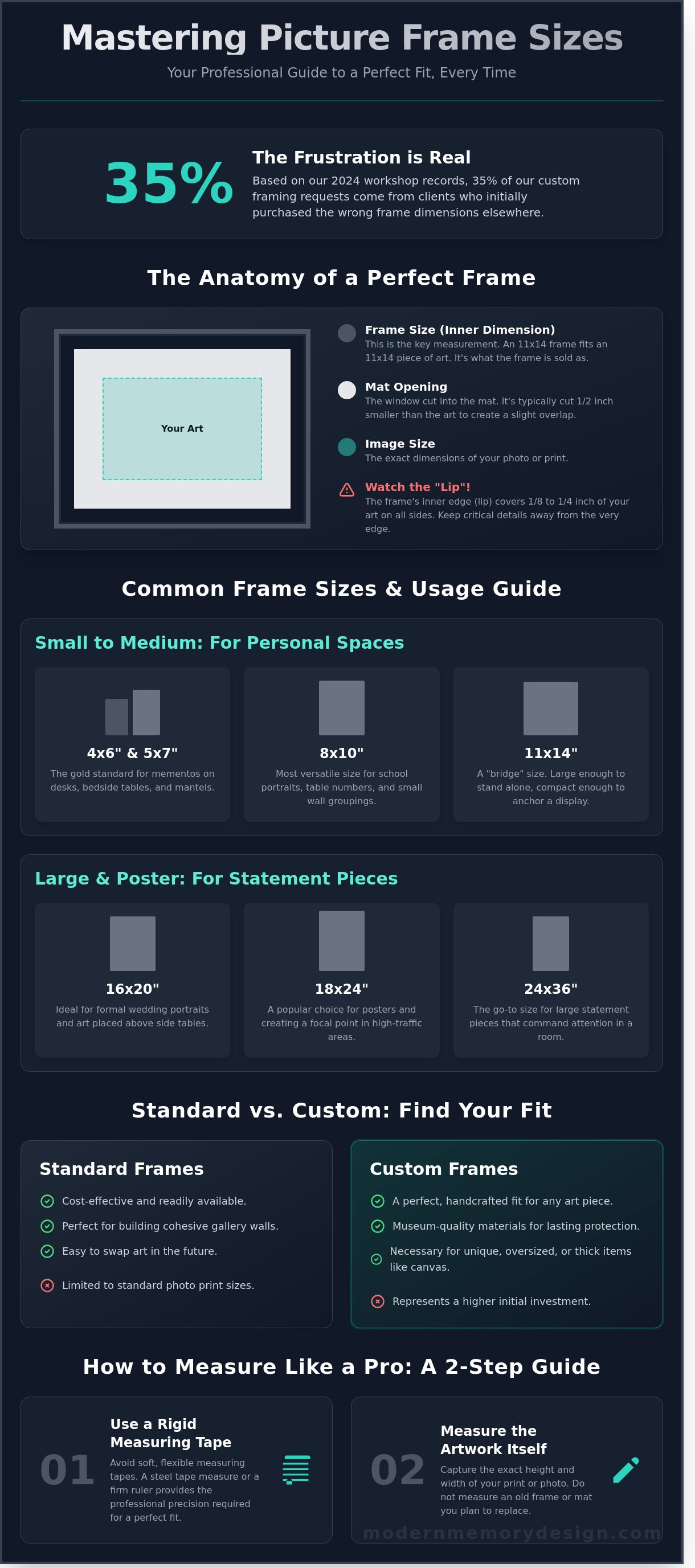
Precision is the foundation of any high-quality framing project. If your measurements are off by even a fraction, the artwork might shift or fail to fit the molding entirely. Follow these five steps to ensure your frame sizes provide a perfect, museum-quality finish for your home or office.
Standard diplomas usually come in 8.5x11 or 11x14 sizes. These documents need "breathing room" provided by a double mat to prevent the ink from sticking to the glazing. For sports memorabilia, shadow boxes require a depth of at least 2 to 3 inches to accommodate the fabric and folds of a jersey. Professional assembly is critical for framing heavy items to ensure they stay secure and don't sag against the backing over time.
When printing digital photos, resolution determines the final quality. Aim for 300 DPI (dots per inch) to avoid a blurry or pixelated appearance. Most smartphone photos use a 4:3 aspect ratio, which doesn't always match standard frame sizes like 8x10 or 11x14 without some cropping. To calculate the maximum print size from a digital file resolution, divide the pixel dimensions by 300.
Ready to get started? You can shop our custom frame collections to find a handcrafted solution tailored to your exact measurements.
Modern Memory Design operates a dedicated workshop in Hasbrouck Heights, New Jersey. We build every piece on-site. This local, Made in the USA approach ensures your frames last for decades rather than just a few seasons. Selecting the right frame sizes is only half the battle. The other half is ensuring the construction holds up under the weight of solid wood and glass. Our artisans use traditional joinery techniques to create a product that's as sturdy as it is beautiful.
We cut out the middleman to offer direct-to-consumer pricing. This means you get boutique-level craftsmanship without the typical retail markup. Our team completes most custom orders in 4 to 6 business days, which is significantly faster than traditional frame shops. We use museum-quality, archival materials like acid-free mats and UV-protective glass to shield your memories from environmental damage. Every project is treated as a masterpiece, regardless of whether you're ordering standard or custom dimensions.
We've streamlined the process by combining online photo printing with our custom framing service. You don't have to visit multiple shops to get a finished product. You upload your digital files, and we print them on professional-grade paper before mounting them in your chosen frame. It's a seamless bridge between digital convenience and physical art that arrives ready to hang.
Large frames present unique challenges for homeowners. A 24x36 inch frame requires specific hardware to stay secure on your wall. We offer professional picture hanging services across New Jersey, New York City, and Connecticut to solve this problem. Our team ensures every piece is level and safely mounted, even on difficult surfaces like brick, stone, or plaster.
In early 2024, we helped a client in Hoboken install a gallery wall featuring twelve different frame sizes. The project required precise measurements to ensure each frame was exactly two inches apart. Our installers finished the task in under four hours, providing a polished look that's difficult to achieve alone. We take pride in being a local artisan business that understands the specific needs of our NJ and NYC neighbors.
Finding the right frame sizes is the final step in transforming a simple print into a lasting legacy. You've learned how to distinguish between standard inner dimensions and custom requirements, ensuring a perfect fit for every unique piece of art. Precision measurement is vital; even a fraction of an inch can change the visual impact of your display. At Modern Memory Design, we bring years of artisan expertise to every project. Our professional framers in our New Jersey workshop complete most custom orders within 4 to 6 business days, ensuring you don't have to wait long for quality results. Every frame is handmade in the USA using museum-quality materials like UV glass and acid-free mats. We're committed to accessible, high-end craftsmanship, which is why we provide free shipping on all orders across the country. Don't let your favorite memories sit in a drawer when they could be a masterpiece on your wall.
Shop Our Handcrafted Standard & Custom Frames
We're ready to help you create a display that you'll be proud to show off for years to come.
The 4x6 inch frame is the most common size for standard photo prints. This size matches the 3:2 aspect ratio used by 85 percent of digital cameras and smartphones. For wall displays, the 8x10 inch size is the most popular choice among 65 percent of homeowners surveyed in 2024. These standard frame sizes are readily available at our New Jersey workshop and through our online store.
You should buy a frame based on the exact dimensions of your artwork or photo. If you have a 5x7 inch print and don't want a mat, buy a 5x7 inch frame. For pieces with a mat, you'll need a larger frame that matches the outer edge of the matting. Our expert framers recommend using a metal ruler for 100 percent accuracy when measuring your piece for our NJ workshop.
Frame size refers to the inside dimensions of the frame, specifically the area where the glass and artwork sit. A 12x18 frame will hold a 12x18 piece of art, but the total exterior dimensions will be larger depending on the width of the wood molding. This industry standard ensures that your picture fits perfectly within the opening without falling through. It's the most reliable way to guarantee a professional fit.
An 11x14 inch frame is the standard choice for an 8x10 photo with a mat. This provides a 1.5 inch border on the top and bottom and a 2 inch border on the sides. You can choose different frame sizes if you want a wider, museum-style border for your art. We handcraft these custom combinations at our NJ shop to ensure your 8x10 photo looks like a professional masterpiece.
You can order a custom frame size online through our website for any dimension up to 48x96 inches. We specialize in handmade, professional quality frames that are built to your specific requirements. Every order is Made in the USA at our workshop, combining the convenience of online shopping with the skill of local artisans. Most custom orders are completed and ship within 4 to 6 business days.
The most standard poster frame sizes are 18x24 inches and 24x36 inches. Movie posters typically measure 27x40 inches, which is known as a One Sheet in the film industry. We provide high-quality wood frames for these common sizes to help you protect and display your favorite art. Our shop uses UV-protective glass to ensure your posters don't fade, maintaining their value for years to come.
The exterior of the frame is typically 1 to 4 inches larger than the picture, depending on the molding's width. For example, a frame with a 2 inch wide molding will add 4 inches to the total width and height of the finished piece. This doesn't change the internal dimensions, which remain fixed to match your artwork. Our modern sleek profiles offer a thinner look for a minimal footprint.
Diplomas often use non-standard sizes like 8.5x11 or 11x14 to maintain a unique institutional tradition. Since 90 percent of diplomas don't fit into standard off the shelf frames, custom framing is the best solution. We create handmade frames tailored to your specific diploma measurements using acid-free materials. This ensures your achievement is preserved in a museum-quality display that lasts for decades to come.
{"one"=>"Select 2 or 3 items to compare", "other"=>"{{ count }} of 3 items selected"}
Leave a comment