


How to Measure for a Picture Frame: The Expert Guide to a Perfect Fit
What if the size listed on a frame, like 8x10, has almost nothing to do with the actual viewable area for your art? It’s a frustratingly common problem. You have a beautiful print, you order what you think is the right size, and suddenly the artist's signature is cut off or there's an awkward gap. That math anxiety over getting the numbers wrong, especially when adding a mat, can stop a framing project cold.
This guide is here to eliminate that guesswork for good. At our New Jersey workshop, we use precise methods to create handmade frames, and now we’re sharing them with you. We promise to teach you the expert techniques for how to measure for picture frame dimensions, calculate perfect mat borders, and ensure your custom frame fits exactly as you envision. You’ll learn the critical difference between artwork size and opening size, a simple formula for matting, and how to confidently order your next frame for a professional, museum-quality result.
Key Takeaways
- Understand the professional standard: "Frame Size" refers to your artwork's dimensions, not the frame's outer edge, to prevent common ordering mistakes.
- Master the correct technique for how to measure for a picture frame by measuring the entire piece of art, ensuring no part of it gets covered unexpectedly.
- Learn the simple formula to calculate the perfect mat board dimensions, allowing you to professionally fit standard art into a variety of frame sizes.
- Get expert instructions for measuring 3D items like stretched canvas or sports jerseys, which require an accurate depth measurement for a perfect fit.
The Golden Rule: Why You Measure the Art, Not the Frame
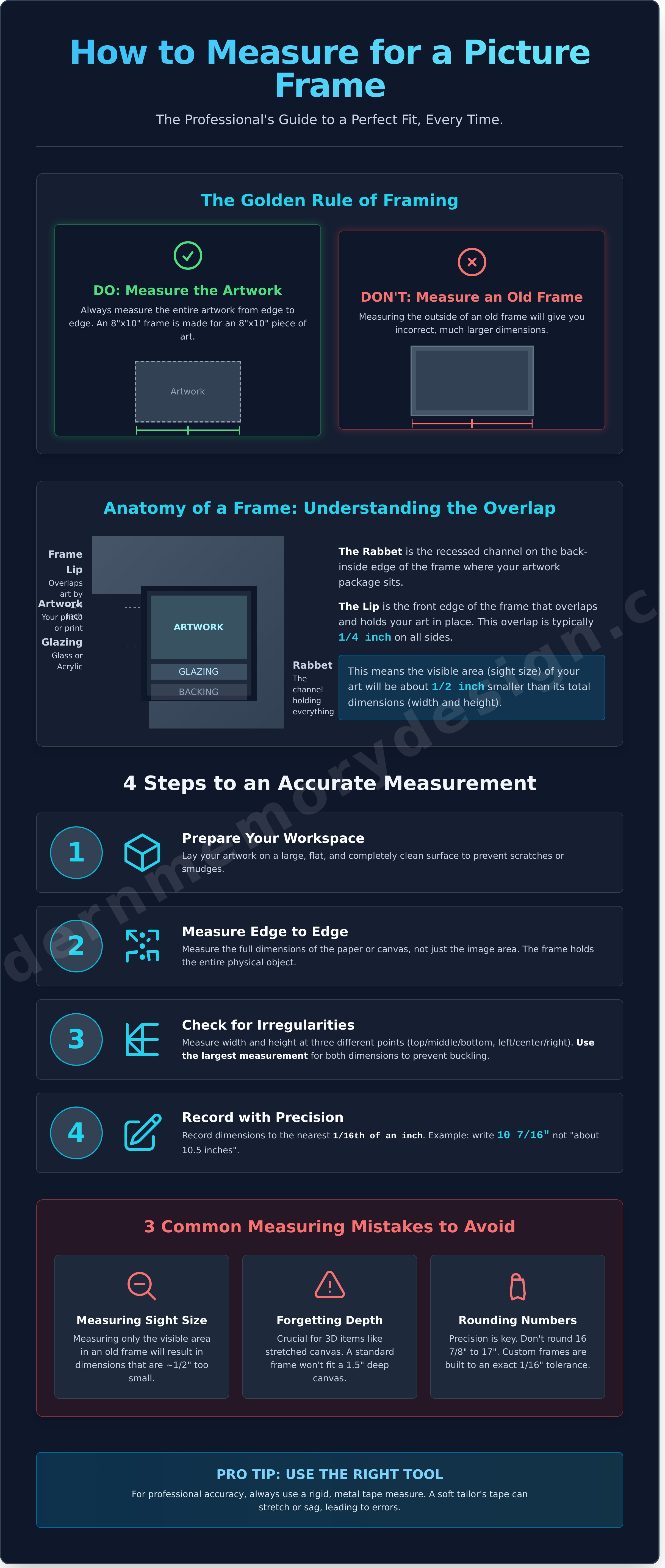
Before you pick up a tape measure, it’s essential to understand the single most important rule in the world of custom framing: always measure the artwork itself, never an old frame you plan to replace. This might sound counterintuitive, but it's the foundational principle that separates a perfectly fitted, handmade frame from a costly ordering mistake. In the professional framing industry, "Frame Size" refers to the interior dimensions of the frame, which are designed to match your artwork's exact dimensions. An 8x10 frame is crafted to hold an 8x10 photo. Measuring the outside of an old frame will give you a much larger number, leading to an order that simply won't fit.
The secret to getting this right lies in precision. That’s why our expert framers at our New Jersey workshop exclusively use a rigid, metal tape measure. Unlike a soft tailor's tape, a metal tape won't stretch or sag, ensuring accuracy down to 1/16 of an inch. A standard 12-inch school ruler is often too short for larger pieces, forcing you to make multiple marks that can introduce errors. For a professional result, the right tool is non-negotiable.
Understanding the Rabbet and Lip
The key to understanding frame dimensions is a component called the rabbet. Think of the rabbet as the recessed channel or groove on the back-inside edge of the frame where your artwork, the glazing (glass or acrylic), and the backing board all sit. To create a secure fit, all professional picture frame components, including the rabbet and the lip, work together. The frame's lip is the front edge that overlaps your art, typically covering about 1/4 inch on all four sides. This overlap is crucial for holding everything in place, but you must account for it so a critical signature or detail isn't hidden from view.
Common Measuring Mistakes to Avoid in 2026
Getting a perfect fit means avoiding the common pitfalls we've seen over more than 15 years of expert framing. The process of how to measure for picture frame accuracy is straightforward when you know what to watch out for. Steer clear of these three frequent errors:
- Mistake #1: Measuring the visible area of an old frame. If you measure only the part of the art you can see in an existing frame (the "sight size"), your measurement will be about 1/2 inch too small on both the width and height. This is because you're not accounting for the artwork hidden under the frame's 1/4-inch lip on each side.
- Mistake #2: Forgetting to measure the artwork's depth. This is especially critical for stretched canvases or matted prints. A standard picture frame has a rabbet depth of about 3/8 inch. A gallery-wrapped canvas, however, can be 1.5 inches deep or more and requires a special canvas frame with a deeper rabbet to fit correctly.
- Mistake #3: Rounding your measurements. Precision is everything. Our custom frames are built to a 1/16-inch tolerance. If your artwork measures 16 7/8 inches, don't round it up to 17 or down to 16.5. Always record the exact measurement to ensure a snug, professional fit that protects your art for years to come.
Step-by-Step: How to Measure Your Artwork Accurately
Precision is the cornerstone of professional custom framing. An inaccurate measurement, even by just 1/8 of an inch, can lead to a frame that either crushes your art or leaves unsightly gaps. Following a consistent, meticulous process ensures the handmade frame you receive from our New Jersey workshop will be a perfect fit. Before you begin, grab a quality steel tape measure, a pencil, and a notepad.
Follow these four essential steps for a flawless measurement every time:
- 1. Prepare Your Workspace: Lay your artwork on a large, flat, and completely clean surface. Any dust or debris can easily scratch or smudge a delicate print or photograph. A clean dining table or a dedicated craft desk works perfectly.
- 2. Measure Edge to Edge: It’s critical to measure the full dimensions of the paper, print, or canvas, not just the printed image area. The frame is built to hold the physical object, so we need its exact outer dimensions. This is the single most important step in learning how to measure for picture frame perfection.
- 3. Check for Irregularities: Paper and canvas are not always cut with perfect 90-degree angles. To account for any variance, measure the width at the top, middle, and bottom. Do the same for the height, measuring the left, center, and right sides. If the numbers differ, use the largest of the three measurements for both width and height. This prevents the art from buckling inside the frame.
- 4. Record with Precision: Write down your final width and height dimensions to the nearest 1/16th of an inch. For example, instead of "about 10 and a half inches," record "10 7/16 inches." This level of detail is exactly what our expert framers use to ensure a secure, museum-quality fit.
Measuring Photos and Paper Prints
Many digital photos and giclée prints arrive with a plain white border around the image. You have a choice: do you want this border to be visible, or should it be hidden? If you prefer to hide it, a custom-cut mat can be designed to overlap the border, showing only the image itself. If you want to display the border, perhaps to show an artist's signature, the mat window will be cut larger than the image. Your 'Art Size' is the total physical dimension of the paper or canvas itself, from edge to edge.
Measuring for 'Full Bleed' vs. Bordered Art
A 'full bleed' display means framing the artwork right to its edges without using a mat. This creates a clean, modern look. To do this securely, the frame's inner lip (called the rabbet) must overlap the artwork by at least 1/8 inch on all sides. This overlap holds the art, backing, and glass tightly together. For example, to frame an 8x10 photo full bleed, you would order an 8x10 frame, and we will ensure the opening is precisely 7 7/8 x 9 7/8 inches for a secure fit. The complex math for determining the right borders can be a challenge; expert resources on Calculating mat sizes offer detailed formulas to achieve perfect margins. For delicate papers with deckled (uneven) edges, consider a float mount to showcase the unique texture. These precise measurements are the first step our expert framers use to handcraft a frame that fits perfectly. If you're ever unsure, our team at Modern Memory Design is always here to guide you through the process.
The Matting Math: Calculating Sizes for Framed Art with Mats
A mat is more than just a decorative border; it’s a crucial tool that protects your art from touching the glass and creates visual space, allowing the piece to stand out. Using a mat is also the single best way to make artwork of any size fit perfectly into a larger frame. The calculation is straightforward once you understand the basic formula.
At its core, the math is simple. You add the width of the mat border to each side of your art's dimensions. The fundamental formula for determining your frame's opening size is:
[Art Width + (Mat Border Width x 2)] = Final Frame Width
However, there's a critical detail professional framers never miss: the overlap. To hold your art securely, the mat opening must be slightly smaller than the artwork itself. We recommend a 1/4-inch overlap on all sides. This means for an 8x10 print, the actual mat window should be cut to 7.5 x 9.5 inches. This small adjustment is a vital step in learning how to measure for a picture frame like an expert.
Choosing the right mat width depends on the art and the desired effect:
- 1.5 to 2-inch borders: Excellent for smaller photos (up to 8x10) or artwork where you want a subtle, clean-lined presentation.
- 2 to 3-inch borders: This is the professional standard for most medium-sized prints (11x14 to 16x20), providing elegant breathing room.
- 3-inch+ borders: Use this for larger pieces or to give a smaller piece a dramatic, gallery-quality presence on your wall.
Single Mat vs. Double Mat Calculations
A double mat introduces a second, underlying mat with a narrow, visible edge called a "reveal." This adds depth and a sophisticated color accent. The standard reveal is 1/4 inch (0.25 inches). To calculate, you simply add the reveal to your top mat's border width. For example, if you want a 2-inch white top mat over a black bottom mat with a 1/4-inch reveal, your total mat border on each side will be 2.25 inches. This combined width is what you'll use in the main formula.
Using Mats to Fit Standard Frame Sizes
Custom matting is a cost-effective secret for achieving a high-end look. Instead of ordering a fully custom frame for an oddly-sized 11x15 inch print, you can buy a high-quality standard 16x20 frame and order a custom mat to bridge the gap. This approach saves money without sacrificing a professional, handmade finish. This is the most flexible way to approach how to measure for a picture frame when working with common sizes. For a complete list of dimensions, consult our expert guide on standard picture frame sizes.
Special Considerations: Canvas, Jerseys, and Deep Items
Framing flat prints and photos is a straightforward process of measuring height and width. But when you're working with dimensional objects like a stretched canvas, a sports jersey, or family memorabilia, a third measurement becomes critical: depth. The standard rules for how to measure for picture frame components must adapt to accommodate the unique thickness and shape of these treasured items. Getting this right ensures a professional, secure fit that protects your piece for years to come.
For canvases, the process begins before the frame is even considered. Professional canvas stretching involves wrapping the artwork around a wooden support frame, called stretcher bars. Typically, this requires an extra 2 to 3 inches of canvas material on all sides to achieve a taut, gallery-quality wrap. Your frame measurement should be based on the final dimensions of the stretched canvas, not the loose, un-stretched fabric.
The most critical measurement for any three-dimensional item is the frame's rabbet depth. The rabbet is the inner channel or groove of the frame that holds the entire package-glazing, matting, artwork, and backing-in place. If your object's total thickness exceeds the rabbet depth, the backing will not fit, and the project will fail. Always ensure the frame's rabbet is at least 1/4 inch deeper than your object for a secure fit.
Measuring for Jersey Framing and Memorabilia
A shadow box is essential for items like jerseys. First, carefully fold the jersey exactly as you want it displayed and measure the resulting height and width. This "fold size" determines your frame's interior dimensions. Next, measure the thickest point of the folded jersey. To prevent the fabric from pressing against the glass, you must add at least 1/4 inch of "air space." A jersey that is 1.25 inches thick at the collar needs a total depth of at least 1.5 inches. For a flawless result without the guesswork, consider Modern Memory Design's expert jersey framing service in our NJ workshop.
Canvas and Floating Frame Measurements
A floating frame creates a dramatic illusion where the canvas appears to hover within the frame. To achieve this, we add a consistent gap, typically 1/4 inch, between the canvas edge and the frame's interior. So, for a 16x20 inch canvas, you would order a floater frame with an interior opening of 16.5x20.5 inches. You must also measure the depth of your canvas's stretcher bar (usually 0.75 or 1.5 inches) and select a frame that is slightly deeper to complete the floating effect.
Because canvases can sometimes be slightly out of square, a careful approach to how to measure for picture frame selection is vital. Measure the width at the top, middle, and bottom, and record the largest of the three measurements. Do the same for the height. Using the largest dimension ensures your canvas will fit perfectly, even with minor imperfections.
Finally, for any oversized art (typically larger than 32x40 inches), we strongly recommend switching from glass to acrylic glazing. Acrylic is up to 50% lighter than glass and is shatter-resistant, making it a safer and more practical choice for large-format pieces. This simple switch protects your art and makes it much easier to handle and hang.
Framing dimensional art requires precision. For a guaranteed professional result on your most valued pieces, let our experts handle the complexities. Explore our Custom Jersey Framing services to get started.
From Measurements to Masterpiece: Ordering Your Custom Frame
You've done the careful work of measuring your art, and now you're ready to transform those numbers into a finished piece. This is where precision meets passion. Before you finalize your order, a quick review ensures your custom frame will be the perfect fit you envisioned.
Your final checklist before clicking 'order':
- Re-measure one last time. We can't stress this enough. Grab your tape measure and confirm your width and height numbers. It only takes a minute.
- Confirm your orientation. Double-check you've recorded your measurements as Width x Height. A 16" x 20" frame is very different from a 20" x 16" frame.
- Note the exact fraction. Don't round your numbers. If your art measures 10 ⅜ inches, enter that precise fraction. Our system is built for this level of detail.
Once you have your final, confirmed dimensions, our online 'Upload & Frame' tool makes it simple. You just input your exact artwork size, and the visualizer shows you how it will look with different mats and moldings. If your measurements fall between standard sizes, that's what custom framing is for. Simply enter your precise dimensions, for example, 11 ⅞" x 15 ¼", and we'll build the frame to those exact specifications. There’s no need to round up or down.
This level of precision is possible because every frame is handcrafted in our Hasbrouck Heights, New Jersey workshop. Being 'Made in the USA' isn't just a slogan; it's our commitment to quality control. Our expert framers use your exact dimensions to cut materials with less than 1/16th of an inch tolerance, ensuring a perfect, snug fit that mass-produced frames can't match. Mastering how to measure for picture frame is the first step; our craftsmanship is the second.
Choosing the Right Glass and Backing
The inside of your frame is just as important as the outside. Your art's dimensions guide the selection of archival materials that will protect it for decades. We recommend UV-protective acrylic glazing, which blocks over 99% of harmful ultraviolet rays that cause fading. All our mat boards and backing are acid-free and lignin-free, preventing discoloration and preserving the integrity of your artwork. Your molding choice should also complement the size; larger pieces often benefit from a wider, more substantial molding for both structural support and visual balance.
Local Support: Professional Hanging and Consultation
For large, valuable, or complex installations, sometimes you need an expert. We offer a professional picture hanging service for clients in New Jersey, New York City, and Connecticut. If you're unsure about your measurements or just want a second opinion, local customers are always welcome to visit our Hasbrouck Heights workshop. Bring your art with you, and our team will verify your dimensions in person to guarantee a flawless result. We bridge the convenience of online ordering with the trust of a local, hands-on shop.
You're now ready to complete the process. Your careful measurements and our expert craftsmanship are about to come together. Each frame we build is a unique piece, handmade for you. Start your custom order today and give your art the beautiful, lasting home it deserves.
Turn Your Measurements into a Masterpiece
You now have the skills for a perfect fit. Remember the two most important rules: always measure the artwork itself, not the wall space, and carefully add the mat dimensions to your calculations. Mastering how to measure for a picture frame is the critical first step, and you've nailed it.
The next step is turning those numbers into reality. At Modern Memory Design, our expert team uses your exact dimensions to create a stunning final product. Every single frame is handmade in our Hasbrouck Heights, New Jersey workshop with museum-quality, archival materials designed to preserve your art for over 100 years. From professional jersey framing to protecting your diplomas, our craftsmanship ensures your piece is displayed perfectly.
Ready to see the difference professional quality makes? Start Framing Your Masterpiece at Modern Memory Design.
You've taken the precise measurements. Now let us handle the expert craftsmanship.
Frequently Asked Questions
Do I measure the image or the paper it's printed on?
Always measure the exact dimensions of the image area you want to be visible. If your artwork has a white border that you wish to cover with a mat or the frame itself, do not include it in your measurements. For example, if you have an 8x10 image printed on an 8.5x11 sheet of paper, you will order an 8x10 frame. Our expert framers build each frame to your artwork's precise size for a professional, custom fit.
How much of my picture will be covered by the frame lip?
The standard lip of a picture frame will cover approximately 1/4 inch of your artwork on all four sides. This overlap, also called the rabbet, is necessary to hold your art securely in place behind the glass and backing. It's a crucial detail, so ensure no important elements like signatures or dates fall within that 1/4-inch perimeter of your piece. This guarantees your art is held safely without obscuring key details.
What is the standard mat size for an 8x10 photo?
For an 8x10 photo, a standard mat will typically add a 2 to 3-inch border, resulting in a final frame size of 12x14 or 14x16 inches. The mat window opening is cut to 7.75x9.75 inches, creating a 1/8-inch overlap that prevents the photo from falling through. This professional technique provides a clean, perfectly centered presentation. We use only archival-quality, acid-free mats to protect your photos for over 100 years.
How do I measure for a frame if I want to include a mat?
First, measure your artwork's exact dimensions. Next, decide on the mat border width you would like, for example, 2.5 inches. To calculate the frame size, double the mat width and add it to your art's dimensions. For an 8x10 photo with a 2.5-inch mat, the calculation is (8 + 2.5 + 2.5) by (10 + 2.5 + 2.5), which equals a 13x15 frame. This is a key step in how to measure for picture frame when you want a classic matted look.
Can I frame a canvas in a regular picture frame?
No, a standard stretched canvas requires a special canvas frame, often called a floater frame, which is designed for its depth. Regular picture frames have a shallow rabbet made for thin art, paper, and glass. A stretched canvas is typically 0.75 to 1.5 inches deep and won't fit securely. Floater frames are custom-built to accommodate this depth, creating a professional gallery look where the canvas appears to "float" inside the frame.
What should I do if my artwork is an odd or non-standard size?
If your art is a non-standard size, our custom framing service is the perfect solution. Simply measure your art's exact width and height to the nearest 1/8 of an inch and enter those dimensions when you order online. That's the beauty of our handmade process; we build every frame to your specific measurements. There's no need to crop your art or settle for a poorly fitting ready-made frame. We guarantee a perfect fit every time.
Is it better to measure in inches or centimeters for custom framing?
In the United States, it's standard practice to measure and order frames using inches. All our frames at Modern Memory Design are handcrafted in our New Jersey workshop using the imperial system. For the highest accuracy, use a steel tape measure and record your dimensions to the nearest 1/8 inch. Providing measurements in inches ensures there are no conversion errors and that your frame will be built to your exact specifications for a perfect, quality fit.
How do I calculate the 'Sight Size' of a frame?
The 'Sight Size' is the viewable area inside the frame, which you can calculate by subtracting the frame's lip from the frame's opening size. Since our standard frame lip covers 1/4 inch on each side, you would subtract a total of 1/2 inch from both the width and the height. For an 11x14 frame, the sight size would be 10.5 x 13.5 inches. Knowing this helps you understand exactly which parts of your artwork will be visible once it's framed.
Leave a comment