


The Ultimate Guide to Picture Frame Sizes: Standard, Common & Custom Dimensions
Buying a frame that is just 1/8th of an inch too small can turn a $200 limited edition print into a damaged piece of paper in seconds. You've likely felt that specific sting of frustration before. You find a piece of art you love, but then you're left staring at a confusing grid of picture frame sizes wondering if you should buy the 8x10 or the 11x14 with a mat. It's difficult to distinguish between the image size, the mat opening, and the total frame dimensions when you just want your memory to look its best.
We believe every piece of art deserves a professional finish, whether it's a family photo or a gallery print. Our guide will help you master these dimensions so you can achieve a museum-quality look without the fear that expensive custom work is your only path to quality. You'll get a clear list of standard dimensions, learn exactly when to use a mat, and gain the confidence to measure your own artwork like an expert from our New Jersey workshop. Let's make sure your next frame is handmade for you and fits perfectly the first time.
Key Takeaways
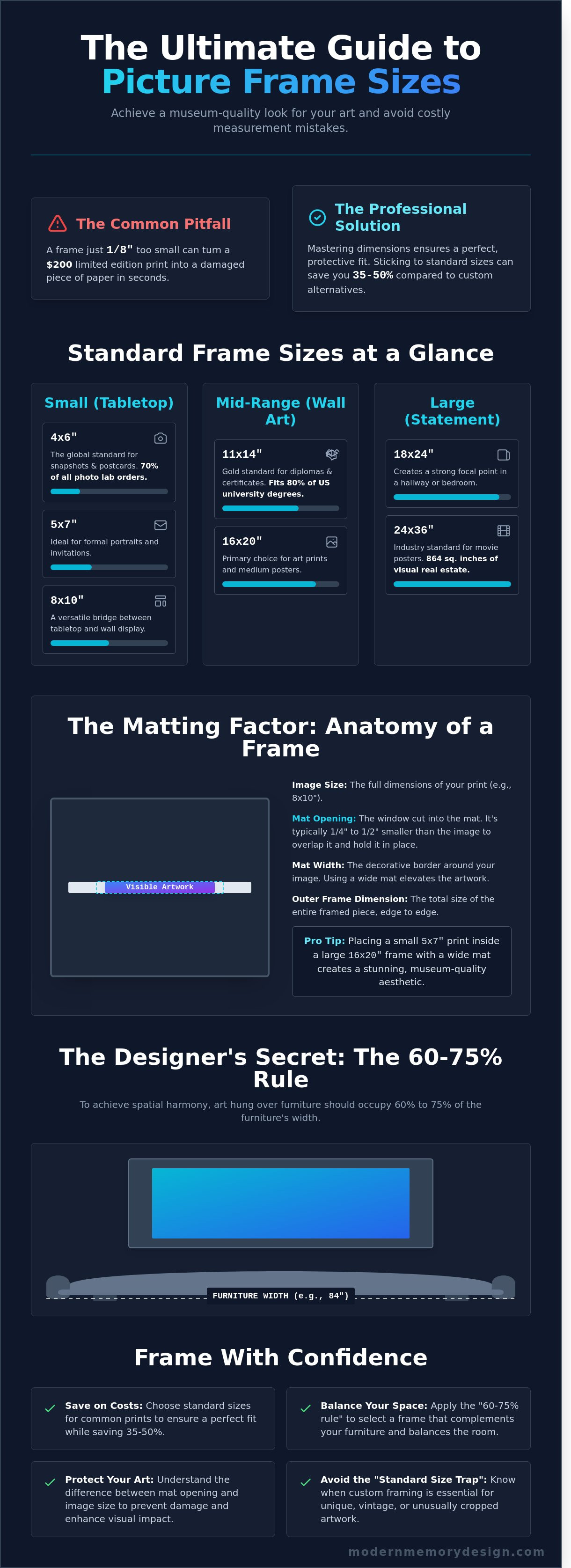
- Learn how to identify standard picture frame sizes to save on costs while ensuring a perfect fit for common photo prints.
- Master the "60-75% rule" to choose a frame that perfectly balances your wall space and complements your existing furniture.
- Understand the crucial difference between mat openings and outer frame dimensions to protect your art and enhance its visual impact.
- Follow our expert 5-step measuring guide to accurately calculate dimensions for any piece, including how to properly account for decorative matting.
- Discover how to avoid the "Standard Size Trap" by knowing when custom framing is essential for preserving the composition of unique or vintage artwork.
What are Standard Picture Frame Sizes? The Basics Explained
A standard frame size refers to the industry-accepted dimensions for ready-made frames. These specific measurements are mass-produced to fit the most common photo print sizes, ensuring that you can find a display solution without waiting for a custom build. By sticking to these recognized dimensions, you ensure your project remains both efficient and affordable. Most retail labs and home printers are calibrated to these exact specs, which makes the process of going from a digital file to a finished wall display seamless.
The concept of a picture frame has existed for centuries, but modern standardization only became a necessity with the rise of commercial photography in the late 19th century. Today, standardizing these dimensions allows manufacturers to produce high-quality pieces in bulk. This mass production typically reduces the consumer cost by 35% to 50% compared to custom-milled alternatives. For a quick decor project, availability is the primary benefit. You can walk into our New Jersey workshop or browse our online store and find dozens of styles in these sizes ready for immediate shipping.
Ready-made frames usually come equipped with 2mm clear glass or lightweight acrylic and a pre-cut backing. This consistency means you don't have to worry about measuring every millimeter of your artwork. If your print is a 4x6, 5x7, or 8x10, there's a frame waiting for it. These "Big Three" sizes dominate the market because they match the aspect ratios of modern digital sensors and traditional film. Understanding these picture frame sizes is the first step in creating a professional-looking gallery wall on a budget.
The Most Popular Small Frame Dimensions
Small frames are the essential building blocks for tabletops, mantels, and bedside tables. The 4x6 frame is the absolute standard for postcard-sized prints and quick snapshots. It's the most common size for physical photo prints globally, accounting for nearly 70% of all lab orders. If you want something with a bit more presence, the 5x7 frame is the ideal choice for portraits and wedding invitations. It offers a slightly more formal look than the 4x6. The 8x10 frame acts as the bridge between tabletop displays and wall art. It's large enough to capture detail from across the room but small enough to remain unobtrusive on a crowded shelf.
Mid-Range and Large Standard Sizes
Once you transition from the desk to the wall, the dimensions scale up significantly. The 11x14 frame is widely considered the gold standard for office diplomas and professional certificates; approximately 80% of university degrees in the United States are designed to fit this specific size. Moving into larger statement pieces, 16x20 and 18x24 frames are the primary choices for art prints and medium-sized posters. These sizes provide enough surface area to act as a focal point in a hallway or bedroom. For high-impact displays, the 24x36 frame is the go-to option. This size is the industry standard for movie posters and large-scale photography, offering 864 square inches of visual real estate. Choosing these standard picture frame sizes ensures that your large-scale art looks intentional and professionally curated.
Choosing the Right Size for Your Space: A Design Perspective
Selecting the right picture frame sizes involves more than just matching the dimensions of a photograph. It's about spatial harmony and how an object interacts with the surrounding architecture. A frame that's too small for a large wall simply disappears, while a massive frame in a cramped hallway can feel claustrophobic. To achieve a professional look, designers rely on the 60-75% rule. This guideline suggests that when you hang art over furniture, such as a sofa or a sideboard, the frame or grouping should occupy 60% to 75% of the furniture's total width. For instance, if your sofa is 84 inches long, your framed art should span between 50 and 63 inches to look balanced and intentional.
The scale of your framing also dictates the perceived size of the room. In a 120-square-foot bedroom, a single oversized frame can actually make the space feel larger. This happens because one large focal point reduces visual "noise" compared to several small items that break up the wall. Placing a small photo in a large frame with a wide mat creates a high-end gallery feel that instantly elevates a personal snapshot into a piece of fine art. At our New Jersey workshop, we've seen how a 5x7 print inside a 16x20 frame with a deep 5-inch mat provides a sophisticated, museum-quality aesthetic that catches the eye from across the room.
Proportion is everything when you're trying to build trust in your home's design. Understanding how to choose the right frame means looking at the wall real estate as a whole. If you have 10-foot ceilings, you can afford to go taller with your picture frame sizes to draw the eye upward, highlighting the height of the room. Our team of expert framers often suggests using archival materials for these larger pieces to ensure the art remains flat and protected for decades.
Sizes for Gallery Walls
Gallery walls are an excellent way to tell a story by mixing various picture frame sizes. To keep the arrangement from looking chaotic, start with a "hero piece." This is typically a 16x20 or 24x36 frame that acts as the anchor for the entire display. Around this anchor, you can layer in standard sizes like 4x6, 5x7, and 8x10 to create visual interest and movement. Using a consistent frame color, like our Modern Sleek Black, can tie these different sizes together into a cohesive unit. For more inspiration on layouts, explore these Gallery Wall Ideas to see how different dimensions work together in real-world settings.
Large Oversized Picture Frames for Impact
When you want to make a bold statement in a living room, entryway, or corporate office, oversized frames are the answer. These pieces are designed to command attention and fill large voids on the wall. For frames larger than 24x36 inches, the width of the frame moulding becomes a critical factor. A thin 0.5-inch moulding might look flimsy on a massive print; instead, we recommend a 2-inch or 3-inch profile to provide the necessary structural integrity and visual weight. Modern Memory Design specializes in large oversized picture frames that are handmade in the USA, ensuring that even your biggest projects meet our strict quality standards. If you're ready to transform your blank wall, you can shop our custom collections to find the perfect fit for your next masterpiece.
The Matting Factor: How Mats Change Your Frame Size
Most people choose picture frame sizes based solely on the dimensions of their print, but adding a mat changes the entire calculation. A mat isn't just a decorative border; it's a functional tool that creates a professional, finished look. The "Mat Opening" refers to the hole cut in the center where your art is visible. We typically cut this opening 0.25 inches smaller than the print on all sides. This slight overlap ensures the edges of your photo don't peek out or fall through the opening. The "Outer Frame Size" is the total dimension of the glass and the frame's interior, which must accommodate both the artwork and the mat borders.
Protection is the most practical reason to include a mat in your framing project. It provides a necessary air gap between your artwork and the glass. Without this space, moisture can condense on the inside of the glass, causing the paper to ripple or the ink to fuse directly to the surface. This physical separation is a hallmark of museum-quality preservation. Our expert framers always recommend acid-free mats to prevent "mat burn," which is the yellowing or brittle texture caused by cheap, high-acid wood pulp mats found in generic store-bought options.
Calculating your final frame size requires basic "Matting Math." You must account for the border width on both sides of the image. For example, if you have an 8x10 photo and want a 2-inch mat border, you add 4 inches to the width and 4 inches to the height. Your final frame size becomes 12x14. Use these standard widths to guide your design:
- 1.5-inch borders: Ideal for small 4x6 or 5x7 photos to prevent the mat from overwhelming the image.
- 2-inch borders: The industry standard that provides a balanced, professional look for most home decor.
- 3-inch borders: Creates a dramatic, gallery-style aesthetic that draws the eye directly to the center of the piece.
Standard Photo to Frame Size Conversion
Matching a standard photo to a larger frame is the easiest way to elevate a simple print. Many users find that a 8x10 Frame Guide helps them visualize how smaller photos fit into classic picture frame sizes. For a traditional look, consider a "weighted bottom" mat. This style involves making the bottom border 0.5 to 1 inch wider than the top and sides. It corrects an optical illusion that makes the bottom border look thinner when hung at eye level.
- 4x6 Photo: Fits an 8x10 frame with a 2-inch mat.
- 5x7 Photo: Fits an 8x10 frame (minimal mat) or an 11x14 frame (generous mat).
- 8x10 Photo: Fits an 11x14 frame for a standard look or a 16x20 frame for a modern, airy feel.
Custom Mats vs. Standard Mats
Store-bought mats are often limited by fixed openings and thin, low-quality materials. They don't offer the flexibility needed for "floating" art, where the edges of the paper are exposed to show off deckled edges. At Modern Memory Design in Hasbrouck Heights, NJ, we provide precision mat cutting for any dimension. Our custom-cut mats allow for non-standard margins and unique shapes that off-the-shelf options can't match. We treat every piece as a masterpiece of design and craftsmanship, ensuring your handmade frame fits your vision perfectly.
How to Measure for a Picture Frame: A 5-Step Guide
Measuring your art accurately ensures your custom piece looks like it was handled by a professional. At our New Jersey workshop, we see how a 1/8 inch error can ruin a project's flow. Follow these steps to get your dimensions perfect before ordering. Understanding how these measurements translate to standard picture frame sizes helps you decide between a ready-made or custom option.
Step 1: Measure the physical artwork. Use a firm metal tape measure rather than a cloth one to avoid stretching. Lay your art on a flat, clean surface and measure the total width and height of the paper or canvas. Don't guess based on the size listed on the packaging; a print labeled 8x10 might actually be 8.25x10.125 inches. Record these numbers exactly.
Step 2: Decide on a mat. If you want a border around your photo, you'll need to add 2 to 4 inches to each dimension. For example, an 8x10 print with a 2-inch mat requires a frame with an opening of 12x14 inches. This extra space provides a visual "breather" and prevents the artwork from touching the glass. Choosing the right picture frame sizes depends entirely on these initial calculations.
Step 3: Account for the frame lip. Every frame has a "lip" or "rabbet" that holds the glass and art in place. This lip usually covers about 1/4 inch of the art on all sides. If your artwork has important details or a signature right at the edge, you may need a larger mat to ensure those elements aren't hidden by the frame's edge. This overlap is what keeps your photo from falling through the front of the frame.
Step 4: Check for aspect ratio consistency. You can't fit a square 8x8 photo into a rectangular 4x6 frame without significant cropping or awkward empty spaces. If your photo is a 4:5 ratio, stick to sizes like 8x10 or 16x20. Forcing an image into the wrong ratio leads to distorted subjects or cut-off heads, which ruins the craftsmanship of the final display.
Step 5: Verify the depth of the art. Standard frames are designed for thin paper or photos. If you're framing a canvas or a jersey, you need to measure the thickness. A standard canvas stretcher bar is often 0.75 inches or 1.5 inches deep. If your frame's "rabbet depth" is only 0.5 inches, the canvas will stick out the back, preventing the frame from sitting flush against your wall.
Measuring for Non-Standard Items
Jerseys and memorabilia require specialized shadow boxes with depths ranging from 1 inch to 3 inches. When measuring a jersey, fold it as you intend to display it and measure the highest point of the fabric to ensure it doesn't press against the acrylic. For canvases, floating frames are a popular choice; these require measuring the "stretcher bar" depth so the art sits perfectly level with the frame edge. You can learn more in our Jersey Framing Guide.
Common Measuring Mistakes to Avoid
- Measuring the old frame: Never measure the outside of an old frame to determine the size of a new one. Frame moldings vary in width, which will lead to an incorrect fit.
- Ignoring the mat overlap: If your mat opening is exactly 8x10 for an 8x10 photo, the photo will fall through. The opening should be 1/8 inch smaller than the art on all sides.
- Rounding up: For any custom project, always measure to the nearest 1/16th of an inch to ensure a snug, professional fit.
Our team at Modern Memory Design is ready to help you turn these measurements into a masterpiece. Shop our custom frames to find the perfect fit for your measured dimensions.
When Standard Sizes Don’t Work: The Custom Framing Advantage
Many shoppers fall into the "Standard Size Trap" when they attempt to fit unique art into mass-produced moldings. While common picture frame sizes like 4x6 or 8x10 are convenient for snapshots, they often force you to crop original compositions. If you have a 9x12 watercolor, forcing it into an 8x10 frame means you lose nearly 20% of the artist's original work. This compromise ruins the visual balance and intended focal point of your piece.
Custom framing provides the perfect solution for odd-sized prints, heirloom vintage photos, and original canvases. Vintage polaroids or European postcards rarely align with American retail standards. Instead of trimming a 100 year old family memory, a custom build preserves every millimeter. Our "Handmade For You" approach ensures that your frame is built to the exact sixteenth of an inch, providing a seamless fit that ready-made options simply don't match.
The difference isn't just about the dimensions; it's about longevity. Roughly 90% of cheap, "off-the-shelf" frames use acidic cardboard backings and standard glass. Over a 10 year period, these materials can cause "acid burn," leading to yellowing and brittle paper. At Modern Memory Design, we prioritize archival integrity. Our custom builds feature 100% acid-free matting and UV-protective glass that blocks 99% of harmful light rays, ensuring your art looks as vibrant in 2040 as it does today.
Expert Framing in New Jersey and Beyond
Our Hasbrouck Heights workshop is more than just a production facility; it's a hub for craftsmanship. We offer in-person consultations for clients who want to touch the wood grains and see mat colors in person. We've bridged the gap for those outside of Bergen County by making it easy to order custom frames online without sacrificing the quality of a local shop. Every frame is Made in the USA, and we provide professional hanging services for large-scale projects across NJ, NYC, and CT.
Final Checklist: Before You Buy Your Frame
Before finalizing your selection, review these technical specifications to ensure your frame meets your display needs:
- Material check: Solid wood offers timeless durability; metal provides a sleek, modern profile for offices; synthetic options work well for high-humidity areas like bathrooms.
- Glass check: Standard glass works for low-light areas, but use UV-Protective glass for art near windows. Choose Non-Glare glass if your room has heavy overhead lighting.
- Installation: For frames over 24 inches, we recommend D-rings and heavy-duty wire. Smaller picture frame sizes can often use simpler sawtooth hangers.
Most custom orders at our workshop are completed within 4 to 6 business days, ensuring a fast turnaround for your home decor projects. Don't settle for a frame that almost fits. Explore our full range of standard and custom frames at Modern Memory Design.
Transform Your Walls with the Perfect Fit
Finding the right picture frame sizes is the final step in turning a simple photo into a professional display. You now know how to distinguish between standard dimensions and when a custom build is necessary to preserve your art. Remember that adding a mat will increase your total frame size, so always measure your wall space twice before ordering. At Modern Memory Design, we've perfected the art of framing in our New Jersey workshop. Every frame is handmade in the USA using museum-quality archival materials designed to last for generations. If you're located in NJ, NYC, or CT, you can even take advantage of our professional hanging service for a flawless gallery finish. Don't settle for mass-produced options that don't fit your vision. You've captured a beautiful moment; let's make sure it's displayed with the expert craftsmanship it deserves.
Shop Handcrafted Custom and Standard Frames at Modern Memory Design
Frequently Asked Questions
What are the most common picture frame sizes?
The most common picture frame sizes include 4x6, 5x7, 8x10, 11x14, 16x20, and 24x36 inches. These standard dimensions represent 90% of ready-made frames sold in our New Jersey workshop. Most desktop photos use the 4x6 or 5x7 format, while 8x10 is the industry standard for school portraits and professional headshots. Choosing these sizes ensures you'll find a wide variety of styles, from modern sleek to ornate vintage.
Does an 8x10 frame hold an 8x10 photo?
Yes, an 8x10 frame is specifically designed to hold an 8x10 photo, though the frame lip covers about 0.25 inches of the image on all sides. This means your visible artwork area is actually 7.5x9.5 inches. Our expert framers use these precise measurements to ensure your print stays secure inside the molding. If you want to see the full 8x10 image without overlap, you'll need a larger frame with a custom-cut mat.
What size frame do I need for a 12x18 print?
You need a 12x18 frame for a flush fit, or an 18x24 frame if you plan to use a 3 inch mat border. Since 12x18 is a common size for digital photography prints with a 2:3 aspect ratio, we keep these wood moldings in stock at our NJ frame shop. Using an 18x24 frame provides a professional gallery look that highlights the 216 square inches of your artwork while protecting the paper edges.
How much larger should a frame be than the picture?
A frame should be 2 to 4 inches larger than the picture on each side when you're using a mat. For an 8x10 print, a 12x14 or 11x14 frame is the standard choice to allow for a 1.5 to 2 inch mat border. This extra space creates a visual focal point and prevents the glass from touching your artwork. It's a technique we use for 100% of our museum-quality archival projects to ensure longevity.
What is the standard size for a gallery wall frame?
The most frequent picture frame sizes for a gallery wall are 8x10, 11x14, and 12x12 inches. Most designers recommend mixing 3 to 5 different dimensions to create visual interest and movement across the wall. In our experience, starting with a central 16x20 anchor piece and surrounding it with 4 smaller frames creates a balanced layout. We've handcrafted over 500 gallery wall sets this year to help customers achieve this professional look.
What size is a large poster frame?
A 24x36 inch frame is the industry standard for a large poster, though 18x24 and 27x40 are also common. Movie studios typically use 27x40 inches for original theatrical one-sheets. At Modern Memory Design, we handcraft these large-format frames using UV-protective glass to prevent fading. These sizes are perfect for making a bold statement in a living room or office space, providing 864 square inches of visual impact.
Can I get a custom-sized frame online?
You can order a custom-sized frame through our website, with measurements accurate to 0.0625 inches. We build every frame by hand in our USA workshop to your exact specifications. Whether you have an odd-sized 13.5x19 print or a large 40x60 canvas, our online tool lets you select the style and glass type. Most custom orders are completed and shipped within 4 to 6 business days, ensuring a fast turnaround for your masterpiece.
Why are some frame sizes harder to find than others?
Retailers focus on 5 standard sizes that match 85% of consumer printer paper and digital camera sensors. Sizes like 13x19 or 10x13 are harder to find because they don't follow the common 4:5 or 2:3 aspect ratios used in mass production. If you have a non-standard print, our professional NJ frame shop specializes in creating handmade solutions. This ensures your unique art gets a perfect fit without being cropped or damaged by ill-fitting materials.
Leave a comment