


Professional Photo Prints: The Expert Guide to Archival Quality & Framing
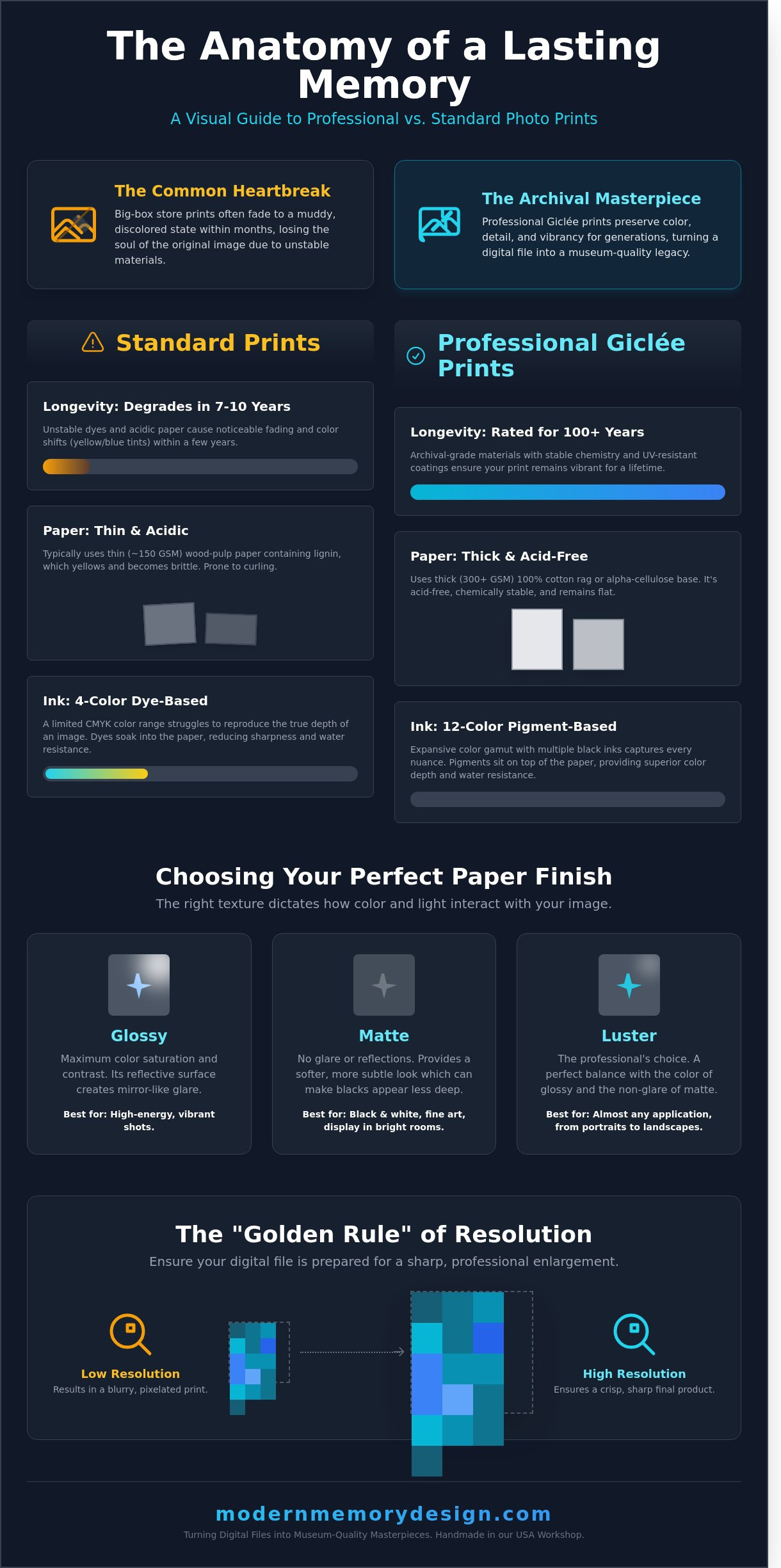
Last Tuesday, a client visited our New Jersey workshop with a wedding portrait printed at a big-box store that had turned a muddy grey within just 12 months. It’s a common heartbreak to see a vivid digital memory lose its soul the moment it hits physical paper. You likely agree that your most significant moments deserve more than thin, acidic paper that curls at the edges or colors that look nothing like the original shot on your iPhone. You want a finished piece that commands attention on your wall and remains vibrant for decades.
Glossy paper is the standard for snapshots because it offers the highest contrast. It's perfect for high-energy shots but can be difficult to handle. A single thumbprint leaves oils that degrade the surface over time. Matte paper removes the reflection entirely. It's the preferred choice for black and white photography or high-key portraits where a soft, artistic aesthetic is the goal. Luster, often called semi-gloss or "E-surface," is the industry workhorse. It features a fine, pebbled texture that hides fingerprints while maintaining 85% of the color vibrancy found in glossy alternatives. This makes it the ideal middle ground for family portraits and Wedding Photography.
This guide will show you exactly how to achieve that by creating professional photo prints using archival materials and precision techniques. We will explain how to choose the right paper weight, ensure your resolution is sharp enough for large-scale displays, and select handcrafted frames for any non-standard size. By the end, you will have the expert knowledge needed to turn a simple file upload into a museum-quality masterpiece that is truly handmade for you.
Key Takeaways
- Discover how selecting the right paper texture and finish can dramatically change the way colors and light interact with your images.
- Master the "Golden Rule" of resolution to ensure your digital files are perfectly prepared for sharp, professional-grade enlargements.
- Protect your investment by understanding why archival materials and professional framing are essential to prevent long-term damage like acid leaching.
- Learn the seamless process of turning your digital files into museum-quality photo prints that are handmade for you in our USA workshop.
- Explore the benefits of a one-stop-shop approach to ensure your prints and custom frames fit together perfectly every time.
Beyond the Digital Screen: Why Quality Photo Prints Matter
Most people have thousands of images stored on their smartphones, yet a 2023 consumer survey found that 82% of digital photos are never viewed more than once after the initial capture. There's a tangible weight to a physical print that a glass screen simply cannot replicate. When you hold a high-quality photo print, you're interacting with a piece of deliberate craft rather than a fleeting digital signal. It's the difference between a temporary file and a lasting legacy. Physical memories provide a sensory connection to the past, allowing families to pass down stories through objects that don't require a battery or a cloud subscription to access.
Standard drugstore kiosks often use thermal dye-sublimation or basic inkjet technology designed for speed over longevity. These machines prioritize convenience, but they often fail to capture the true color profile of your image. Professional labs focus on the technical nuances of the photographic printing process to ensure color accuracy and structural integrity. Cheap prints often shift toward a sickly yellow or blue tint within 48 months because the dyes are chemically unstable. Professional-grade prints use stable chemistry and specialized coatings that resist environmental degradation and UV exposure.
Modern interior design relies heavily on these physical touchpoints to create a sense of home. A well-curated gallery wall in a residence or a corporate office requires visual consistency. If one print fades while others stay vibrant, the entire aesthetic fails. At our NJ workshop, we frequently see customers who bring in faded drugstore prints hoping for a professional restoration and a reprint that actually lasts. Investing in professional quality from the start ensures your decor remains as vivid as the day it was hung.
This principle of creating physical touchpoints isn't limited to framed prints. Functional, beautiful items like custom photo calendars can also serve as a year-round gallery of your favorite moments. For those looking to create such personalized pieces, Photobook Press offers high-quality options that turn your digital images into daily joy.
Archival Quality vs. Standard Prints
An archival print isn't just a marketing term; it refers to materials that are chemically stable and permanent. Standard prints use wood-pulp papers containing lignin, which turns yellow and brittle over time. Archival prints utilize acid-free bases, often 100% cotton rag, paired with pigment inks. While a standard print begins to noticeably degrade in 7 to 10 years, an archival-grade photo print is rated to last 100 years or more under normal indoor lighting conditions. This museum-quality standard is the benchmark for anyone looking to preserve family history.
The Craftsmanship of Giclée Printing
Giclée printing represents the pinnacle of high-definition inkjet output for fine art. Standard home or office printers rely on a basic 4-color CMYK process, which severely limits the range of colors they can reproduce. Professional labs like Modern Memory Design use 12-color pigment-based systems. These systems include multiple shades of black and gray, alongside vibrant oranges and greens, to capture every nuance of the original file. Pigment inks sit on top of the paper fibers rather than soaking in like dyes, resulting in superior color depth and significantly better water resistance.
Choosing the Right Paper Finish for Your Photo Prints
Selecting a paper finish isn't just a final step; it's a design choice that dictates how your images interact with the environment. High-quality photo prints require a foundation that matches the intended display area. For example, a 300 GSM (grams per square meter) paper provides the structural integrity needed to prevent edges from curling over a 10 year period. Thinner papers, often found in 150 GSM economy options, lack the cotton or alpha-cellulose fibers required to maintain flatness in humid environments.
The texture of the paper changes how your eyes perceive color and depth. Glossy finishes use a smooth coating to reflect light directly, which increases the perceived Dmax, or maximum black density. This makes colors appear more saturated. However, this same coating creates a mirror-like glare. Matte finishes scatter light in multiple directions. This reduces glare to near zero but can make dark shadows look slightly softer. If you've invested time creating high-quality digital masters, choosing a paper with a high ISO brightness rating of 92 or above ensures those digital highlights translate accurately to the physical page.
Glossy vs. Matte vs. Luster: A Comparison
Glossy paper is the standard for snapshots because it offers the highest contrast. It's perfect for high-energy shots but can be difficult to handle. A single thumbprint leaves oils that degrade the surface over time. Matte paper removes the reflection entirely. It's the preferred choice for black and white photography or high-key portraits where a soft, artistic aesthetic is the goal. Luster, often called semi-gloss or "E-surface," is the industry workhorse. It features a fine, pebbled texture that hides fingerprints while maintaining 85% of the color vibrancy found in glossy alternatives. This makes it the ideal middle ground for family portraits and wedding photography.
Specialty Media: Canvas, Metal, and Fine Art Paper
For those seeking a museum-grade presentation, fine art rag paper made from 100% cotton is the gold standard. These papers are typically 310 GSM or heavier and are acid-free to prevent yellowing. Canvas prints offer a 3D presence, especially when stretched over 1.5 inch wooden bars. This eliminates the need for glass entirely. Metal prints use a dye-sublimation process to infuse ink into aluminum, creating a waterproof finish that's 3 times more durable than traditional paper. These specialty media options often dictate your framing. A canvas usually requires a floating frame, while fine art paper needs a deep mat to keep the heavy fibers from touching the acrylic.
When exploring these premium options, services like Photobook Press can be a great resource for seeing how different materials translate into finished wall art.
When placing your photo prints behind glass, the finish matters. Glossy prints often "Newton ring" or stick to the glass if they aren't separated by a mat board. At our New Jersey workshop, we recommend luster or matte finishes for frames using standard acrylic to minimize internal reflections. If you're using UV-protective glass, a matte finish helps the viewer see image details without battling overhead light bounce. Heavyweight papers also resist the "waving" effect that occurs when thinner 170 GSM papers react to temperature changes inside a sealed frame.
Resolution and Sizing: Preparing Your Files for Large Prints
High-quality photo prints start with the right data. The industry standard is 300 DPI, which stands for dots per inch. This means for every inch of paper, your file should provide 300 individual pixels of information. If you try to print an image at 72 DPI, which is the standard for digital screens, the result will look blurry or soft on paper. Professional labs require this density to ensure that every detail, from the texture of a sweater to the sharp lines of a cityscape, remains crisp during the physical printing process.
To check your digital file size on a Windows PC, right-click the image file, select Properties, and look at the Details tab. On a Mac, press Command+I to open the Get Info window. You need to look for the pixel dimensions. For example, if your file is 1200 x 1800 pixels, it will produce a perfect 4x6 print at 300 DPI. If those same pixels are stretched to an 8x10, the DPI drops to 150, which may lead to a loss of clarity.
Native resolution refers to the raw data captured by your camera sensor. A standard 12-megapixel smartphone camera produces a 4000 x 3000 pixel image. Upscaling is a software process that uses AI to create new pixels to fill gaps when enlarging a small photo. While AI tools have improved significantly since 2023, they can't perfectly replicate missing details. It's always better to use the original, unedited file for your photo prints to maintain the highest possible integrity.
Aspect ratio describes the relationship between an image's width and height. A standard 4x6 print has a 2:3 ratio, which is what most DSLR cameras capture natively. An 8x10 print uses a 4:5 ratio. If you take a 2:3 photo and try to print it as an 8x10, you'll lose about 2 inches of the image on the longer side. This is why 11x14 prints are popular; they offer a middle ground but still require specific cropping. Always preview your crop before finalizing an order to ensure you don't cut off a subject's head or a vital part of the landscape.
The Resolution Cheat Sheet for Common Sizes
For a sharp 8x10 print, your file should be at least 2400 x 3000 pixels. If you're planning a large 24x36 poster frame for a gallery wall, a resolution of 7200 x 10800 pixels is ideal for close-up inspection. Larger prints require less DPI if they're viewed from a distance of three feet or more. A billboard, for instance, often prints at only 15 to 30 DPI because the viewer is hundreds of feet away.
Avoiding the "Pixelation Trap" in Enlargements
Pixelation happens when a low-resolution file is stretched beyond its capacity. You'll see jagged "staircase" edges and blocky, distorted colors in shadow areas. Smartphone compression is the most common culprit. Apps like WhatsApp or Facebook Messenger often strip 90% of a file's data to save server space. At Modern Memory Design, our expert framers in our New Jersey workshop perform a file verification check on every order to catch these issues. We've found that files under 1MB rarely produce professional results for sizes larger than 5x7. We recommend uploading the original "Actual Size" file directly from your camera roll to avoid these quality drops.
The Perfect Pairing: Integrating Prints with Custom Framing
Ordering high-quality photo prints is only the first step in preserving a memory. If you take a professional-grade print and place it in a cheap, mass-produced frame, you risk damaging the image within 24 months. Total integration between the printing and framing process ensures a perfect fit. When we handle both at our NJ workshop, we eliminate the 1/16th-inch measurement errors that often lead to paper buckling or unsightly gaps between the print and the frame lip.
Off-the-shelf frames found in big-box stores present hidden dangers to your photography. About 85% of these budget frames use acidic backing boards containing lignin. Over time, this acid leaches into the paper, causing yellowing and brittle edges. Even worse is "wood gassing" from composite MDF frames. These materials release chemicals that react with the photo emulsion, leading to silver mirroring or color shifts. Choosing custom, acid-free materials is the only way to guarantee your print looks the same in ten years as it does today.
Mats are a critical component of this protection. Beyond the aesthetic benefit of "breathing room," a mat creates a vital 1.5mm air gap. This prevents the print from touching the glass. Without this space, trapped moisture can cause the photo to fuse to the glazing, making it impossible to remove without tearing. To complete the protection, we utilize specialized glass that blocks 99% of UV rays. Standard glass allows 30% to 40% of harmful light to pass through, which can fade a vibrant color print by nearly half its intensity in just five years of indirect sun exposure.
Designing Your Gallery Wall with Prints
Creating a curated look requires a thoughtful mix of sizes and styles. We recommend blending 4x6 and 5x7 prints for detail shots with 11x14 or 16x20 anchors for main focal points. This variety creates a dynamic energy on your wall. When selecting moldings, look at the darkest tones in your photo prints to choose a frame color that adds depth. For inspiration on layouts and spacing, explore these Gallery Wall Ideas to see how professional arrangements transform a room.
The Modern Memory Design Print & Frame Service
Our NJ workshop streamlines the entire "Upload to Wall" process. You don't have to worry about the logistics of matching sizes or finding a local framer. Every frame is Made in the USA and handcrafted from real wood moldings. We take pride in our artisan roots, having completed over 1,200 custom projects in 2023 alone. For customers in the NJ, NYC, and CT areas, we provide professional picture hanging services to ensure your new gallery is perfectly level and securely mounted. It's a full-service experience that turns digital files into heirloom art.
Ready to turn your favorite moments into a professional display? Upload your photos and start framing today.
Order Your Custom Photo Prints from Modern Memory Design
Ordering professional photo prints shouldn't be a confusing or generic task. At Modern Memory Design, we've refined the process into a few simple steps that prioritize both ease and artistic integrity. It starts with our secure upload portal. We recommend using files with at least 300 DPI to ensure your final product remains sharp and clear at any size. Once your image is uploaded, our interface allows you to see a live preview of your art. You aren't limited to standard 4x6 or 5x7 dimensions; you can specify custom sizes that fit your exact wall measurements.
Customization is where your vision truly takes shape. You can select your paper type, such as our popular archival luster or a deep matte finish, and pair it with a handcrafted frame in one seamless workflow. We offer a curated selection of wood moldings, ranging from modern sleek black to ornate vintage gold leaf. Unlike automated services, our system lets you adjust matting widths and glass types in real time. We use 100% acid-free mats and UV-protective glass to prevent your images from fading or yellowing over the years. This commitment to museum-quality archival materials ensures that your investment remains a centerpiece for decades.
Quality requires a deliberate pace, which is why our 4 to 6 business day turnaround is our specific "sweet spot." While big-box retailers might offer one-hour printing, those rushed results often use thin paper and unstable dyes that degrade quickly. Our timeline allows for a multi-stage production process. This includes precision printing with pigment-based inks, hand-cutting the wood frames, and a three-point quality inspection before the package leaves our facility. We don't skip steps because we believe every piece of art deserves a professional touch.
Handmade for You in New Jersey
Every order we fulfill is a testament to the value of local American craftsmanship. We build your frames from scratch at our Hasbrouck Heights workshop, where expert framers oversee every detail. Supporting a local NJ frame shop means you're getting a product made by people who are passionate about design and durability. If you're in the Bergen County area, you can even visit our workshop to see our materials firsthand. Before you finalize your order, run through this quick checklist to ensure perfection:
- Verify that your image resolution is high enough for your chosen size.
- Confirm the frame style matches your existing home decor.
- Check that your shipping address is accurate to ensure a smooth delivery.
- Review your crop selection to make sure no vital details are cut off.
Get Started with Your Masterpiece Today
Our team handles your photo prints with the precision of a gallery curator. Using our Print & Frame tool is the fastest way to move your favorite memories from a smartphone screen to a physical wall. We offer free shipping on all standard orders within the United States, which saves most customers between $15 and $30 on delivery costs for larger frames. It's time to stop letting your best photography sit unused in digital storage. Upload & Frame Your Photos Now to begin creating a custom piece of art that reflects your personal style and lasts a lifetime.
Bring Your Digital Gallery to Life Today
Digital files often sit forgotten on phone screens, but professional photo prints turn those fleeting moments into a permanent legacy. Selecting museum-quality archival materials ensures your images won't fade for over 100 years, preserving every detail for future generations. It's essential to pair high-resolution files with the right paper finish and expert craftsmanship to achieve a true gallery look. At our Lodi, New Jersey framing workshop, we use 100% acid-free mats and solid wood moldings to protect your art from environmental damage. Every piece is handmade in the USA by our skilled artisans who focus on meticulous detail and artistic integrity. You don't have to settle for standard, mass-produced options when you can have a custom solution designed specifically for your space. Whether you're displaying a single portrait or a large corporate collection, the quality of the materials defines the longevity of the memory. We're ready to help you transform your favorite images into stunning physical masterpieces that you'll be proud to display on your walls.
Preserve your memories with our professional Print & Frame service
We look forward to crafting a beautiful display that tells your unique story for years to come.
Frequently Asked Questions
What is the best resolution for photo prints?
The industry standard for high-quality printing is 300 DPI, which stands for dots per inch. For a standard 8x10 inch print, your digital file should have a resolution of 2400 x 3000 pixels. Lower resolutions like 72 DPI often result in visible pixelation and blurry edges when you enlarge the image for framing.
What is the difference between glossy and luster photo paper?
Glossy paper features a high-shine finish that reflects 90% of light to make colors appear more vibrant. Luster paper provides a subtle sheen with a pebbled texture that resists fingerprints and reduces glare. About 85% of professional wedding photographers choose luster because it combines the color saturation of gloss with the durability of a matte finish.
Can I print photos from my phone at Modern Memory Design?
You can upload your images directly from any smartphone to our website to order professional photo prints. Our mobile-friendly uploader handles files up to 50MB in size. We process every order at our New Jersey workshop to ensure your mobile memories receive the same expert attention as high-end DSLR photography.
How long do professional photo prints last before fading?
Professional prints last between 100 and 200 years when you store them in archival conditions. We use acid-free materials and UV-protective glass that filters out 99% of harmful rays. In a typical home environment, these prints maintain their original color integrity for 75 years before any noticeable fading occurs.
What size should I print my photos for a gallery wall?
A balanced gallery wall usually includes a curated mix of 8x10, 11x14, and 16x20 inch sizes. Designers recommend leaving exactly 2 to 3 inches of space between each frame for a clean look. Adding a 1.5 inch white mat board helps smaller images feel more substantial and draws the eye toward the center of the artwork.
Do you offer custom sizing for non-standard photo prints?
We provide custom sizing for any unique dimensions at our Bergen County workshop. Our computerized mat cutters produce precise measurements down to 1/16th of an inch. Whether you have a 12.5x12.5 inch square or a long 10x30 inch panoramic shot, we build a handcrafted frame that fits your specific image perfectly.
What is Giclée printing and why is it better for photos?
Giclée is a fine art printing process that uses 12 different pigment-based inks to create museum-quality photo prints. Standard home printers use only 4 colors, but this 12-color system captures 98% of the visible color spectrum. This results in smoother gradients and deeper black tones that won't shift or yellow over the next century.
How do I choose the right frame for my photo print?
Select a frame that complements both your room's decor and the specific color palette of your photograph. A 1-inch black wood frame suits modern, minimalist spaces, while a 3-inch ornate gold frame fits traditional settings. We offer over 500 different molding styles to ensure your finished piece matches your personal aesthetic and home architecture.
Leave a comment