
Made in America (NJ)
for your Wall Decor
Handcrafted Picture Frames

A jacket is the hardest garment we frame — and the most rewarding. Unlike a jersey, which lies flat and thin, a coat has structure: a collar that stands, lapels that roll, shoulders with padding, cuffs, zippers, buttons, badges, and a quilted liner that refuses to compress. Get the depth wrong and the glass presses down on the collar. Get the background wrong and a navy dress coat disappears into its own shadow. Get the hanging hardware wrong and forty pounds of framed leather comes off the wall.
This is how we approach jacket and coat framing at Modern Memory Design, our custom frame shop in Hasbrouck Heights, New Jersey — and what to think about before you bring one in or ship one to us.
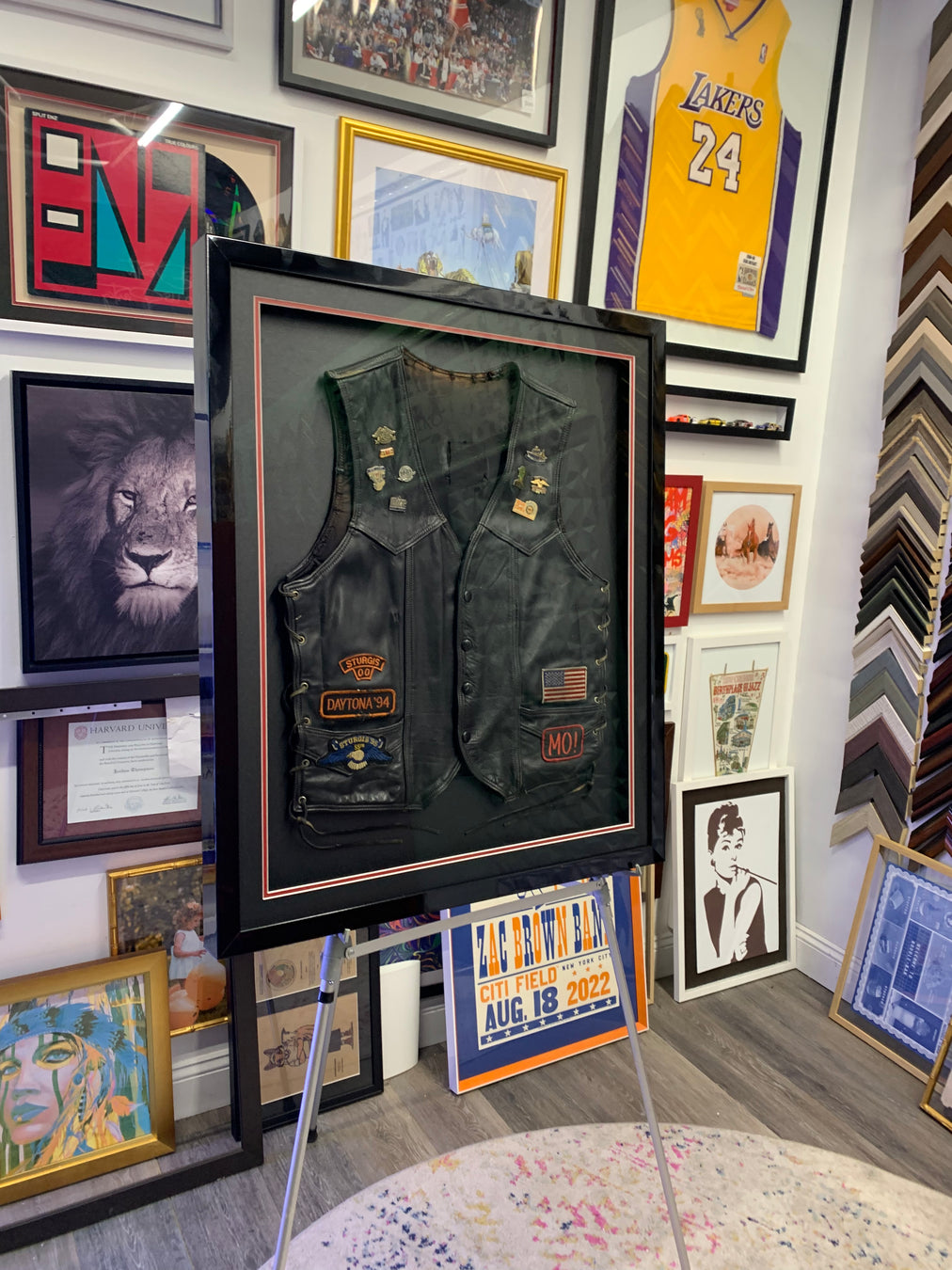
A leather motorcycle jacket framed in a deep shadow box — one of our favorite garment projects. See more in Our Work.
Almost any of them. The garments that come through our shop most often:
If you've framed a jersey before, the process will feel familiar — but the depth math is completely different. Our related guide on shadow box framing a work apron walks through a career tribute build in detail.
Before anything gets measured, we decide the pose. This single choice drives the frame size, the depth, and the cost.
Then we measure the garment in that exact position, laid out the way it will live inside the frame — full width across the shoulders or folded sleeves, full height from collar to hem. We then add a visible border of background around it. That breathing room is what makes the piece read as framed art rather than a coat stuffed in a box.
A shadow box is defined by its interior depth: the usable space between the glazing and the backing board. For garments, the rule is simple and non-negotiable — the frame must be deeper than the thickest point of the jacket, plus clearance. Nothing should ever touch the glass. Contact causes compression marks, moisture transfer, and permanent creasing.
The thickest point is rarely the body of the coat. It's the collar roll, the shoulder seam, a fastened zipper placket, or an epaulette with a rank pin behind it. We measure that point, then add clearance.
| Garment | Recommended interior depth |
|---|---|
| Doctor's lab coat / nurse scrub jacket (thin cotton-poly) | 1" – 1.5" |
| Chef coat / light work jacket | 1.5" – 2" |
| Leather biker vest (flat, back-facing) | 1.5" – 2" |
| Army service coat / dress uniform with ribbon rack | 2" – 2.5" |
| Varsity / letterman jacket (wool body, leather sleeves) | 2.5" – 3" |
| Leather motorcycle jacket with hardware | 2.5" – 3.5" |
| Firefighter turnout coat with liner | 3" – 5"+ |
| Any of the above with a contoured shoulder form | add 1" – 2" |
This is the single biggest reason a jacket usually can't go into an off-the-shelf shadow box. Our ready-made shadow box frames carry a 1.5" interior depth, which is perfect for a lab coat, a flat vest, a jersey, or a folded scrub top. Our Black Shadow Box Deep Profile and Modern White Shadow Box mouldings are available in 99 stock sizes from 8x8 up to 48x72, plus fully custom sizes.
For anything bulkier — turnout gear, leather, uniforms with dimensional insignia — we build the box deeper in-house, stacking moulding and adding internal spacers to create the exact cavity your garment needs. There is no maximum depth we can't build to. Bring us the coat and we'll measure it.
Most jacket shadow boxes land between 24x30 and 36x48. A folded-sleeve vest can come in around 20x24. A full-layout firefighter turnout coat or a large men's service coat with sleeves extended often needs 32x40 or larger. We size every one to the garment, not the other way around.
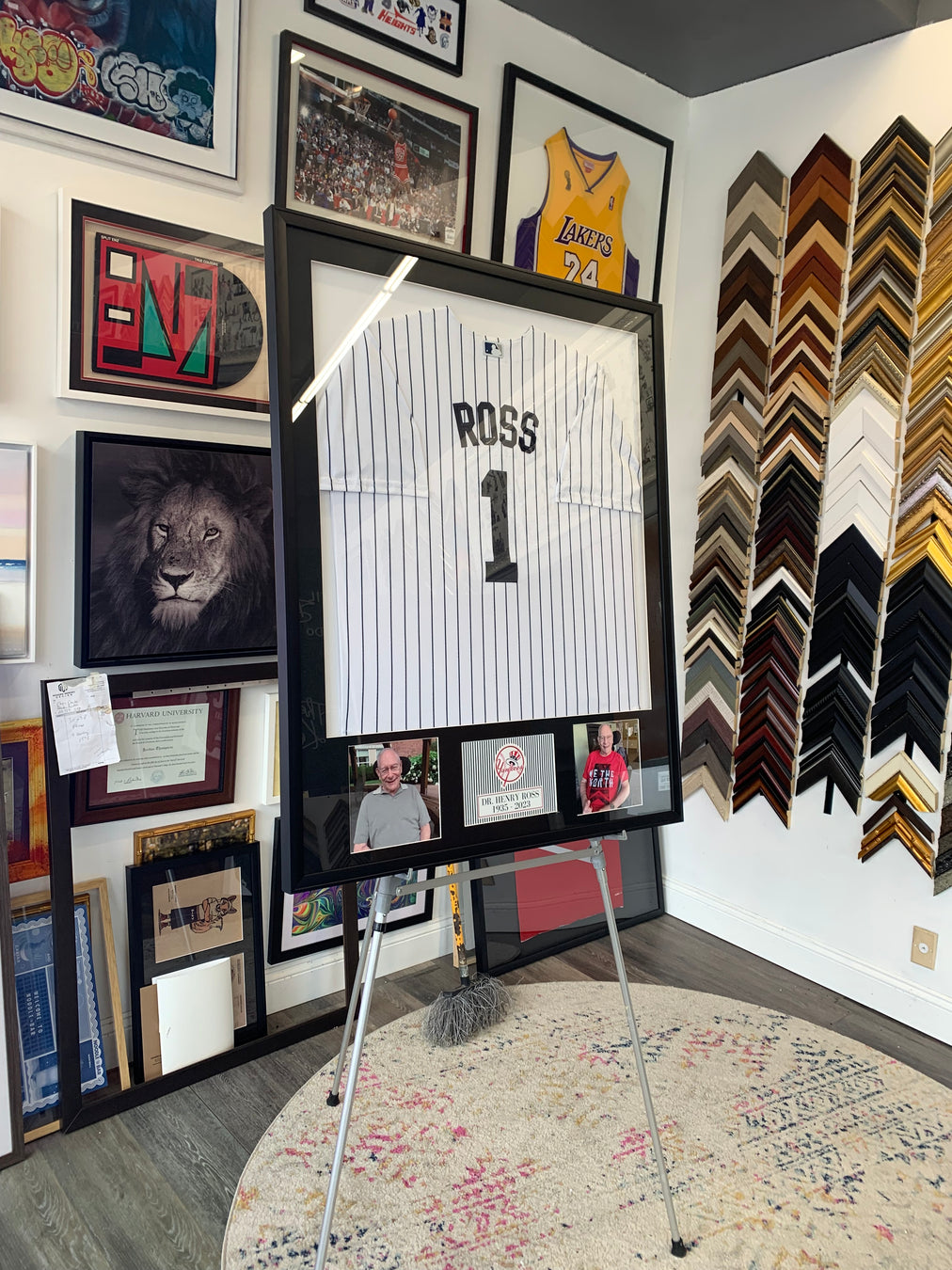
The background is the wall your jacket hangs on inside the frame — and it does more work than people expect. The goal is separation: the garment has to lift off the background, not sink into it.
Our guiding rule: go opposite in value, close in temperature. A dark garment wants a lighter background; a light garment wants a darker one. Then keep the undertone sympathetic so the whole piece feels intentional.
We can print the background itself — a department logo, a unit crest, a hospital or practice mark, an engine company number, a repeating pattern, a service date range, or a name. For retirement tributes and department gifts this is far more powerful than a plain board, and it's one of our specialties. We can also print a subtle photographic background, like a firehouse, a campus, or a base.
Materials: solid conservation matboard, suede or linen-wrapped board, or fabric backing. Every surface that touches the garment is acid-free and archival.
Matting on a garment shadow box works differently than on a print. There's no window mat lying on top of the piece — instead the mat forms the interior border and the walls of the box. Three ways we handle it:
On border width: give a jacket 2" to 4" of visible background or mat on all sides. Tight borders make a big garment feel crammed. Generous borders make it feel deliberate. Weight the bottom border slightly heavier than the top — the classic framing proportion — so the piece sits visually balanced on the wall.
Matting also does real conservation work here: it holds the glazing away from the garment and creates the air gap that prevents contact damage. Browse our custom cut matting and mat board options.
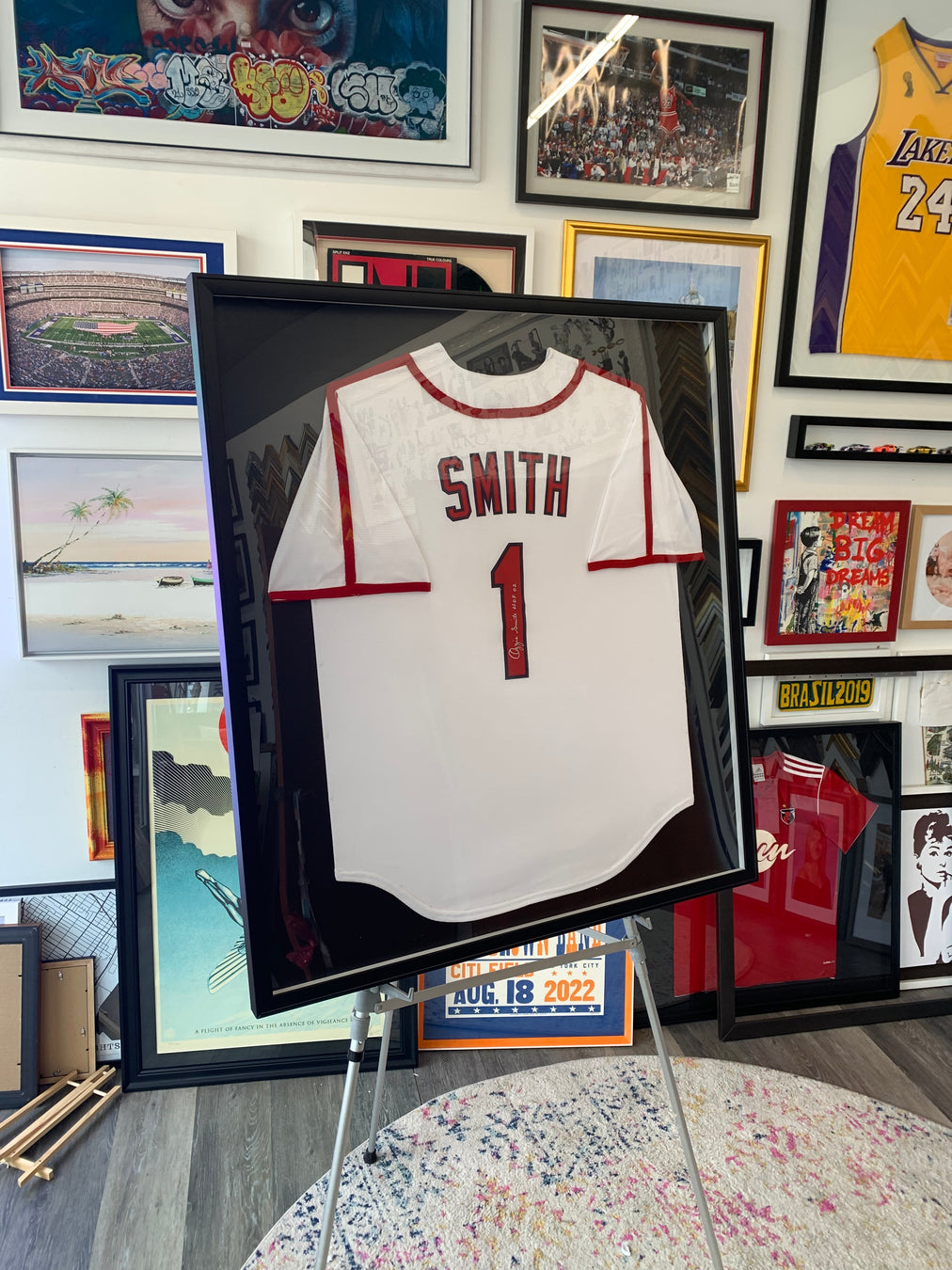
When the contents are busy — patches, badges, hardware, insignia — the frame's job is to contain, not compete. Our standing advice:
On profile width: a large, deep box needs a moulding with enough face width to look proportional. A 36x48 shadow box with a skinny 3/4" frame looks unfinished. We generally spec 1.5" to 3" face width on jacket boxes, scaled to the finished size. Our shadow box mouldings come in black, white, silver, and gold, and we carry a broad range of profiles from Decor Moulding and other suppliers if you want something more specific.
Glazing is where people are most tempted to save money and where saving money costs the most. Textiles are among the most light-sensitive materials there are. UV exposure fades dyes, yellows white cotton, degrades the reflective striping on turnout gear, and makes wool brittle. A uniform framed behind ordinary glass and hung on a sunlit wall can show visible fading in a few years, and that damage is permanent and irreversible.
Here's how we guide every garment customer:
Blocks 99% of UV light. This is the baseline for anything you actually care about: uniforms, leather, embroidery, patches, and any paper keepsakes mounted alongside. If you only upgrade one thing on your project, upgrade this. For most jacket boxes it's a modest addition to the total and it protects everything else you're paying for.
UV protection plus an anti-reflective coating. In a bright room, ordinary glass on a large 30x40 box acts like a mirror — you see the window, the lamp, and yourself instead of the jacket. Museum glass is so optically clear that people reach out to touch the garment. This is the right call for a piece hanging in a firehouse dayroom, a hospital corridor, a bright living room, a lobby, or anywhere with windows or overhead lighting. On a large uniform box, it's the difference between a display and a showpiece.
Roughly half the weight of glass and it won't shatter. We specify UV acrylic for:
The tradeoff is that acrylic scratches more easily than glass and should be dusted with a soft dry cloth only — never a household glass cleaner, and never a paper towel.
Standard clear glass with no UV coating, on anything irreplaceable. And non-glare etched glass on a deep box — because the diffusion effect increases with distance from the surface, a jacket sitting 3" behind non-glare glass looks soft and hazy. On deep shadow boxes, museum glass is the correct anti-reflective answer, not non-glare.
Every garment we frame is mounted with reversible, archival methods. We hand-stitch with fine polyester thread through existing seams, use padded internal supports and shaped forms to carry the shoulders, and pin or bracket dimensional items like badges, pins, and helmet shields. Nothing is glued, taped, trimmed, or permanently altered. If a family ever wants the jacket out of the frame, it comes out exactly as it went in.
We also recommend against dry cleaning a garment before framing unless there's active soiling — patina, wear, and honest use are part of what makes these pieces meaningful, and aggressive cleaning can weaken old fibers and set stains permanently.
This is where a beautiful project gets ruined. A finished jacket shadow box is not a picture frame. A 30x40 deep box with glass, matting, backing, and a leather jacket inside can weigh 25 to 45 pounds. A large turnout coat box can go past 50. Standard sawtooth hangers and adhesive strips are not remotely adequate, and a failure destroys the glazing, the frame, the garment, and whatever it lands on.
What we build and specify:
Find the studs. A cleat lagged into two studs is the gold standard and takes the weight question off the table entirely. In drywall with no stud available, use rated toggle bolts — not plastic anchors, not molly bolts, not picture hooks — and confirm the rating exceeds the frame weight with a healthy safety margin. In plaster or masonry, use the appropriate masonry anchor. If you're hanging in a public building, a firehouse, a school, or anywhere the public passes underneath, add security hardware so the piece can't be lifted off the wall.
Center the piece at roughly 57 to 60 inches from the floor to the center of the frame — standard gallery height. And regardless of your glazing choice, keep it off walls that get direct sun and away from heat sources, bathrooms, and unconditioned spaces. UV glass buys you protection, not immunity.
If you'd rather not do this yourself, we offer professional picture hanging service across New Jersey, New York City, and Connecticut — we'll bring the right hardware, find the studs, and hang it level.
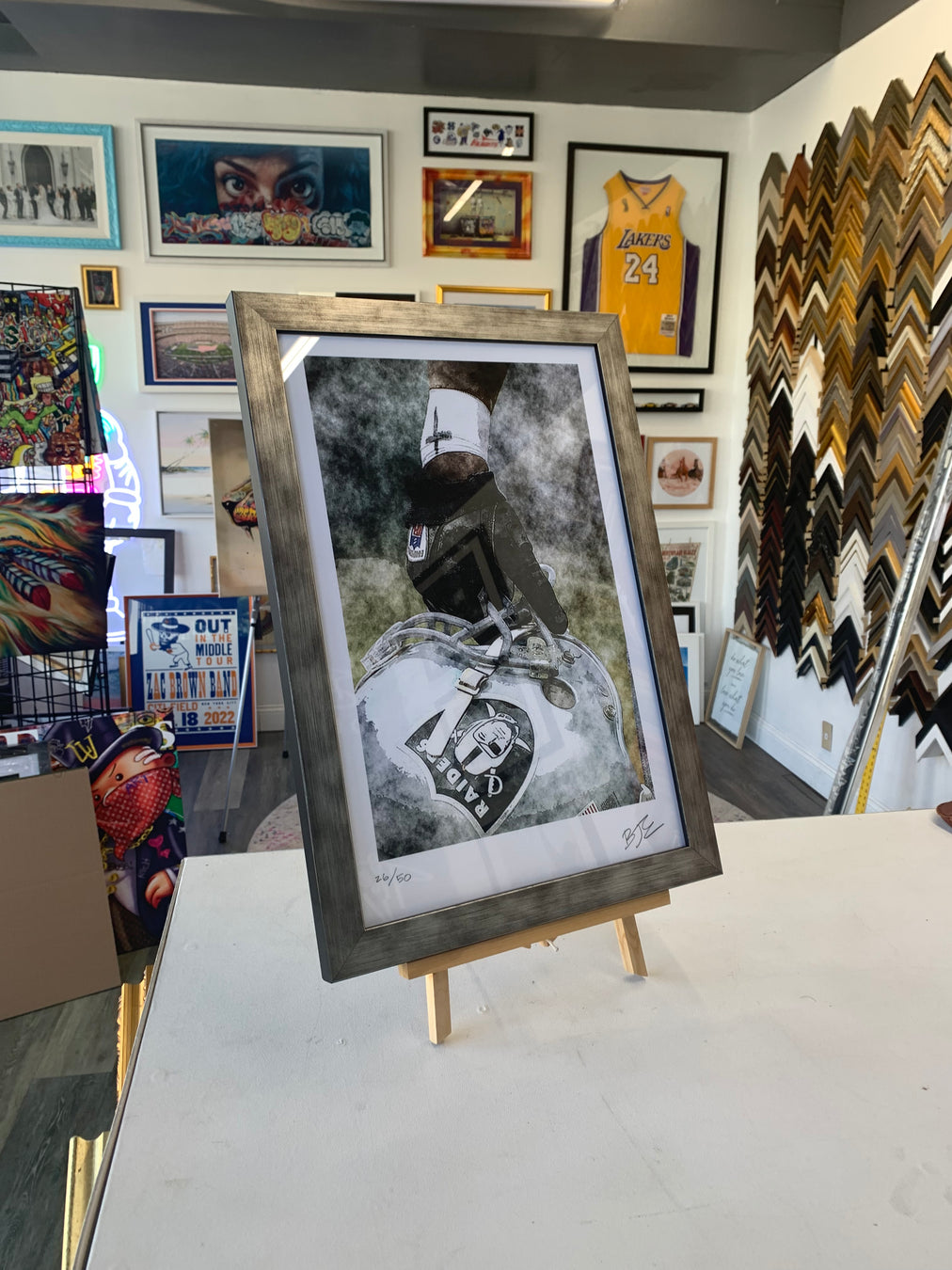
To get the most out of a jacket project, gather the story around it:
Out of state? We frame jackets and coats for customers nationwide. Email us photos and rough measurements and we'll walk you through safe packing and shipping.
It depends on the finished size, the depth we need to build, the background and matting, the glazing you choose, and how many additional keepsakes need individual mounting. A compact lab coat or vest box sits at the lower end; a full-layout firefighter turnout coat with museum glass and a custom printed background sits at the higher end. Send us photos and measurements and we'll give you a real number — email us for a quote.
Most jackets need 2" to 3.5" of interior depth; firefighter turnout coats with liners often need 3" to 5" or more. Thin garments like lab coats and scrub jackets fit comfortably in a 1.5" box. Always measure the thickest point — usually the collar or shoulder — and add clearance so nothing touches the glass.
Yes, and it's one of our most requested projects. Medals, ribbon racks, rank insignia, unit patches, dog tags, and discharge documents are all mounted archivally alongside or on the garment. We can also print a unit crest or service dates into the background.
No. We use reversible, archival mounting — hand-stitching, padded supports, and pins. Nothing is glued or cut, and every material in contact with the garment is acid-free. The jacket can be removed unaltered at any time.
UV-filtering conservation glass at minimum, to block 99% of UV and prevent fading. Choose museum glass if the piece will hang in a bright room or a public space where reflections are a problem, and UV acrylic if the box is very large or will be shipped or transported.
Expect 25 to 50 pounds depending on size and glazing. Hang it with heavy-duty D-rings and rated wire into studs, or better, a French cleat for anything over about 25 pounds. Use rated toggle bolts if you can't hit a stud — never plastic anchors.
Most garment projects are completed in one to three weeks, depending on custom depth construction, printed backgrounds, and glazing selection. Tell us your deadline — retirements and ceremonies have dates, and we work to them.
Yes. We build shipped pieces with UV acrylic instead of glass and crate them for safe transit nationwide.
Every jacket that comes through our door carries something a photograph can't. Twenty years on an engine company. A tour overseas. A first white coat. Ten thousand miles of road. We build the frame around the story.
Email us for a custom quote and free design consultation. Send photos of the jacket, rough measurements, a note about any medals, patches, or keepsakes you want included, and where it's going to hang. We'll come back with a design direction, depth and glazing recommendations, and pricing.
Explore more: Shadow Box Frames · Custom Framing Services · Jersey Framing · Our Work
{"one"=>"Select 2 or 3 items to compare", "other"=>"{{ count }} of 3 items selected"}
Leave a comment